A Philippine Sexual Assault Investigation Kit Is Finally Here
Built to let evidence speak for those who cannot, the SAI.Kit helps preserve crucial evidence in sexual assault cases, including those involving children.

Published on Apr 8, 2026
For 25 years, researchers at the University of the Philippines Diliman have worked on a tool to help survivors of rape and sexual assault. Their efforts have resulted in the SAI.Kit, which preserves DNA evidence and helps hospitals and child protection units handle cases safely and effectively.
How the SAI.Kit Began
The project began in 2003, when University Research Associate Frederick Delfin pioneered the development of a local ‘rape kit’ as part of his Master’s in Molecular Biology and Biotechnology. The kit was designed to identify perpetrators through the genetic traces they leave behind—a tool that, at the time, did not exist in the Philippines.
Taking up the challenge on their own, Dr. Maria Corazon A. De Ungria and her team at UP Diliman’s Natural Sciences Research Institute developed a prototype sexual assault investigation kit, called SAIK. Backed by the World Bank’s Panibagong Paraan grant in 2004 and other funding sources, they refined the kit over time through research and collaboration with multiple researchers, turning it into a reliable tool for forensic investigations.
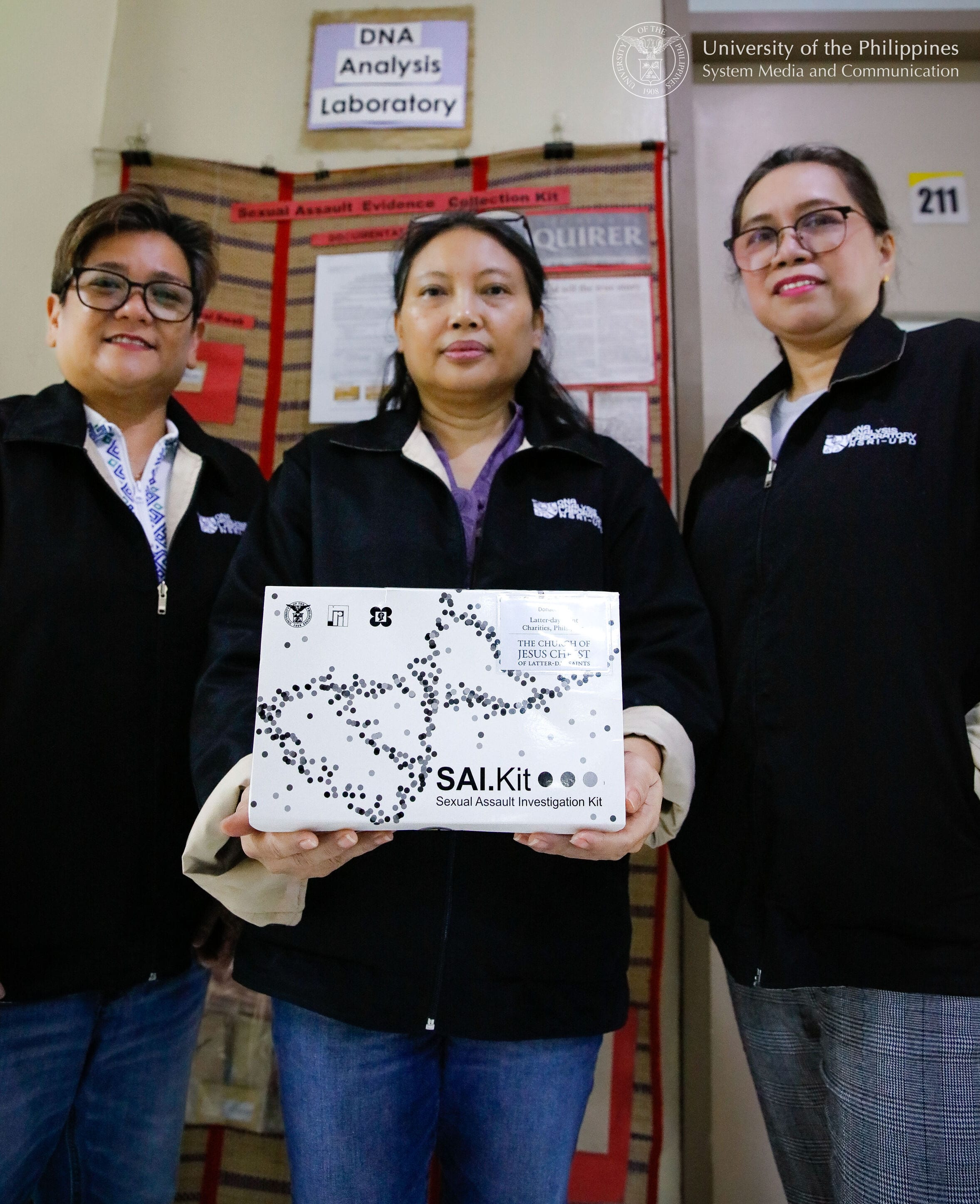
What began as a long and patient endeavor has reached a defining moment. In 2026, through a partnership with Manila Healthtek Inc., the SAIK has been transformed into the SAI.Kit. Now ready for wider use, it carries the spirit of malasakit—the Filipino value of compassion—giving voice to the evidence when survivors themselves cannot.
From Prototype to Practical Tool
Miriam Ruth Dalet, a research associate, helped guide the development of the kit from prototype to practical tool. Along with colleagues Minerva Sagum, Bea Gallardo, Gayvelline Calacal, and Nelvie Fatima Jane A. Soliven, she worked on packaging, documentation, and testing to make the kit ready for use in hospitals and child protection units.
“Our prototype used to come in a large brown envelope with big 15-milliliter tubes and color-coded labels,” Dalet said. The new version comes in a professional, easy-to-handle box. It includes swabs, containers for clothing or larger items, and tamper-proof pouches. An instruction manual guides medical personnel on which samples to collect and how to do it correctly.
.jpg)
Patient narratives help determine likely points of contact where perpetrator DNA might be present. For females, this is usually the internal genitalia. For males, it could be the anus. Other areas like the mouth or skin may also be sampled. The kit’s swabs and containers make collection and storage more efficient and reliable.
Each kit comes with Set A and Set B. Set A is sent to the laboratory for analysis. Set B remains with the collecting agency, sealed and unprocessed. This redundancy preserves the evidence and allows additional analyses if requested by a court.
Documentation and Chain of Custody
Forms included in the kit help ensure that samples are collected properly and documented clearly. English and Filipino versions guide health professionals in recording consent, patient narratives, sample details, and the chain of custody. These records are essential if an incident goes to court, as they protect the integrity of the evidence.
The lab has provided prototype kits to partners such as the Child Protection Network for years. Collaboration with Manila Healthtek expands access across the country. Dalet notes that translating the technology from the lab to the market took more than seven years and included unexpected challenges, including delays caused by the COVID-19 pandemic.
Financial support also helped make production feasible. Initial plans called for around 2,000 kits, enough to ensure cost-efficient distribution to government hospitals serving largely indigent patients.
With assistance from Dr. Lilian Villamor and The Church of Jesus Christ of Latter-day Saints’ humanitarian committee, the first 2,000 kits were delivered by Manila Healthtek in October 2025. They will reach hospitals, Child Protection Units, and women’s and children’s desks, accompanied by training in proper use.
.jpg)
Timing and the Importance of DNA
Dalet emphasizes that biological evidence is most likely to be found within 72 hours of an assault. Prompt medical attention improves the chances of collecting DNA that can support a legal case.
“DNA is unique to each person,” Dalet explained. “Detecting a profile that does not belong to the patient provides strong evidence of intimate contact. With proper collection, it can help identify the perpetrator or clear someone wrongly accused.”
“A lawyer’s role, with support from victim testimony, is to establish that this contact was nonconsensual. In cases involving children or individuals unable to give consent, DNA evidence may constitute compelling proof of sexual assault.” Dalet shared.
In one validation case, the team recovered male DNA from a two-year-old child. “It can speak for a child, woman or man who may not be able to speak for themselves,” the researched added.
The kit highlights the importance of acting quickly if abuse is suspected. With this new tool, hospitals and child protection units have the start of a professional system within reach. While it cannot prevent abuse, it gives survivors a better chance at justice and marks the beginning of stronger, more reliable support in the future.
Hanna is a News Desk Writer at Smart Parenting, covering parenting, health, culture, and more. Off the clock, she’s likely people-watching at a café or park, matcha latte in hand.