Moms, Feel Free to Raise Your Arms, Kids Care More About Values
Here’s something we can learn from the new gen—character beats looks.

by Em Cruz
Published on Sep 26, 2025
Among all the images from the Trillion Peso March, one of the most talked-about online was that of a young woman.
Wearing a bandanna over her hair and a black top, she raised one arm in protest, lending her voice and presence to a fight she clearly believes in.
But instead of focusing on her courage, values, and role in one of the country’s largest anti-corruption demonstrations, some people online chose to zero in on the appearance of her underarms. One internet personality even shared her photo while also promoting a skin-lightening brand, captioning it: “Para kahit makibaka, hindi chaka.”
Here’s one thing I learned from my tween: young people don’t care about dark skin or body hair. Unlike the older generation (myself included), who were raised on unrealistic beauty standards—smooth, white, even-toned skin with no trace of hair—the younger generation sees these things as no one else’s business.
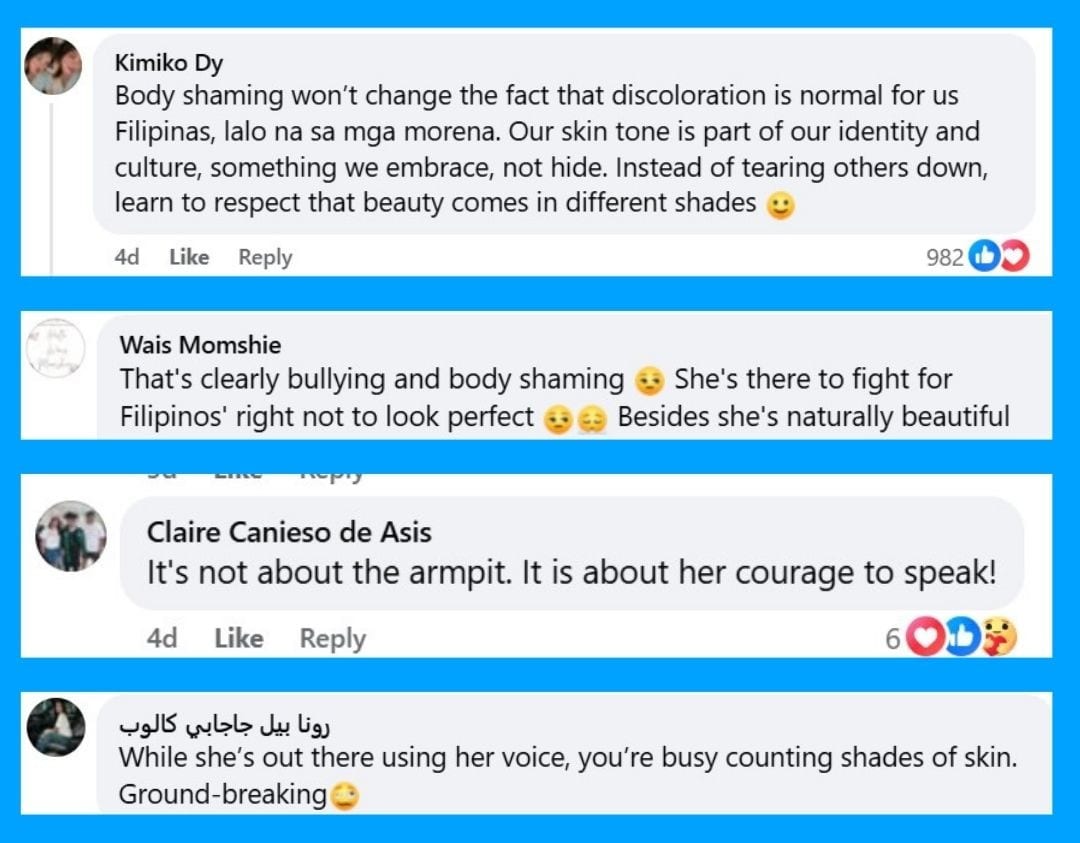
While some netizens laughed and cracked jokes about her underarms, many others were quick to defend her and push back. This group praised her courage and her beauty, reminding everyone what really matters. To quote my tween, perfectly summing it up: “Why are you even looking? No one cares.”
Obviously, there’s a clear takeaway here.
Skin Discoloration is Common—And It’s Not a Problem
Let’s get one thing out of the way: skin discoloration, including dark underarms, inner thighs, neck, elbows, and knees, is incredibly common and is not inherently a sign of poor hygiene or health.
According to the Cleveland Clinic, common causes of hyperpigmentation or skin darkening include:
Friction from clothing or shaving
Hormonal changes
Post-inflammatory hyperpigmentation (darkening after irritation, eczema, or acne)
Acanthosis nigricans, which causes thickened, darkened skin in body folds, is often linked to genetics, obesity, or insulin resistance—not dirt or neglect.
In tropical countries like the Philippines, where heat, sweating, and the need for layering clothes are daily realities, skin darkening in certain areas occurs naturally. It’s not shameful. It’s just biology.

Embracing Mom Bod! 6 Moms Say Bye To Insecurities, Hello Sexy And Strong Body
Read hereYounger Generations Know That—And They’ve Moved On
Thankfully, there’s a visible generational shift. Teens and young adults today are growing up in a more body-positive, inclusive digital space. They’re less obsessed with looking flawless and more interested in being real.
Dark underarms? Body hair? Stretch marks? This generation doesn’t see them as problems to fix—but as facts of life. And while there’s nothing wrong with opting for skin treatments to achieve smoother, or more even-toned skin, more people understand that it’s a personal choice—not an expectation or standard.
Older generations, however, were raised on ads for whitening creams and hair removal products that equated femininity with “smooth and fair” skin, and they sometimes still carry those beauty standards. And while this belief isn’t entirely our fault, we need to recognize that the world has changed—and so have our kids.
You can clearly see this shift in how young people defended the protester:
“She’s out here fighting corruption, and people only see her armpits?”
“Hindi bale nang maitim ang kilikili, basta hindi maitim ang budhi.”
The young woman in the photo herself made her message clear in a Facebook post a few days after the image went viral: “Sa lipunang kinakahon ang kababaihan sa unrealistic beauty standards, wag na wag mong ibaba ang iyong kamao! Hindi nakakahiya ang katawan na nakikibaka para sa patas at anti-korap na kinabukasan. Ang buhok at diskolorasyon sa kili-kili ay katiting lamang kung ikukumpara sa suliranin na kinakaharap natin.”
She further wrote: “Ang kagandahan ng babae ay hindi nagtatapos sa pisikal na anyo at lalong hindi nasusukat sa iisang panukat lamang. Kayang-kaya ng babae na lumikha, mag-isip, mag-question, magalit at higit sa lahat, ipanagot ang nagnanakaw sa bayan!”
The collective voice is loud and clear: Respect people for their actions and integrity, and not for their appearance.
What Should Parents Do?
As parents, we need to recognize this shift and actively support it. Here’s how we can use moments like this as a powerful parenting lesson:
Model respectful language about people’s bodies.
In short: Huwag mamintas ng iba. Avoid criticizing your own or others’ appearances, especially in front of your kids. If you say things like, “She shouldn’t have worn that top since she has dark underarms,” or “I need to whiten my knees because they look dirty,” kids will internalize that judgment.
Focus on values over looks.
Celebrate courage, compassion, honesty, and resilience in your child and others. In this case, highlight the protester’s boldness and convictions, not her body.
Correct misinformation.
Educate your child about the realities of the human body. Stop saying comments like, “She has dark skin because she’s unhygienic,” or “She should’ve shaved.” Instead, explain the facts that skin discoloration and body hair are natural.
Equip kids to push back.
Teach your kids to question shallow beauty standards and to stand up for those who are unfairly judged. Encourage kindness and help them see that pamimintas and nitpicking are not normal or okay.
Finally, when we choose to highlight a young woman’s skin over her convictions, we send a message that appearance matters more than character. However, if the online response to this viral image is any indication, it appears that the new generation is done with that way of thinking.
They’re standing up for one another, for causes they believe in, and for the truth that real worth is not skin deep.
As parents, it’s up to us to maintain the momentum. Let’s raise kids who know what really matters. And it’s definitely not skin discoloration or body hair.
Here’s a guide to navigating body hair with your teen.

I Hated My Body Growing Up, And I Don't Want My Child To Feel The Same Way
Read hereEm, Smart Parenting’s Asst. Managing Editor and mom of two, thrives on coffee, stories, and motherhood’s chaos—recharging with books or movies.