What Every Child Deserves: Liza Soberano’s Hard-Earned Truths

by Em Cruz
Published on Aug 20, 2025
We know her as the beautiful heroine who once asked: “Am I not enough? May kulang ba sa akin? May mali ba sa akin? Pangit ba ako?”
Liza Soberano may have captured our hearts with those lines onscreen, but in an episode of Can I Come In? By Sarah Bahbah, she revealed that this question wasn’t just fiction. It’s been a recurring theme in her life. When a celebrity sits down to share the darkest corners of her childhood, it becomes more than a confession. It’s a call to action, because what children like Liza need is not pity, but accountability from adults, from systems, and from a society that too often looks away.
Hers is not just a story of survival. It’s a warning: words are not enough. Children don’t need promises. They need protection, presence, and proof that love is not just words we say, but something we do. As Liza puts it:
“People told me they loved me, but then they would do the complete opposite of what you do when you love someone.”
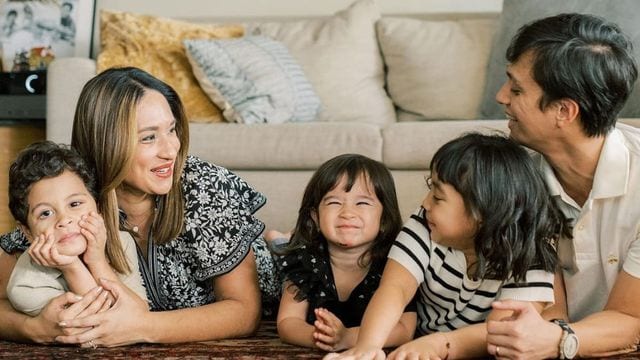
‘Families That Want To Adopt Should Do So Because They See The Beauty Of It': What To Expect, How To Prepare For Adoption
Read hereWhen parents are just kids
Liza’s tell-all started at the beginning. She was born in Santa Clara, California, to teenage parents. “They were still children,” Liza said. “The one thing they had in common was they were so misguided.”
“They were working multiple jobs to make ends meet. My mom sadly had a really bad addiction to crystal meth. And my dad was a chemist among many other things. So they were kind of like this Bonnie and Clyde duo,” Liza shared.
Her father was later deported after multiple charges. Liza and her brother stayed with their mother and her new boyfriend. Liza admits that while she’s very young during this time, she still remembers them and the trauma, saying, “It comes to me in flashes, in vulnerable moments… A sense will get triggered, and I can remember these moments. And these moments have been validated by the things that a lot of the grown-ups around me have told me.”
Under the care of her mother and her new boyfriend, Liza and her brother experienced kidnapping, abandonment, and physical violence: “He had stolen a minivan from off the street, and then he took me, my mom, and my little brother… I remember one morning, I woke up, and I just somehow knew how to get out of a car seat at that age. And I remember I was making a run for it because at this point, we were missing for a few days… My mom’s family had already filed for a missing person’s report… And so I ran out of the van, and I can only run so far… I remember Michael scoops me up… He carried me and brought me back to the van. And then there was this big fight between my mom, me, and Michael.”
“My mom had made an excuse because he was just screaming at me and screaming at me and so she said, ‘There’s some things we need to buy,’ and we were parked at a Walmart. And she left me and my brother to buy those things,” Liza continued. “The next thing I remember was he was screaming at me, telling me to hit my brother in the head with my car seat, to use it to bash his head… I was so lost, I didn’t know what to do… The next thing I knew, he hit me in the head with the bottom of a gun that he was holding.”
Her mother was then sent to prison, and Liza and her brother entered foster care.
When no adult is safe
Foster care did not improve Liza and her brother’s condition. Liza remembers one foster home in particular, that of a woman named Melissa: “I remember, in the beginning, it was all right. I didn’t feel super happy or excited about the situation, but it was okay. And then eventually, she started treating me differently as a few weeks went on.”
“It started with one of her son’s birthday parties. She had three kids, and he was celebrating his birthday with classmates. I remember her telling me and my brother that we should stay in our room,” Liza recalled. “We were just in our rooms, and then out of nowhere, her other son called us… Once we headed out, they all started throwing cupcakes at me and my brother."
While Liza admits that she doesn’t fully grasp if the cupcake incident was a good or bad thing, the next memories she recounted of how the family treated them were much harsher: “They would do family nights once a week and I was the only one that wasn’t allowed to participate in family movie nights because I was the family dog. They would literally call me the family dog. And I would have to sit in, like a big cardboard box, behind the sofa. And I would just sit there like a dog.”
“Then after that, she started really abusing me, not just psychologically,” Liza went on. “I was eating spaghetti at the table, and this is why I have a phobia of meatballs now. She forced me to eat a meatball, and I choked. And she didn’t do anything, she just watched me.”
Another instance was when Liza was asked to clean the family dog’s poop on the carpet, and Melissa asked her to clean it using her tongue. “I thought she was kidding until she grabbed the back of my head and forced me on the carpet,” Liza said.
Furthermore, Liza said that Melissa knew how to manipulate the system that was supposed to protect foster kids, saying that Melissa was sweet whenever it was time for the social workers’ regular visit, and cruel when the schedule was still far off. “I noticed this pattern, she would treat me really badly, but whenever it was about time that the social worker was going to come by, she would, all of a sudden, treat me really nicely, like extra nicely… She would tell me all the things that I wanted to hear. And so whenever the social worker came by and asked me questions and everything, I’d lie and say everything was fine, that I was happy, that Melissa was so good to me, that the kids were good to me, that my conditions were fine.”
“I would lie because I would actually believe that she loves me when she said she loves me. Because when you’re a kid, that’s just what you do,” Liza explained. “You believe anything that an adult says because you think that they have their best interest for you.”
New Law Simplifies Adoption Process In The Philippines: Less Legal Fees, Hearings, And Waiting Time
Read hereA stable home
Eventually, her paternal grandparents adopted her and her brother, offering stability for the first time: “My grandparents took very good care of us. We were actually living a very lavish lifestyle.”
But despite this, the trauma lingered, “I was obsessed with my mom… I craved and longed to be with her. I never built up hatred or resentment. It was the opposite.”
Learning to choose herself
Her childhood experiences taught Liza several things, one of which is the gap between what adults said and what they did: “There was no lack of words of affirmation. People told me they loved me. But if your actions don’t show it, then it’s not true.”
Moreover, her experiences taught her to shrink, to tolerate disrespect, and to chase love from those unwilling to give it: “I developed this habit of making myself so small out of fear of being a burden… I tolerated and accepted a lot of disrespect and abuse out of fear of losing people that weren’t afraid of losing me.”
When Sarah asked for her message to baby Hope, she emphasized that she’s choosing differently: “Hope, I promise you… I’m never going to let anyone make you feel inferior, ever.”
“Don’t let people hurt you. Don’t stay because you’re afraid of rocking the boat. Love yourself first, and life will get so much better.”
The bigger picture: Adoption and the role of community
Liza’s tell-all has spawned several news reports, but a key takeaway is that Liza’s story is not unique. It happens to a lot more children and even underprivileged people than we would care to admit. And Sonjia Calit-Kakilala, adoption advocate and a member of Smart Parenting’s board of experts, emphasized:
“Liza’s story isn’t an isolated case, unfortunately. So many children are abused in foster homes in the US. The system is really broken and imperfect. There really are people, like Liza’s foster mom, who take advantage of the system, robbing children of the right to a safe and loving home. Here in the Philippines we don’t know much about foster care but we do have that available. This is why GOOD PEOPLE need to step up to give children safe and loving homes. When it comes to foster care, having a stable home can be a good bridge for a child to experience what it’s like to be part of a family before they go home to their forever homes. It’s in families, not institutions, where they learn to be loved and learn how to care for others. A healthy family is where a child can start their healing and grow into healthy adults. I really hope Filipinos can see the beauty of foster care and adoption. We may not be able to solve the entire problem at once, but one saved life can make a huge impact.”
Moreover, Liza’s story reveals deeper truths about how children in care understand love. Adoption advocate and Smart Parenting board of experts member Chrina Cuna-Henson explains:
“For children who are in foster care or who have been adopted, even the most wonderful of parents need to understand the role that their history plays in how they make sense of what love is. If you’ve been abandoned or neglected, you are already predisposed to question what real love really is. That’s why actions have to match words—and they need to be repeated, consistently, over time.”
She adds that in the Philippines, kinship care is common, with grandparents, titas, or titos stepping in when parents cannot. But even with extended family, children carry invisible wounds:
“These children might not be able to articulate the pain of being separated from their parents, but at a very deep level, their hearts know that pain. They need reassurance spoken and shown over and over again, so they truly believe they are loved.”
Cuna-Henson also emphasizes the science of attachment:
“Attachment can start in the womb. The fact that Liza remembers her earliest years shows how deeply traumatic it was. But the good news is that our brains can rewire. Families, communities, and the church all have a role to play in building healthy attachment. It’s not enough for a child to be safe—they have to feel safe. That’s how children truly experience love.”
She reminds us that focusing only on material needs is not enough:
Liza also highlights the needed work once more on her Instagram, citing figures of exploited Filipino children and individuals, with a call to “Make a stand together, fight together, and work together, to create a safer and kinder world for each other.” In her caption, she further wrote, “Bit by bit, let’s make meaningful change and stop allowing callous and greedy [people] from driving our narrative.”
Liza shared her story of freedom, healing, and learning to let go. And her testimony is a mirror and reminder for parents, families, and caregivers everywhere: If we truly love our children, our actions must prove it. Baby Liza needed protection and actions, not just words. And so does every child.
This mom overcame trauma and addiction to live her best life.

Adoption Is About The Child, Not Just My Dreams To Have A Child: A Mom-In-Waiting's Thoughts On Adopting
Read hereEm is a section editor at Smart Parenting (smartparenting.com.ph). A mother of two school-aged children and happily married for 15 years, she draws on her background in Public Relations and Digital Marketing to create meaningful content.
Read more stories about