
It’s hard to believe, but once upon a time, children were not glued to phones or consoles or laptops all day. Nor were they into other conventional things like basketball, ultimate disc, badminton or soccer, but diversions from a simpler, more innocent (and slightly more hazardous, less hygienic) time.
True, the sweltering heat these days makes playing outside seem like torture, but it’s good to reminisce that not too long ago, kids actually went outside and hung out with other kids to play games out in the streets, in the village, the neighborhood or the barrio. If you recall afternoons spent running around and laughing or arguing about who was ‘taya’, then this article is for you.
If you’re a parent itching to separate your kids from their gadgets, try adding a twist to these games to update them and / or make them part of your weekend (indoor) activities. Throwing in a little nostalgia (Nung bata kami, heto ang laro namin… / When I was a kid, these are the games we used to play) won’t hurt, either.
Luksong Tinik
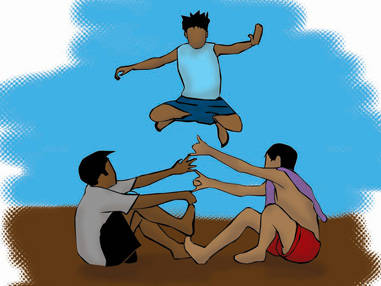 Literally translated as “thorn jumping” this game required at least two to three players. They would decide amongst themselves as to which one will get to be the Jumper while the rest would be the Thorns. The Thorns sat on the floor or ground, with their feet touching, sole to sole, while the Jumper would jump over them, making sure not to come into contact with any body part of the Thorns players. If the Jumper was successful, the Thorns would proceed to up the ante by creating an artificial barrier using their legs. With each successful jump, the Thorns would raise the barrier further, eventually using their arms to prevent the Jumper’s success. Eventually, the Thorns would also get a turn and the Jumper would switch roles with them.
Moro-Moro (Agawan Base)
Usually played in a wide, open area, Moro-Moro required practically all the kids in the neighborhood or a classroom. The number varied between 4 and 10 kids per team (with as equal a number between them as possible) although more could play depending on the size of the play area. Each group assigns a spot like a pole or a pillar of a building as a base and the kids play a more complex version of tag with each other. The kids approaching the enemy base can tag the base by touching it, resulting in a point, usually up to whoever scores five points first. The defenders of the base can tag the attackers and if they succeed, the attacker becomes a prisoner, who then holds the pole and stretches himself or herself outward, like a human link. If any of her teammates comes to touch her, she is freed and returns to her team.
Tumbang Preso
 An interesting and fairly original tag variant, Tumbang Preso (‘Falling Prisoner’) involves up to 9 or 10 children with one chosen as the ‘it’. An old can is placed in a target area with a circle drawn around it (these games are ideally played on dry, open earth where lines can be drawn with no obstruction from grass or weeds) to note the area the can must be in to be declared ‘safe’. A line is drawn a few meters away from the can – this is where the rest of the players line up to attempt to topple the can with a puck (usually one’s own slipper, flip-flop or a stone). If a child throws her slipper and topples the can, the ‘it’ must retrieve it and restore it to the target area, while the thrower must also reacquire said footwear or else she in turn will become ‘it’. Note that her fellow players can assist her by running towards the toppled can to take it away from the ‘it’.
[previous|page|next]
Habulan Upo
This is a version of tag with an addendum – a player can be immune from tagging if they manage to get into a sitting or squatting position before the ‘it’ makes physical contact with them. However, said player can only remain seated for around 3-5 seconds.
Patintero 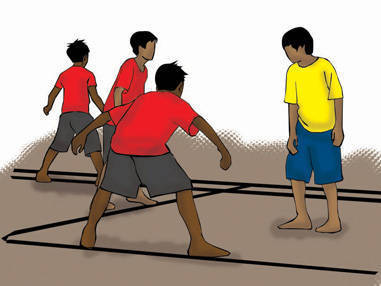 Yet another tagging game, Patintero differs from others of its ilk by limiting the movement area of some of its players. The game is played on a grid, one large square representing the playing area, with the square divided into four smaller squares, like a window pane. Requiring at least five kids per team to form two teams of runners and blockers, the game is set up by assigning the opposing team areas to block the runners. The blockers are allowed to be on the inner lines of the playing field, with one blocker in the middle that can move vertically, while the other blockers move horizontally. The runners try to get to the other side while avoiding being touched by the blockers – getting caught means being out of the game.
Sabong sa Kaka  Spider Fighting is a blood sport and pastime that has fans all over the world, from the reserved prefectures of Japan to Florida’s teeming prisons. In Singapore, the activity is even televised on local networks. In the Philippines, the most popular spider for dueling is the Orb Weaver Spider, found practically anywhere dank and dark in the city or rural areas. Some children would catch the spiders themselves and place them in matchboxes, while others would purchase them from enterprising peddlers who would sell them near schoolyards. Two spiders would be placed on the rib of a coconut leaf and the spiders either fight to the death or the first to fall from the rib three times.
Step No, Step Yes  A game that combines aspects of Hopscotch and Marco Polo, Step No, Step Yes is played on either dirt surfaces with lines drawn on them or on a floor with tiles to denote the play area. The player is blindfolded or closes her eyes while jumping from tile to tile until she reaches the agreed-upon end of the play area (some versions require the player to head back the way she came, even jumping backwards sometimes), while asking, “Step?” Fellow players tell her either “No” if she misses a line, or “Yes” if she touches one instead of jumping over it. The player loses her turn if she crosses a line without jumping.
[previous|page|next]
Langit-Lupa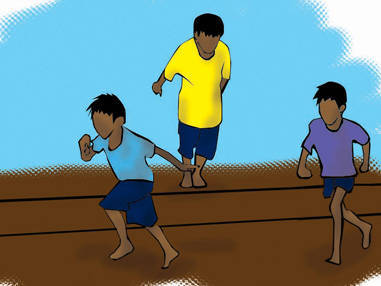 Perhaps the most ominous entry of this list, this game comes complete with its own creepy nursery rhyme (and who says only the British have a monopoly on creepy nursery rhymes?):
Langit, lupa impyerno, im - im - impyerno (Heaven, earth, hell, he-he-hell)
Sak-sak puso tulo ang dugo (Stabbed heart with dropping blood)
Patay, buhay, Umalis ka na sa pwesto mo! (Dead, alive, get out of there!)
This tag game has rules similar to Habulan Upo; only, instead of squatting, the players have to find elevated safe areas such as chairs or benches to avoid being made ‘it’. Also, the chant has to be done before players can make their way to elevated perches.
Chinese Garter
If some children found themselves too old for Luksong Tinik, Chinese Garter would’ve been the more likely alternative for play. Taking ideas from jump rope and limbo dancing, this game is set up by two children who would string a line of stretched garter or rope around 2-3 meters from each other. A third child would jump over the Chinese garter, with the two children elevating it at ankle level at first, then knee level, eventually ending all the way up to above the head. Needless to say, this gives the impression that Filipino children could leap as high as gazelles.
Tsato/Siyato 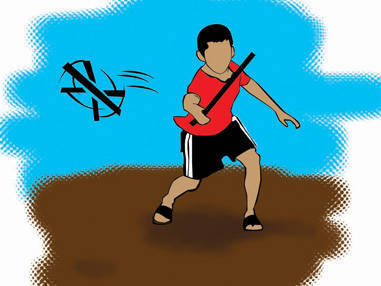 Another game that required props, Tsato had two sticks, one longer than the other and both flat. The players would take turns placing the short stick into a hole dug into the ground (once again, flat, dry ground with no vegetation was suitable, and in the case of Philippine barangays, ubiquitous) and the hitter would strike the short stick with his long stick. While the short stick was in the air, the hitter would have to hit the stick again – failure would mean losing his turn. The other player would chase the short stick and if he caught it, it would be his turn. Somehow, this game resembles Fetch, with the other player taking the role of the dog.
Watch a short video news clip below entitled "Mga larong Pinoy, muling binubuhay" (Pinoy games being revived) from GMA News TV's Good News program:
Illustrations from forexworld.com.au. Thumbnail image from ponyung.blogspot.com

Lorem ipsum dolor sit amet, consectetur adipisicing elit, sed do eiusmod
Lorem ipsum dolor sit amet, consectetur adipisicing elit, sed do eiusmod
