

A childhood would not be complete without reading fairy tales. What with its stories of magic, bravery, the battle of good versus evil, and the idea of happily ever after with a Prince Charming, who would not be enchanted?
Fairy tales, being classics, have also been entertaining and educating children for centuries. Take, for instance, the re-telling of Sleeping Beauty, Maleficent, as proof of fairy tales’ timeless magic.
But more than the commercialized and popularized fairy tales we have grown up with, there are hundreds, if not thousands more that come from all over the world, each with its own charm, touch of mystery and adventure.
Here are some of the olden European fairy tales and their characters you might have only learned about today.
1. Tattercoats (1894)
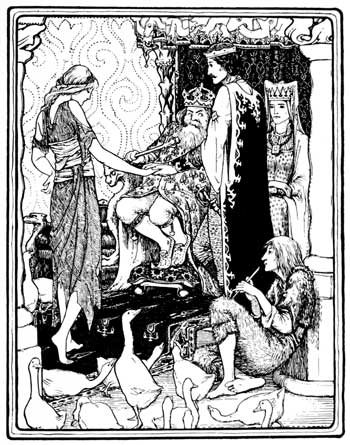
Illustration by John D. Batten, from “More English Fairy Tales” (wikimedia commons)
Background: English fairy tale from Joseph Jacobs’s “More English Fairy Tales”
The story: A lord had lost his daughter upon her giving birth. He had no other living relatives except for his granddaughter. But due to his grief, he did not give much attention to her, and even her clothes were nothing special. As a result, she was called Tattercoats. She grew up playing in the fields together with her friend, a gooseherd.
One day, the lord was invited to the royal ball, but went ahead without bringing Tattercoats along. The gooseherd suggested he and Tattercoats go to the ball and watch. As he was playing his pipe, a well-dressed man asked them for directions to the castle. When he found out that Tattercoats and the gooseherd were also going to the ball, he asked Tattercoats to marry him.
Flabbergasted, Tattercoats told the man that he should look for a suitable bride at the ball instead. The man said he would dance with her at the event come midnight.
With geese in tow, the gooseherd and Tattercoats did come to the royal ball. As it turns out, the well-dressed man earlier was the prince, and he declared to his father that she was the one he wished to be wed to.
As if on cue, the gooseherd played his pipe, and Tattercoats’ ragged clothes were magically transformed into magnificent robes fit for the occasion. The geese became men who held her train for her. The crowd burst into applause, and the wedding took place.
Mysteriously, the gooseherd was never seen or heard of again. Meanwhile, the lord, Tattercoats’s grandfather, went home and back to mourning until his dying day.
Our verdict: Sounds a lot like Cinderella, eh? Notice the familiar fairy tale themes of “love at first sight”, the idea of a “Prince Charming”, and of a friend slash fairy godmother, in the guise of the gooseherd.
[previous|page|next]
2. Mossycoat (1915)

Illustration by Heisuke Kitazawa, from hypehopewonderland.com
Background: English fairy tale from Katherine M. Briggs and Ruth I. Tongue’s “Folktales of England”
The story: A peddler wanted to marry a widow’s daughter. But the daughter didn’t want to. Her mother told her to ask the peddler to bring her a white satin dress with gold sprigs that fit her perfectly, and three days later, he brought her just that.
Next, the mother instructed her daughter to ask the peddler for a dress with the color of all birds, and which would fit her perfectly, and again, he brought her this.
Next, the daughter followed her mother’s order to ask the peddler for a pair of satin slippers which fit her perfectly, and once more, the peddler fulfilled her request. The mother told the peddler to come back the next day.
In the morning, the mother presented her daughter with a coat made of moss and gold thread, which could magically transport her where she wishes, and which also bestows the ability of shape-shifting.
The girl was sent to work at the castle, but no one would hire her as a cook or undercook, because they were so jealous of her beauty. They made her wash dishes instead, and often hit her head with a skimmer.
There came news of a ball, and on that night, she put the other servants to sleep with magic, washed up, and wore the white satin dress, together with the mossy coat. The prince fell in love with her, but the only thing she told him was that she comes from a place where people hit her head with a skimmer.
She went back, waking up the other servants and threatening to tell their master that they had been sleeping on the job. Frightened, they started to treat her better.
Another ball was organized, and this time, she attended using her other dress, but knowing that her sleep enchantment on the other servants would soon fade, she hurried back. The prince, hurrying after her, caught one of her shoes. He roamed the kingdom and made all the women try the shoe, and found the girl, whose foot perfectly fit it. He and “Mossycoat” got married thereafter.
Our verdict: Another “Cinderella” from history. This time, though, no fairy godmother. But it also has the element of magic, which we love.
[previous|page|next]
3. Snow White and Rose Red (1832)

1911 illustration by Jessie Wilcox Smith (wikipedia)
Background: German fairy tale from The Brothers Grimm
The story: There were two girls, sisters, named Snow White and Rose Red. They were daughters of a widow and lived a poor life. Snow White was the more reserved sister, while Rose Red was more outspoken and adventurous.
One cold winter’s night, a bear knocks on their door, frightening them. The bear reassured them that he only needed a place where he could ward off the cold for the night. The girls let him in and took care of him, and the bear would keep returning several times, as it had endeared itself to the family.
In the summer, the bear bids them goodbye as he must protect a treasure of his from an evil dwarf. One day, while strolling, the girls see a dwarf with his beard caught in a tree, and they set him loose by cutting his beard.
Annoyed, the dwarf doesn’t even express gratitude, but the girls would keep encountering the dwarf and rescuing him on different occasions.
The bear returns, and the girls see the dwarf once again, who this time, is begging the bear for mercy. He tells the bear to eat the girls instead of him. The bear swats the dwarf and kills him, transforming into a prince. He had been under the spell of the dwarf the whole time.
The prince marries Snow White. Rose Red, on the other hand, marries the prince’s brother.
Our verdict: Once again, the protagonists end up marrying a prince, but the beauty of this tale is that it highlights the triumph of good over evil.
[previous|page|next]
4. Aurore and Aimée

Image from polyvore.com
Background: French fairy tale by Jeanne-Marie Le Prince de Beaumont
The story: A woman had two beautiful daughters; one of them, good, named Aurore; and the other, evil, named Aimee. As the woman was growing old, she had someone accompany Aurore to the country. That person, however, left Aurore alone in a forest. It was a good thing that she stumbled upon a shepherdess’ cottage. The shepherdess discovered Aurore and raised her as her own. Aurore learned to pray, work, read, and take walks. She would also keep telling Aurore that some misfortunes lead to happiness.
A prince named Ingenu went hunting and upon seeing Aurore, fell in love with her and wanted to marry her. The shepherdess consented, and the prince promised to return in three days. While tending sheep, Aurore fell into a thicket, scratching and bruising her face.
Prince Ingenu had an evil brother, King Fourbin. When Fourbin learned about Aurore, he declared he’d marry her instead if she were that beautiful. But when he saw Aurore’s bruised face, he told his brother to marry her immediately and banned them from the palace. Ingenu, nevertheless, still loved Aurore, and the shepherdess was able to restore her face with mystical water.
Back at the castle, King Fourbin called for portraits of beautiful women and fell in love with one of Aimee. He married her thereafter.
In time, Aurore gave birth to a son named Beaujour, but he suddenly disappeared one day. Having heard of the birth of his nephew, the King had his men hunt and kill Beajour. Not finding him, Aurore, Ingenu and the shepherdess were ordered to be placed in a boat at sea.
They found themselves in a land at war. Ingenu offered to fight for the king and killed one of the enemy’s greatest commanders, sending them away, and ending the war. The king, having no son, made Ingenu his heir.
Fourbin eventually died of grief because of his wife Aimee’s wickedness. The people, angered, sent Aimee away, hence, calling for Ingenu to claim his right to the throne.
While sailing back to their kingdom, they were shipwrecked, and they discovered a woman with Beaujour. As it turns out, the woman was a pirate’s wife and had kidnapped Beaujour; however, they were shipwrecked.
They went back to their kingdom, and Aurore finally discerned the truth in her shepherdess mother’s teaching about misfortune and how it often leads to happiness.
Our verdict: There’s something wonderful about fairy tales when there are contrasting personalities such as the case of sisters Aurore and Aimee, and brothers Ingenu and Fourbin. Evil characters eventually meet their demise, while the good characters attain wealth and happiness.
[previous|page|next]
5. Babiole (1698)

Illustration from magpieandwhiskeyjack.blogspot.com
Background: A French fairy tale written by Madame d’Aulnoy
The story: A queen thought she would never bear a child because she was cursed by the fairy Fanferluche. Fanerluche denied this and said she would have a daughter that would bring her so much sadness. In order to prevent this, Fanferluche instructed the queen to attach a branch of hawthorn to the child’s head once born. The queen, as predicted, did become pregnant and gave birth to a girl. She followed Fanferluche's instructions; however, the baby transformed into a monkey.
An attendant convinced the queen to have the monkey thrown to sea in a box. The servant tasked to bring the monkey to sea liked the box so much that he took Babiole out and took the box. A boy, the son of the queen’s sister, happened to see Babiole and adopted it as a pet.
When the monkey turned four years old, it started speaking, and the boy boasted about it to the nobility and educated it. Little did he know that Babiole was already falling in love with her cousin.
Magot, the king of the monkeys, wished to marry her, but she refused to do so and professed her undying love for her cousin, which he scoffed at. Babiole ran away, and sank to the depths of a river where she was welcomed by the King of the Fish. He told her that the prince would marry only the most beautiful princess in the world, and reminded her to keep safe the glass chest that Magot had sent her. He gave Babiole a tortoise to ride, but was caught by Magot’s men.
Babiole was kept in a carriage. As they entered a city, which was her own, she became frightened, as there was an order from the queen to ban all monkeys, so she and Magot’s men were caught. But Babiole, being well-dressed, and having gained a name for being the smart, educated monkey that she is, was treated well by her captors. The queen met her and realized that this was her daughter, but her lady attendants persuaded her to keep Babiole locked up in a castle. Having heard of this, Babiole escaped.
Babiole, having nothing to eat, opened the glass chest from Magot and found an olive inside, which she ate. Oil oozed out of the olive and transformed her into a beautiful princess. Babiole also ate a hazelnut inside the chest, and from it, a castle emerged with attendants. She reigned queen of the castle, and had many a tournaments held there.
One day, some knights got wounded after a fight. Discovering that one of the nearly dead men was her cousin, Babiole had servants tend to him. Realizing that her love for him was causing him pain, she ran away. The fairy Fanferluche captured her and placed her inside a glass bottle.
The prince, having recovered fully, went searching for her, and along the way, met the King of the Fishes. The king told him of Babiole’s whereabouts and the prince was able to rescue her. She told him everything, and he asked for her forgiveness. They married and brought their kingdoms together.
Our verdict: There's always some form of human to animal or animal to human transfiguration in fairy tales, and this very sense of magic is what enamors children. This story involves the issue of justice and how love conquers all, but just to be clear, we do not approve of the incestuous theme.
Source: en.wikipedia.org

Lorem ipsum dolor sit amet, consectetur adipisicing elit, sed do eiusmod
Lorem ipsum dolor sit amet, consectetur adipisicing elit, sed do eiusmod
