
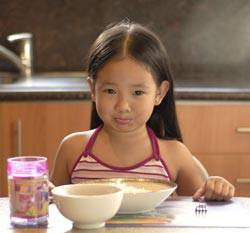
 “Ubusin ang pagkain..grasya ’yan.”
“Maraming nagugutom sa mundo kaya huwag sayangin ang nakahain.”
“Dapat malinis ang plato.”
“Huwag tatayo hangga’t hindi ubos lahat.”
Growing up, businesswoman Leslie Montes* heard these a lot—from parents, teachers and older relatives. Even if she didn’t like the food or wasn’t very hungry, she says she felt compelled to eat when her mom or her lola started lecturing about rations, how lucky they were to have food, and why she and her siblings had to “clean their plates.”
Fortunately for Leslie, her sisters and brothers had huge appetites, always willing to finish what she couldn’t. “Ako ’yung pinakamahina kumain sa family namin,” she reveals with a smile. She remembers coming home from school one day with the ham sandwiches her mom packed for baon still uneaten. So that her mom would think she devoured the sandwiches, she threw them in the trash can, hoping that nobody would find out.
Her sister, however, saw the untouched baon and reporte the misdeed to their mom. “That one time I was actually wasteful,” confesses Leslie sheepishly, although she claims that the practice of polishing off plates in their household taught her to be economical and careful with food.
Happy Meals
Now a mom to eight-year-old son, Leslie likes Miguel* to enjoy his meals, so she does not force him to eat. Times at the dining table, she believes, should be fun, as well as stress- and struggle-free. “Ayoko ’yung laging pinipilit ang bata na kumain. It takes the pleasure out of eating and being together. Basta gutom naman si Miguel, sinasabi niya sa akin at kumakain siya,” explains Leslie. Of course, she is delighted when her youngster asks for seconds, and she’s consistently supportive, too, when he tries new dishes.
This is how the experience of eating should be, according to Luchie Callanta, who teaches Nutrition at the College of Home Economics in UP Diliman and at the Center for Culinary Arts-Manila in Quezon City.
“The dining table environment should be positive for the child to appreciate food, to enjoy eating and being with other people, and to develop good food and eating habits...it should not be a venue for disciplining the child,” she stresses. In affirmative and encouraging surroundings, your little ones are more likely to finish their food, and learn about important values, too, such as sharing and spending time with the family. “Mas gaganahan siyang kumain,” she adds.
Click here to read more about how to teach your child to finish his or her food.
[previous|page|next]
Read on to learn more about how to teach your child to finish her food.
Dining Dilemmas
In contrast, children who are frequently subjected to reprimand and disapproval at mealtime will only toy with their food. “If all the parent does is scold and discipline the child, hindi niya isusubo ang pagkain at lalong hindi niya uubusin,” says Callanta. With such an off-putting and unenthusiastic atmosphere, “hindi kasalanan ng bata kung mawalan siya ng ganang kumain,” she points out.
Distractions when dining, like a nearby TV set or loud voices, may likewise confuse a child and lead to loss of appetite. Other factors such as sleepiness, exhaustion or bad timing may affect the child’s eating experience, too. “Parents need to create a setting that is conducive to eating, and there really should be a specific place where the family eats,” she asserts. Moms and dads should make it clear to their kids, for example, that the place to have meals is at the dining table, not on the sofa in front of the TV or on the bed. Mealtimes must be agreeable affairs for the child and his family.
Be realistic
True, the “clean plate” rule teaches people of all ages to value food and to not be excessive. Many will also agree that leaving food on the plate is a bad habit for a child to have. Nevertheless, parents should be reasonable with their expectations, particularly with very young kids. “How can a child finish everything on his plate if he is given an adult-sized serving? And who put the food on the child’s plate in the first place? If you want a child to finish his food, he should be given the right portion size,” clarifies Callanta.
Keep in mind that children’s eating practices and preferences are not yet well-established and, being kids, they can be fickle. Don’t expect them to end each and every eating session with an empty plate. Compliment them when they do, and acknowledge their efforts, but don’t automatically think your children are hopeless if occasionally, they consume only half of their regular helping.
On her part, homemaker and mother of four, Girlie Angeles admits she constantly persuades her brood to eat well but “hindi ko sila pinipilit ubusin ang pagkain ’pag busog na sila.” Besides, she says, nobody likes the feeling of being overly full or experiencing the consequences of overeating.
Click here to read more about how to teach your child to finish his or her food.
[previous|page|next]
Read on to learn more about how to teach your child to finish his or her food.
Table train your tots
Callanta singles out a common adult mis-con-ception that “walang [kakayahan] ang mga bata to get their own food.” On the contrary, parents help cultivate sound eating habits when they provide guidance while letting their children decide on what to eat, how much to eat, and when to stop eating or what to do when they feel full.
Once old enough to join the family dining table, your tykes must be encouraged to eat on their own and to make “food decisions.” Whether you’re eating at home or outside, Callanta recommends training kids as young as three or four to get a small, manageable portion of a dish first. “Teach your child to get just enough for herself. Tell her that she can always return for more, but she has to finish first what she put on her plate.”
“That’s what I tell my children when we go to parties or buffets,” says Girlie. “I let them know na okay lang bumalik for more food, kesa kukuha ka agad ng napakarami tapos hindi naman mauubos.”
When it comes to eating, parents should be good examples to their kids, Callanta says. They have to ensure that moments at the dining table are worthwhile, comforting, and something to look forward to as a family. “With the amount of time we spend eating, the experience should not be negative or stressful. Dapat from childhood, maganda ’yung experience in eating and at the dining table...so that the child would not have emotional problems or issues about food,” she advises.
Leslie concurs. “You really should stop eating when you’re full...and you don’t have to eat everything if you’re not hungry. Mahalaga ang pagkain...pero hindi ’yan dapat pag-awayan o pagmulan ng conflict. I think it’s much more important that you have a great relationship with your kids and that your family is happy.”
A child who acquires an unhealthy or wrong attitude toward food could develop eating disorders later in life, such as bulimia and being takaw-tingin, warns Callanta. That is why parents should provide a warm and constructive ambience at home and educate their kids on appropriate food and eating behavior.
After all, she reasons, “How the child eats is a reflection of how his parents eat.”
Click here to learn about anti takaw-tingin tips.
[previous|page|next]
Read on to learn about anti takaw-tingin tips.
Anti-takaw-tingin tips
Nutrition professor and mother of four, Luchie Callanta offers helpful hints on how not to overeat:
• Do not attend with an empty stomach. Some people deliberately starve themselves before a party, and then stuff themselves at chowtime. Callanta advises to have something before going to an event—even if it’s only a snack, just in case the serving of the food is delayed, too. You’ll be more rational when there’s no rumbling in your tummy.
• Make a survey. Before “attacking” the buffet table, survey the selections first and choose what you really want to eat so you won’t feel obliged to get a sample of every dish.
• If possible, pick the smaller plate. An undersized dish at its fullest still holds considerably less than what’s on a big plate.
• Start with fruits or salad. These “light” fares are digested more easily than meat and won’t put your tummy in overdrive all at once.
• Take your time eating. It takes 20 minutes for the brain to register fullness, so do not gobble up those appetizers, entrees, and desserts like you’re being clocked. Instead, eat at a leisurely pace, chew unhurriedly to savor the food.
• Socialize. Stimulating conversation and fascinating company can limit trips to the buffet table.
• Move away. Sit a good distance away from where the food is to take your mind off it.
Photography by David Hanson Ong

Lorem ipsum dolor sit amet, consectetur adipisicing elit, sed do eiusmod
Lorem ipsum dolor sit amet, consectetur adipisicing elit, sed do eiusmod
