
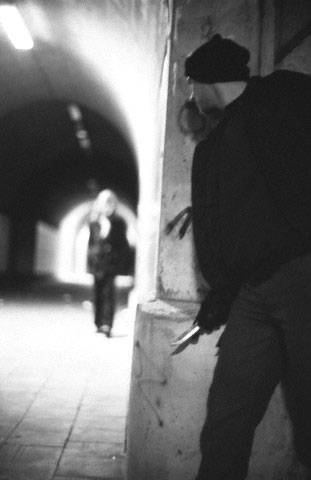
 On the day of her birthday, Olivia Fernandez drove to a nearby bakeshop along Bayan-bayanan Ave., Concepcion, Marikina. She was with her daughter Fiona, 3, and Fiona’s nanny. “After parking the car, I got off to buy a cake. I decided to leave Yaya and Fiona in the car since I wasn’t going to take long. Thing is, I forgot to lock the doors,” she recalls.
While inside the car, two decent-looking men approched the yaya and told her there were sparks coming from under the hood. “Yaya didn’t believe them since the car was just a few days old.” Suddenly, one guy opened the door and tried to snatch Fiona from her yaya, saying, “Delikado ang sasakyan niyo; ibaba mo ang bata.” Thinking about Fiona’s safety, her yaya refused to give the child to the men. When the strangers left, she immediately asked the delivery men nearby to call Olivia.
“When I got to the scene, everyone was telling me about these suspicious-looking guys. The delivery men told me that the guys threw coins at them, probably to distract them. Upon hearing Yaya’s account, I easily surmised that it was a modus operandi. I was so relieved that she refused to believe the men. Then I noticed that my bag, which I left on the passenger seat, was gone.”
One of the many
Olivia is just one of the many victims of the Bukas Kotse Gang, one of the various scams that target mostly women. As moms, our children’s safety is our priority but if we ourselves are in danger, our children are compromised as well. “It was a good thing I brought my wallet with me. Inside my bag were my cell phone, a camera, our house keys, and a passbook which had our home address. That night, we changed our gate’s padlocks. The next day, we had all our door locks changed. I was just so thankful that my daughter was unharmed,” says Olivia. “Now I no longer leave anyone or anything valuable inside the car, even if it will only take me a minute to do an errand.”
[previous|page|next]
Cecilia Bautista, a preschool teacher and mom to Santino, 3, thought her car was safely parked in front of a school lot in Pasig. “I parked my car in my usual slot. Two hours later, I received a call from the building’s administration office informing me that my car window had been smashed!”
SPC Josefine Modesto, officer- in-charge of Women and Children Protection Desk (WCPD)/Anti-Trafficking Section and Policewomen Mobile Patrol Unit (PMPU) at the San Juan City Police Station, cites the most common reported scams in the National Capital Region Police Office and gives useful information and safety tips to avoid being victimized by such fraudulent schemes.
1. The bukas-kotse operation
“Karaniwang binibiktima ng ‘Bukas Kotse’ ang mga taong kapaparada lang at kakalabas lang sa kanilang sasakyan. Ito ay upang makasigurong matagal pa silang babalik, habang sila ay nasa loob ng sasakyan na panlolooban. Karaniwa’y hinaharangan nila ng mas mataas na sasakyan kagaya ng van ang sasakyang kanilang nilolooban upang maikubli ang pagnanakaw.” But the gang also targets occupied vehicles like in Olivia’s case. They point to the victim’s car, implying a flat tire or a spark. This usually makes the victim step out of her car to inspect it. Meanwhile, the accomplice steals the valuables inside the car. Modesto’s advise to women: 1) Always lock your car doors. 2) Park your vehicle where it is visible to everybody at all angles. 3) Park in well-lit areas where there are security guards. 4) Do not leave belongings that are visible to passersby and that may attract robbers.
2. Petty theft
Pick-pocketing, bag-snatching, and other forms of petty theft are rampant whether you are in a crowded place or in a public vehicle. The Salisi, Ipit, Laslas Bag/Bulsa, and Laglag Barya Gangs all use the tactic of distraction while stealing is in progress. Strangers may come up to you to ask for directions, push, shove or squeeze past you, or even drop their coins so you’d feel obliged to bend down and pick them up, while their accomplice steals the items in your bag. They usually prey on a distracted mom whose attention is focused on her child. The Pitas Gang victimizes commuters seated by open windows of public utility vehicles by snatching their handbag, wristwatch, bracelet, earrings, cell phones - anything within reach, as the suspects run past the windows.
To protect yourself, keep your bags close to you, and within your sight, at all times. Refrain from hanging your purse at the back of your chair while eating in public places. If you will take public transportation, avoid wearing jewelry and exposing your gadgets. Always keep a close watch on your belongings.
[previous|page|next]
3. The dugo-dugo operation
The Dugo-Dugo Gang victimizes household helpers while their employers are away from home. Farrah Javier*, mom of three, recalls how it happened in her own home. “We were at a restaurant when Tinay, our cook, received a call at home."
"The caller told her that my husband had a car accident and was in bad shape. He even made my helper talk to my ‘supposed husband’ on the phone. He said that he had lost some of his teeth during the accident, making it difficult for Tinay to understand him. He then instructed her to gather all my jewelry and to meet someone at a nearby mall. Our cook did as she was told. After someone had taken all my valuables, he then told Tinay to wait for my ‘husband’ to be brought out in a wheelchair. It was only after an hour of waiting that our cook realized she had been conned!”
Modesto reveals how this gang knows which households to prey on: “Sa pamamagitan ng pagkakaroon ng ‘di pangkaraniwang pagsensus sa lugar para makakuha ng impormasyon sa target nilang pamilya, at pagmamanman sa mga personalidad na napili nilang maging biktima upang malaman ang kanilang mga gawi, oras ng pagpasok, at pag-uwi.” A gang member calls and tells the unsuspecting helper that a family member has met an accident and needs money for the hospital bill. The caller instructs the distraught helper to get whatever cash and valuables she finds in the house and deliver them to the caller.
Be sure to inform your helpers about this common scam. Give them specific instructions as to what to do in case they receive such call. Give them a list of phone numbers of trusted people to call to verify your whereabouts and condition. Also, keep your money and valuables in a secret place your household helpers do not know about.
4. Untrustworthy house help
Michelle D. Salvador, grade school teacher and mom to Andrea, 4, and Gabriel, 2, had her own yaya scare. She found out through other helpers living in their family compound that her son’s yaya would often leave her baby unsupervised. “She would leave my son in the crib and go out to buy cigarettes, with no one left to guard my son and our home.” Modesto shares receiving numerous reports on stolen money, jewelry, appliances, even family cars, by helpers and drivers - some of whom are newly hired, while others have been working for the family for years. Her advice: “Huwag lubusang magtiwala sa mga bagong katulong, bisita, o kakilala. Mahalagang hanapan ng kaukulang dokumento tulad ng police at NBI clearance, at birth certificate. Alamin ang bawat detalye ng nag-a-apply na katulong.” Michelle adds, “Interview the maids well. Keep the lines of communication open with them so they can tell you what’s going on at home.”
Be vigilant
Modesto says it all boils down to vigilance. “Sa mga biktima, magulang at katuwang na ahensiya: Maging alerto sa lahat ng bagay o pangyayari sa inyong paligid. I-report kaagad sa malapit o nasasakupang presinto ng pulisya o barangay [ang anumang kaduda-dudang tao o pangyayari].” It pays to be cautious and prudent wherever you may be: at home, on the road, in the mall, or other public places—whether it’s one that’s familiar and generally safe, or not.
Photo by jeffoops from flickr creative commons

Lorem ipsum dolor sit amet, consectetur adipisicing elit, sed do eiusmod
Lorem ipsum dolor sit amet, consectetur adipisicing elit, sed do eiusmod
