
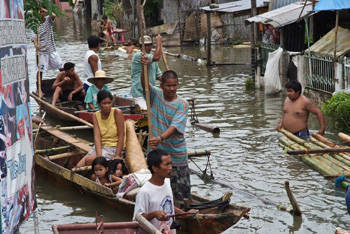
 In the latter part of 2009 and the first quarter of 2010, the world was rocked by natural disasters one after the other. First there was Typhoon Ondoy in September 2009, then the earthquake in Haiti, then within a couple of months, the earthquake in Chile. You know it happens anytime, anywhere. The problem is, you never think it will happen to you and your family.
“Disaster preparedness isn’t a one-time thing,” says Raffy Consunji, M.D., Critical Care and Trauma surgeon and president of Safe Kids Philippines. “It should be an automatic response. It helps if it’s not the first time you’re reacting to an emergency.” He explains that it’s like building a muscle. It takes practice to be prepared for disasters. He recommends that it be part of a family’s regular routine so that it makes a difference.
An-Marie Villarin, managing director of The Little Gym’s Terrific Tots Preschool Program, agrees, “In our school, we have a regular fire drill where we practice our exit routes. It helps that the kids know what to do when they hear the emergency bell. When you’re prepared, you don’t panic.”
Always think: Prevention
“Practicing for emergencies and disasters is under-recognized,” admits Dr. Consunji. But he says it’s critical. In fact, it’s the only thing that will really save your family because at the point of impact, you will just go with your automatic response and gut feel. When an emergency happens, you go on automatic mode and that’s where the training and the habit of preparedness kicks in.
Villarin recommends that parents get to know their communities better: What are the areas that are prone to floods and earthquakes? What is the community’s agreed upon response? Is there a community plan?
[previous|page|next]
Dr. Consunji gives the following checklist for disaster preparedness:
• Have a pre-agreed “rally point” for your family. In case of emergencies, make sure you agree with your family to meet somewhere, such as a place within the village or a relative’s home. Have several options, and make sure everyone in the family knows it.
• Have a list of emergency numbers laminated, and make sure these numbers are always in your kids’ bags. The list should include important numbers of relatives in case you cannot be reached.
• Ensure that your family has a disaster drill both at home and at school. Make sure to practice more than once a year.
• Don’t panic. Your child will model your behavior.
• Keep lines of communication open as much as possible.
Earthquakes: Triangle, shield, and stay
According to Dr. Consunji, the notion of staying under a heavy table or standing under a doorway is outdated. “You should find a heavy piece of furniture like a book case or a filing cabinet and stay beside it so that when the ceiling caves in, the piece of furniture blocks anything above you from crushing you.
Make sure you don’t get hit by the piece of furniture. The idea is to create a triangle of space around you.”
“Next, make yourself as small as possible,” Dr. Consunji advises. Make sure you and your family shield your faces and heads. Crouch as low as possible within the triangle of space. Avoid staying beside anything that might shatter such as glass windows.
“Stay put,” Villarin says. In case of an earthquake, it’s best to stay where you are in the event of aftershocks, and wait for security personnel or a rescue party to get you. “The initial shock may destabilize a building’s foundations and the aftershocks will push it to collapse,” Dr. Consunji warns. So it’s best to remain where you are until help arrives.
Both Villarin and Dr. Consunji advise parents never to take the elevator even if the electricity remains operational.
After the earthquake, the first thing Villarin recommends is to do a headcount and to make sure everyone is side by side and settled down before explaining what happened. Keep your explanation simple and factual.
According to Dr. Consunji, if you notice any unusual behavior in your child like not being able to eat or sleep after a day or two, check with a post-traumatic specialist.
[previous|page|next]
Fires: Stop, drop, and roll
Remember this rule of thumb: Stop, drop, and roll. That’s all your kids need to keep in mind during a fire. Dr. Consunji says running fans flames and is counterproductive. Also, being close to the ground helps your family from inhaling fumes and getting suffocated. Following this basic set of rules will also make it easier for you to be rescued.
“Never fire fight,” Dr. Consunji emphasizes. The point is to be rescued and not to attempt putting off the fire. Always prioritize your safety and your family’s safety. Unlike earthquakes, the advice is to get out of the building as soon as possible. He gives the following first-aid tips for burns in the event that you have access to water:
• Clean water can help cool down a burn and prevent second-degree burns.
• Clear off as much of the debris on the burn as you can.
• Do not touch or burst the blisters. Blisters are a good sign that your body is healing.
• Wrap the burn in a clean cloth.
• Do not attempt to self-medicate and leave it to a professional burn specialist to treat.
Lastly, as Dr. Consunji has always emphasized, prevention is key. “I advise parents to invest in a fire alarm system. It’s best to locate it near the kitchen where most fires start.” Also, have a fire extinguisher at hand. “Know your fire escape route at home, at school, and at work,” Villarin advises. Knowing ahead and not during the fire itself is a life-saver.
Floods: Lives over property and survival afterwards
“The main thing to remember during a flood is lives over property,” Dr. Consunji emphasizes. “Properties can be replaced but not lives.” During a flood itself, you’ll have no idea how much time you really have. Villarin says, if you’ve already prepared ahead of time, you will know what important documents or items to take with you to an upper floor. But if you are caught unaware, the safest thing for you to do is to get out and save lives. “If you can,” Dr. Consunji says, “Turn off the main circuit breaker of your home to prevent electrocution.”
Dealing with the aftermath of a flood is critical because a lot of disease can spread afterwards due to contaminated water and the build-up of stagnant water.
Dr. Consunji gives the following checklist for families so you’re prepared for both the flood and the condition after the flood:
• Have a battery-powered or crank radio on hand for emergency broadcasts.
• Stock up on flashlights and batteries. Make sure to replace your batteries every six months.
• Prepare enough clean drinking water for the family (the estimate is five gallons of water each).
• Prepare enough emergency food (canned goods, replace according to expiry dates).
• Have an emergency first-aid kit at home and in your car.
Lastly, train your children to be prepared for a flood the way they are prepared for earthquakes or fires: through practice. Villarin asks parents to have a personal plan and to know the community plan, too. And always make sure your kids are together and calm before you brief them about what happened.
[previous|page|next]
Yaya—your disaster-preparedness partner
Your household helpers are your partners in keeping your family safe. Villarin says it’s best to brief them of all the prevention plans and escape routes together with the rest of the family. Yaya should be just as prepared as all your kids. Dr. Consunji advises that you teach Yaya how to turn off the main circuit breaker. Apart from your spouse, your helper may be the only other adult who can help you get things done. Make sure she is prepared for her role. Dr. Consunji recommends that you brief her on your plans and principles (like “lives over property”) and encourage her to have an emergency kit of her own.
The thing to remember about disasters is that they could happen anytime and catch you unprepared. The best way to counter this is by making it a habit to have presence of mind and react in a way that is automatic and coordinated. There’s nothing like constant practice to help build this inner instinct in your family. If you haven’t already, start making it a habit today.
Real Moms’ Disaster Dos and Don’t’s
REAL MOM Bubbles SALVADOR’s STORY:
Bubbles’ baby was only five months old at the time that Typhoon Ondoy hit her home. She remembers having called up her brother to help her figure out how to keep her baby safe and transport him without any difficulty. The practical solution: a palanggana.
Dos:
• Know your neighbors, and don’t hesitate to ask for help.
• Store your valuables in waterproof resealable bags.
• Put your supply of milk and water for your baby in a place that’s easy to evacuate.
• Give your location and contact numbers to people around you so you’re reachable through the people around you.
• Save yourself and your family first. Let go of everything else.
• Pray and keep your sense of calm.
Don’ts
• Don’t panic.
• Don’t waste your time saving things.
[previous|page|next]
REAL MOM RACHEL PEREZ’s STORY:
Rachel didn’t realize what the impact of Typhoon Ondoy would be. She treated it lightly until the water started reaching the first floor of the house. What helped her out was her being calm.
Dos:
• Make sure someone’s always watching over your kids.
• Have a clear state of mind.
• Prioritize! If you have time, just save what’s really valuable. Otherwise, just save yourselves.
• Give yaya clear and calm instructions.
Don’ts
• Don’t expose yourselves to contaminated water.
• Don’t push for something that’s not feasible (like saving your fridge).
• Don’t cry over spilled milk.
Photo from fotopedia.com

Lorem ipsum dolor sit amet, consectetur adipisicing elit, sed do eiusmod
Lorem ipsum dolor sit amet, consectetur adipisicing elit, sed do eiusmod
