
Rio de la Cruz
Running coach and race organizer, 32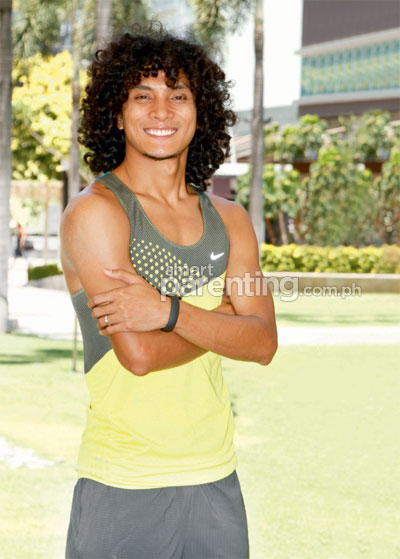
“Growing up, my family lived in what was like the slums in the movie "Slumdog Millionaire". I didn’t have a computer, so I played Filipino outdoor games like tumbang preso, agawan base, and patintero. I’d also race against my friends. I’d insert my slippers through my arms and run barefoot. These games developed my running skills.
“I became competitive and driven because of my family background: We didn’t have money. We ate only twice a day. I said to myself, ‘Ayaw ko ng ganitong buhay.’ Then I saw the opportunity to improve my life through running. My goal was to be very good at it, so I could make it to the varsity team and not have to pay for my education. I eventually graduated from the University of the Philippines (UP) with a degree in physical education.
“After college, I wanted to join the London marathon. I needed a lot of money for that, of course, so I decided to work and save for it. I had a corporate job but quit after five days.
“Then, my main direction changed: I wanted to organize my own fun run, an event that’s better than the ones I had joined. A month after my first, I organized another fun run, and then another the next month, until it became a weekly thing. At first, I did everything for the races by myself: marketing, logistics, and setup. All that hard work gave me feelings of fulfillment and achievement. I’d wake up every morning excited to organize a race.
“I also coached individuals. I got to know a lot of celebrities and CEOs, so my network expanded. My students really improved, and my reputation as a coach spread through word of mouth. I even had to choose between coaching and organizing events. But now, because other people are helping me organize races, I can still coach. I conduct free running clinics twice a week to de-stress.
“Kung naging maganda ang buhay ko noong bata ako, hindi siguro ganito ang magiging trabaho ko. For example, kumakatok ako noon sa mga kapitbahay para magtanong kung magpapatapon sila ng basura. Because of the hardships I experienced, I became business-minded. Also, because of running, I became disciplined and good at time management. Hindi hadlang ang kahirapan, as long as you have drive and a goal in life. At the same time, dapat wala kang inaapakang ibang tao.”
Photo by Vincent Coscolluela
[previous|page|next]
Lex Ledesma
School director of The One School, entrepreneur (owner, Whistlestop chain of restaurants), and doctorate student, 39
“I graduated from De La Salle University with a civil-engineering degree and 24 units of failure—just one more and I would have been kicked out. I also barely passed the board exam, but I was a persevering and hardworking student. I was never lazy. I just wasn’t a fit for the traditional teaching method. I liked to ask why I need to learn things. I wanted to feel like my teacher cared about me outside the classroom, which couldn’t be possible in big classes. I also have a short-term memory; I can’t memorize to save my life, so I wasn’t good at taking written tests.
“Prior to that, I went to an international school and studied for two years in the U.S. where I was an honor student, and then I entered a traditional all-boys high school in Manila. Because my grades were so good, I was put in the honors section, but I just crashed and burned. I was transferred to the regular section after my first year. All throughout high school, I passed, but I was at the bottom of my class.
“I realized that if I was flunking all the time, I needed to have good relationships with my teachers and classmates, so I honed my public-relations skills. I also thought that if the teachers knew my name and thought that I was doing my best, they would give me a better grade. I always asked questions in class and got close to the smart ones who could tutor me. I learned how to do things that I would not otherwise have done, practical stuff like finding the teachers who had a reputation for giving high grades—anything to pass. I also picked a good group of people to work with— and that’s how you succeed in the real world. You need to form good teams. I found teammates who had the skills I didn’t have. I had presentation and critical-thinking skills, but I didn’t have some of the technical ones, so I looked for people who had them.
“I really believe in that whole idea of multiple intelligences. Parents have to find what their children are good at and help them excel. Although I was flunking in school, I was good at many things. Early on, I was succeeding outside the classroom; I joined international debate competitions. My college thesis even won the gold medal for outstanding thesis in civil engineering—much to everyone’s surprise. But a thesis is totally different from a test. You start with a really good idea, choose the best group mates, do all of your experiments properly, and then defend your thesis well.
“After college, I went to Stanford University in the U.S. for my master’s degree in civil and environmental engineering. I got As and Bs, even though I worked with only 30 percent of the effort I exerted back in college. I even got to play golf four times a week. That’s because 40 percent of my grade came from classroom participation. It was a very different learning perspective.
“I’m a big believer in discipline and hard work, not in memorization and rote learning. If you know how to think critically, solve problems, and communicate well, then you have a much bigger chance of succeeding. This is at the heart of The One School. Here, we’re trying to create an environment for critical thinking, which is the synthesis of old knowledge and application. It’s about being solution-oriented, being creative in your thinking processes, and pushing your limits.”
Photo by Miguel Miranda
[previous|page|next]
Efren Peñaflorida
CNN Hero of the Year 2009, educator, and social worker, 33
“I grew up in a slum area near a dump site in Cavite. Our house was just a small shanty. Syempre, hirap ang mga magulang ko na paaralin kaming tatlong magkakapatid. Mahirap ang buhay. Maswerte na kami kung tatlong beses kami nakakain sa isang araw. It was really a struggle.
“I was bullied by gangs. Tinutukso ako noon. Pinagti-trip-an ako. When I was in grade six, pinagbababato ako ng malalaking bato. May isang beses noong high school na sinuntok ako habang nakatalikod, tapos bigla akong sinunggaban. Gangs were really very rampant where I lived, pati ang mga awayan sa kalye. Magkamali ka lang ng tingin mo sa kanila, pagtitripan ka na nila. In high school, gusto ko na talagang tumigil sa pag-aaral at sumali sa isang gang para makaganti.
“But that’s when I met my mentor, Harnin ‘Kuya Bonn’ Manalaysay, na nagpabago sa isip ko. Ang pagganti ay ’di makakatulong. He asked me, ‘Gusto mo bang gumanti?’ But he had something else in mind. He said, ‘Gagantihan natin sila nang tama. Tatapatan natin ng positive.’ Kuya Bonn brought me to a jail and said, ‘Kung gumanti ka, dito ka mapupunta.’ And then we went to a cemetery. Sabi niya, ‘Kung ’di ka sa kulungan mapupunta, dito naman ang bagsak mo.’ That changed my mind. I started volunteering when I was 13 for Club 8586. When I was 16, I started Dynamic Teen Company (DTC) under Club 8586 with my fellow volunteers. We wanted to fight against gangs by keeping the kids they want to recruit in school o ineenganyo namin sila na bumalik sa pag-aaral.
“Naniwala ako sa prinsipyo niya na huwag ka dapat tumigil sa pag-aaral, at mahalin mo ang pagaaral. I continued my studies even if I was afraid to go to school because of the bullies. I held on to that belief so I could eventually change my situation. Pinaniwalaan ko ’yun kaya ako nakatapos ng kolehiyo. Now I have two degrees: associate in computer technology and bachelor of secondary education. I actually wanted to become an engineer so I could build a nice house for my family, but I realized that it was more important to build the lives of children than to build houses.
“CNN saw what we were doing on YouTube, where I uploaded a video about Kariton Klasrum. Pinagtatawanan kasi kaming mga nagtutulak ng kariton—sinisigawan, binabato, minumura. Sabi pa ng mga tambay, ‘Walang patutunguhan ’yan. Mga basurero kayo!’ I made a video called Slumdog Educators.
“The heart of DTC is the determined and dedicated volunteers. I just represented the team for CNN Heroes. It’s an honor to be the ‘face’ of DTC. I was chosen to represent those children who need help and also the volunteers who help them.”
Photo by Miguel Miranda
[previous|page|next]
Nix Lañas
TV commercial and indie film director, and former professor and thesis consultant at De La Salle University, 32
“When I was in high school, I wanted to be known as an athlete, a band member, and a CAT officer. I was a jack-of-all-trades, but I wouldn’t say I was a master of none; I was part of the first five in our basketball team and I was one of the top CAT officers. People would say to me, though, ‘You could have gotten the top position if you were…’ I eventually realized that I should have had focus.
“But my main problem back then was I was always absent. I’d get intense dizzy spells, palpitate, and, for some weird reason, get very depressed. For years, doctors had been trying to diagnose my condition. Finally in college, I found out that I had anxiety and panic disorder. Don’t be afraid to seek help. I’m so thankful for my parents’ support and affirmation, which saw me through.
“Despite my condition, college was like one big party—at first. I used to stay in a condo unit where all of my friends hung out during breaks. But these ‘extra-curricular activities’ hindered my academics. During my first year, I nearly got kicked out of school. But towards the end of college, I joined a writing organization, where I got inspired to write. I also met friends who inspired me to straighten up my life. I started to redeem myself. I studied hard, and before I knew it, I was already on the dean’s list.
“Then, I took a leave of absence for three years to earn money for my thesis, a film. At that time, my family faced a financial crisis—my dad’s company folded. I had to raise money for my own tuition and the film myself. To earn money, I’d edit the videos of other college students. My friend and I set up a simple editing space in my apartment. Basically, we did other students’ projects while we did our own, which was the movie "Doble Vista". It won the Audience Choice Award in the Short Feature category of the 2007 Cinemalaya film festival.
“After college, I worked for a music channel and then put up my own business. I did video editing and event coverage at first, and then I started making audiovisual presentations for different corporate clients. I also taught classes on the side. Now, I’m into directing TV commercials.
“I try to think like an entrepreneur, too. I don’t want to be a starving artist. I treat everything as an investment. I also educated myself, so during my leave I attended a lot of classes and workshops.
“When I was making Doble Vista, I said to myself, ‘I’m going to use this film as a passport to my dreams.’ Now, I have a definite dream: to be the best female commercial and film director out there. That’s what I’m focused on.”
Photo by Miguel Miranda, makeup by Pipo Santos

Lorem ipsum dolor sit amet, consectetur adipisicing elit, sed do eiusmod
Lorem ipsum dolor sit amet, consectetur adipisicing elit, sed do eiusmod
