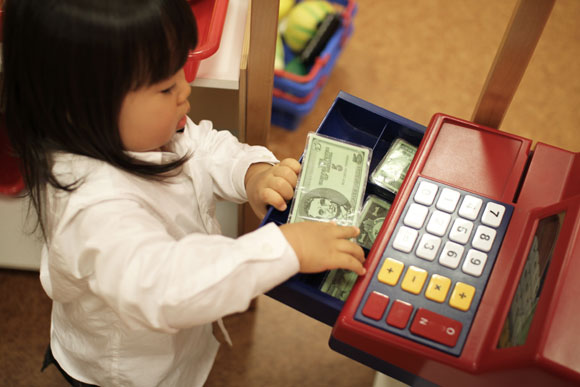
My mom loves retelling a story about my little brother wanting a particular toy. The little guy asked my mom for some money so that he could buy the toy, but my mom replied nonchalantly, “I don't have money for that.” She did, but she had reason to give that response. You see, as young as he was, my brother (as with all three of us siblings) had an allowance of HK$10 weekly. His asking for cash on this particular occasion meant he had no more money, probably from buying a toy a few weeks before.
My brother creased his little brows and then appeared to have a light bulb moment. “Then just go to the wall and get some money!” referring the ATM, which probably to a child was accessible from any wall. He got another “no” from my mom!
Suffice it to say, my brother did end up saving his allowance for a few more weeks and finally bought his heart's desire, which was probably another G.I. Joe action figure.
Kids and money. It's a tricky topic for many parents, probably because we ourselves are baffled by money itself. Currency, savings, budget, debt, investments, interest - these are all big words for kids, and most parents themselves struggle with these aspects of financial life. Still, money wisdom needs to be taught, and there are ways to teach your child about money in an age-appropriate way that he or she will understand.
Here are five important lessons you can impart to your young kids about money, along with tips on how to teach each lesson in a simple way.
1. Money is something we use every day.
Our children observe us using money all the time. When they reach preschool or Kindergarten, certain money concepts could already be introduced, such as:
- Teach your child some basic money and currency facts. For starters, teach them the difference between centavos (5, 10 and 25 centavo coins) and pesos (1, 5 and 10 peso coins). Then teach them about the value of different monetary units.
- Impart early Math skills and age-appropriate Math equations that will help them understand how money is used in everyday life. For example: Take them to the supermarket and ask them to find an item that's worth Php10.00. Help them add up the coins they need to pay for that item and help them realize that money can pay for things they need, like food.
[previous|page|next]
2. Money can be used to buy what you want.
Once they realize that there’s more to money than just spending on whatever their latest impulse is, they’ll want to buy something larger than the amount they have on hand. That’s when you teach them about savings goals.
- Let's say your child wants to buy a new toy: Instead of buying them that toy, illustrate the need to save up for it. For example: “You want a new toy? Well, let's see how much one costs, and then we'll know how much you need to save up for it. If you save Php50 each week, you can buy that toy in 3 months. But that will mean not going to get McDonald’s after school on Friday and not buying other little toys every weekend.”
- Here's a fun idea: Make a chart for you kid’s room that shows his or her financial goal and cumulative savings along the way. This way, when your kid sees the savings getting closer to the total amount he needs saved, he will be excited about watching his savings grow as well as reaching his goal of buying the toy he wants.
3. Money needs to be budgeted.
Teach your kids how to manage a simple budget rather than simply handing them money - even if you can afford to buy them what they want. Don't make a complicated budget, but show how planning expenses each week can help them save effectively for the things they want.
- Make the elements of the budget simple: Let's say for one month they have Php600 -roughly Php20 a day. If, for example, he or she needs to set aside Php300 savings for a new toy, Php100 for a birthday gift for mom, and Php200 for spending on whatever else they like that month, teach him how to split the money up and how to keep his spending within these planned amounts.
By teaching your kids to acquire the habit of planning a budget for their monthly needs, they will retain it as long as you approach it positively. It’ll pay off in a big way when they are older.
[previous|page|next]
4. Money must be spent responsibly—otherwise, you might have none to spend at all.
Kids who don’t have control of money before they become adults - even before they reach teendom - will always expect that money will be provided for them. Or when they finally get money of their own to spend, such as an allowance, they may spend it liberally without any thought about savings or goals. One way to teach kids about being responsible for their money is to give them control of it. As a parent, allot some of your own budget for your kids and let them control that amount. Here's how to do that:
- Allocate portions of your budget to your kids. Let's say you have a monthly dining-out budget of Php6,000 a month; give your kid control of Php500 of this amount. Do the same for your toy budget for the month.
- Once you allocate these portions for your kids, let them have complete control over that portion of money. At first, they will probably spend on impulse: a frozen yogurt, a toy, or some frivolous item. But when they realize they want something in particular, they’ll have to learn to save for that want or desire, and cut back on other expenses.
- As your kid cuts down on frivolous expenses in order to meet a financial goal for a new book or toy, they'll learn how to make decisions, be more frugal, and be responsible for the money that's in their control.
5. Advertising can make us spend our money, even when we don't need to.
These days, advertising, marketing and consumerism has all the more affected the way we spend our money. One important lesson to teach your kids about money is that money does not have to be spent; it can also be used to build a strong financial foundation.
- Early on, teach your kids about the goal of advertising. Show them how TV commercials and mall ads get us to buy stuff and services - in short, ads make people spend their money.
- Talk to your kids about materialism and consumerism in a way that they will understand. For example: Show how spending too much on material possessions like toys, clothes and gadgets can cause pollution and hurt the environment, or how some children in less fortunate parts of the world have no money at all, even for basic needs.
- Teach your kids to be conscious about how they spend their money. Show them how to pause before buying anything, and to weigh the pros and cons about buying something just because they “feel” like it at that moment.
- Teach your kids that you don't need to buy things (cars, clothes, shoes, gadgets, etc.) for the sake of appearances.
A final note
Before we teach our kids about being money-wise, we as parents need to be knowledgeable enough about saving, budgeting or investing money. Educate yourself on some beneficial money management practices. It's important to be comfortable about your personal finances so that you can live a lifestyle that is a good example to your kids about being money-wise.
Photo by MIKI Yoshihito from flickr creative commons

Lorem ipsum dolor sit amet, consectetur adipisicing elit, sed do eiusmod
Lorem ipsum dolor sit amet, consectetur adipisicing elit, sed do eiusmod