
 All parents wish they could gift their kids with hefty trust funds. But while a small fortune leads to a head start in life, instilling money-smart attitudes in your kids is even more important.
Tough times, wise kids
When money is tight, how do you deal with the situation? Do you go into denial and spend freely, praying things will somehow workout? Or do you turn into a worrywart and deny your family any extras? According to Liane Pena Alampay, M.D., development psychologist, your child can easily pick up on your anxiety, and feel this anxiety himself –no matter which end of the spending spectrum you fall under. Here are tips oon how to raise financially empowered kids:
- DO make kids feel that they have a choice. “If your sons want an expensive toy, ask him if he would like to have it now as an advanced birthday gift, or wait for his actual birthday.” States Dr. Alampay. “Remind him that if he gets the toy today, he won’t be able to buy a new one later on. If you’re at the supermarket and your daughter wants an imported chocolate bar, ask her if she’d rather have that, or a huge pack of her favorite cookies that will last a whole week.” Let your children weigh their options, and make their own decisions. This will help them feel that they are in control.
- DON’T give your child choice you aren’t ready to fulfill, as you never know which one he’ll pick. If he chooses to buy the toy now, don’t give him another toy on his birthday just because you feel bad. You can still celebrate his big day with a special yet simple celebration.
- DO explain matters properly. There’s no need to talk about the nitty-gritty of your financial situation, but be honest about why you can’t buy a certain toy right this minute, even if your child throws a fit. Dr Alampay shares, “My son once asked me if we were poor when his cousins left for a vacation in Bangkok. I explained that we are not poor, but that we aren’t rich either. I told him we have enough for what we need. I also reminded him that we had just taken a trip to Cebu where we had a lot of fun. We don’t have the budget to go to Bangkok, but we could save up for a future trip.”
- DON’T use guilt to get your kids to comply. “Don’t scare them by saying other children don’t even have any food, as this is something they can’t really do anything about at that moment,” states Alampay. “It may also leave them with unnecessary stress.”
- DO let them see how money works. “Let your kids use play money,” says Dr Alampay. “When we’re at the mall and my eldest son wants a snack, I ask him to check how much it costs, so I can give him the money to buy it. Sometimes, I give him a large bill so he sees that he gets change in return.”
- DON’T shelter them from money matters, or from knowing how much things cost. “Exposing your children helps them understand what is expensive, and what is not,” says Dr Alampay.
Click here to read more about value for money, saving savvy and how to go easy on the budget.
[previous|page|next]
Read more about value for money, saving savvy and how to go easy on the budget.
Value for money
Now that you’ve established the basics with your kids, you can start teaching them the valuing of saving, budgeting, and even earning. Some activities you can try:
Saving Savvy
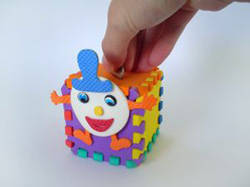
- THE PIGGY BANK METHOD is always a good place to start. Kids can get excited about a bank that gets heavier with each new coin. They’ll be thrilled to see that all coins can buy them a nice treat in the end.
- CHURCH DONATION BOXES also work on a similar premise. Only this time, your child can see that those who have less also need to save up for food and clothes –and that he can actually help them get what they need.
- SAVE UP. If your child is longing for a new toy car, help him save up for it. He can collect his birthday money and set aside coin he finds here and there. Help him out by agreeing to give him a peso for every three pesos he saves. This way, he’ll feel a sense of achievement when he does buy his toy car –and he’ll truly value it.
Easy on the budget
- STICK TO IT. “When my brother and sister-in-law first took their sons then aged four and six to Hong Kong, they brought them to Toys R Us,” share Miel Sadhwani, a preschool teacher at Brent International School in Subic. “They explained what a budget was, and gave each of them the same amount. They had to stick to this amount, but they could buy anything they wanted from the store with it. Their sons rushed through the aisles, and would run back to their parents who had a calculator to check their total. In the end, one son got many small items, while the other chose one big toy. The best part? Neither focused on what they couldn’t have. They were just excited about what they could buy.”
- EXPLAIN THE IDEAOF A BUDGET USING NON-MONETARY OPTIONS. “I reward my three year old Natalia by treating her to anything she wants in the bookstore that’s worth P100. Since she doesn’t yet understand the value of money, I show her she can get two coloring books a pack of crayons. She then chooses what she wants,” shares Sadhwani.
- MAKE A LIST. At the grocery, kids often like to point to what they want. When they draw up your grocery list, let your child draw up one as well. Give him a budget so he can decide on what’s important to him, and help him stick to it while at the store.
Click here to read more about earning, learning and life lessons from money.
[previous|page|next]
Read more about earning, learning and life lessons from money.
Earn and learn
- SHOW YOUR CHILD THAT HE HAS TO EARN WHAT HE WANTS. This is a great way to teach him that money doesn’t grow on trees. Make sure you reward him for legitimate chores (like helping set the table) instead of things you randomly make up,” shares Dr. Alampay. “Otherwise, he won’t feel that he had to put effort and sacrifice into it –which is what really teaches this value to your kid.”
- BE CAREFUL WHEN GIVING OUT REWARDS. “Your child needs to see the value of what he is working for,” shares Dr Alampay. Explain that getting high grades has value in itself, and that a trip to Disneyland is just a prize he gets at the end. If not, your child may no longer be motivated to reach his goal once you remove the reward.
- COME UP WITH THE CREATIVE IDEAS. “My students earn popsicle sticks for good behavior. They try to collect as many sticks to buy prizes from my treasure chest. The prizes range from cute pencils to stuffed toys and stickers, and they all differ in ‘price’. This is a great incentive program for them because not only are they on their best behavior, they also get to make decisions like how to choose prizes and how to ‘spend’ the sticks they collect,” shares Sadhwani.
Life lessons
Teaching your kids how to save, budget, and earn doesn’t just teach them about money, but about the ways of the world. “ Setting limits and not giving your child everything he wants even if you can afford it builds character,” says Dr Alampay. You may not be able to give your child material possession he desires, but if you instill these values in him, he’d know what he needs to know when faced with the real world –where not everything is handed to you on a silver platter.
SOURCES
- Dr. Liane Pena Alampay, M.D. developmental psychologist; faculty member, Ateneo de Manila University, Quezon City
- Miel Sadhwani, kindergarten teacher, Brent International School, Subic.
Photo from sxc.hu

Lorem ipsum dolor sit amet, consectetur adipisicing elit, sed do eiusmod
Lorem ipsum dolor sit amet, consectetur adipisicing elit, sed do eiusmod
