
Here at Smart Parenting, we’re always finding ways to bring our audience what it needs. We understand that sitting down to digest an information-packed article can be a challenge for parents. Especially when there’s always laundry to fold, meals to make, and kids to drive around. So we made it easier for you to get the expert-backed information you need. Introducing the Smart Parenting Podcast, the audio version of some of our top articles. Smart Parenting Podcast allows you to listen to our content so you can either make the best use of your time or give your eyes a much-needed break from the screens.
Smart Parenting Podcast is exclusively available on the website. If you like what you’re hearing, click this link to browse our episodes. This audio content was created with the help of AI. #SmartParentingListens
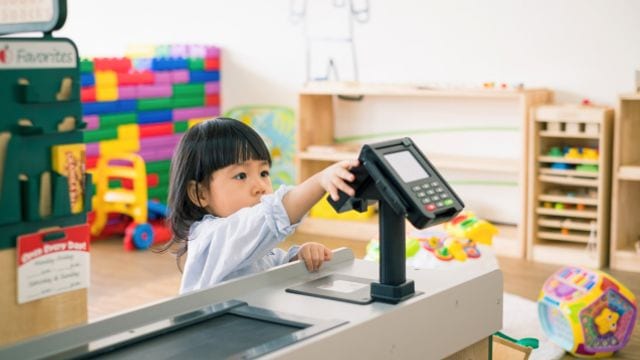
As more parents go cashless, this inevitably shapes the way children may perceive money and affect their spending habits as they grow up. When they see mommy pressing a button to order a new toy online and this toy shows up at the doorstep a few days later, it can be easy for the child to think that that is how one acquires something they want, missing out on the process of the need to earn or save the money first before purchasing something.
The Philippines is not far behind in this cashless phenomenon as a 2024 Visa Consumer Payments Attitude Study found out. According to the study, there is “a notable decline in cash usage to 87%, from 96% in 2022,” among Filipinos especially the younger generation (Gen Y and Gen Z) and the more affluent segment of society. The study further noted that “Filipino consumers are increasingly embracing cashless transactions, going without cash for an average of 10 days. Specifically, card payments usage was at 70% (including swipe/ insert, online, and tap-to-pay/contactless payments) in 2023, while mobile wallets usage stood at 87%, on par with cash transactions.”
This cashless trend, which gained great momentum during the pandemic, is expected to increase even before this decade ends, according to the same study. “1 in 3 consumers (37%) believe that the Philippines will be a cashless society by the year 2030—if not sooner.”
Debit cards, credit cards, and mobile and digital wallets using QR codes are just some of the available contactless modes of payment in the country. While the study says there is still ‘some way to go’ for Filipinos when it comes to embracing cashless payments, there is no arguing about the convenience it brings for families when doing the groceries, shopping, paying bills, and traveling abroad. Given the inevitability of a cashless society, the youngest children of this generation are bound to grow up in an era where money is no longer tactile and piggy banks are a thing of the past. If this is the case, the challenge is how can parents teach the new generation about financial literacy?
Financial literacy in children growing up in a cashless society
An article in the Washington Post poses this question: So what does it mean, then, if many kids aren’t actually seeing money the way their parents once did? Citing the difference among generations, the article elaborates that when GenXers and Millennials were coming of age, they saw their parents paying in cash, counting change at the store, or handing checks at bank counters. Now, this same generation has to teach their kids the value of money in an increasingly cashless landscape. Quoting Jessica Pettelier, a mom of two and executive director of the financial education nonprofit FitMoney, the Washington Post writes that parents have to help kids understand that a gift card or a payment app or even a single tap of the finger can convey the same value as physical money—it may be an a difficult lesson to teach but an essential one.
So where should parents start if they want to teach their children the value of money and how to save in a cashless society? Here are some moves that can jumpstart their financial literacy as they adapt to modern modes of using money.
5 ways to teach children financial literacy in an increasingly cashless society
1. Talk to them about how money is earned and where it comes from.
Tell them about Mommy and Daddy’s job and how the work they do earns them a salary to buy food and other essentials for the family. This way they will understand the process of how money is earned and how it is used to buy things for the home and that, when there is extra, to buy things they want like toys.
You can also demonstrate this better by paying them when they accomplish a chore or have them participate in a garage sale or fundraising activities in school. According to Dan Britton, a financial literacy and enterprise education enthusiast who has posted his articles on Linked In, it is important to “describe to your kids the purchase path or the flow of money; from earning it, to depositing into the bank and ultimately the final purchase and receipt.”
RELATED: These 5 Tried And Tested Lessons Can Teach Your Kids To Be Money Smart
2. Start with physical money and yes, a piggy bank still works.
Teach them that the cards you use to pay for shopping have a physical equivalence. Give them a peso bill and let them know that what they are holding in their hands has worth. Through a piggy bank, you can also set goals to save a specific amount and once that goal is reached, you can bring your child along with you as you put the savings into a bank account to demonstrate how physical money is saved and that they can keep track of their money and their spending online.
3. Consider adjusting your money habits depending on your child's age.
If your child is school-aged, you may want to consider using cash when around them. This can help them grow accustomed to our currency. Using cash will also allow you to practice the age-old life skill of having children pay, receive and count their change, and double-check receipts to learn about money. If your children are older and already very familiar with local currency, you may move on to showing them the movement of money via e-wallets and debit cards.
4. Slowly introduce debit cards or mobile wallets and teach them that there are limits to it, too.
When your kids become teens, you can start introducing debit cards or digital wallets where you can transfer money for their weekly or monthly school allowance. These modes can easily be used to make contactless payments as well as to withdraw cash when needed. This teaches them that once the money is used they have to wait for the next allowance from mom or dad. “These cards can be monitored online and teach the principle that money, whether invisible or not, can only be spent once,” writes Britton.
5. Utilize apps designed to teach children about financial management.
Older children, tweens, and teens may respond well to tech tools to learn financial literacy. This commentary published by Channel News Asia recommends gamified apps to learn about money, like Financial Football and Biz Kids. Teens may learn to manage their allowance via money management apps for teens, similar to an adult's use of money management apps to learn budgeting.
With additional reports by Ronna Capili Bonifacio
More from sp

Lorem ipsum dolor sit amet, consectetur adipisicing elit, sed do eiusmod
Lorem ipsum dolor sit amet, consectetur adipisicing elit, sed do eiusmod
