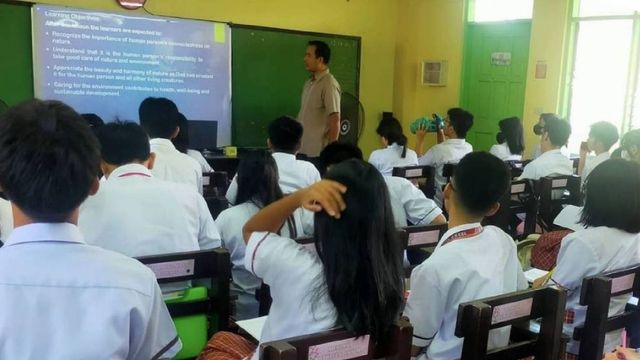
Big changes are underway in the education system, aiming to give Filipino students more freedom through options. In case you missed it, the House Committee just approved House Bill 11213, or the Education Pathways Act, on the final reading. If passed, it could make Senior High School (SHS) optional for qualified students or those pursuing a technical-vocational track.
ALSO READ: DepEd Targets Reduction Of SHS Core Subjects
What is the House Bill 11213 or Education Pathways Act?
You might be wondering: what kind of "pathways" are we talking about? Under HB 11213, students graduating Junior High (Grade 10) will have the option to choose between two distinct paths: a University Preparatory Program under the Department of Education (DepEd) or a Technical-Vocational Program overseen by the Technical Education and Skills Development Authority (TESDA).
If they choose the latter, TESDA will take over, offering industry-driven programs designed to make students job-ready with real-world skills. This marks a major shift from the current K-to-12 system, where all Senior High programs, including vocational tracks, fall under DepEd's jurisdiction.
So, What's Changing?
TESDA is set to take on a larger role, planning to partner with industries to align its programs with job market demands. This could mean more apprenticeships, hands-on training, and updated courses to keep up with evolving skill sets. The goal is for students to learn beyond the basics and gain practical experience that makes them employable right away.
For those who still want to pursue college later, the bill provides a path. If a student completes a TESDA program or earns a certification of eligibility, they can enroll in colleges and universities under a ladderized education system, provided they pass the Philippine Educational Placement Test or an equivalent assessment conducted by DepEd for Grades 11 and 12.
Meanwhile, students who choose the college prep route will follow DepEd's University Preparatory Program, a comprehensive curriculum for Grades 11 and 12 designed to prepare them for college admission. DepEd is also expected to collaborate with the Commission on Higher Education (CHEd) to keep things aligned with college expectations.
The bill also requires DepEd to conduct regular assessments, like the Early Language, Literacy and Numeracy Assessment and National Achievement Tests, to help students and parents make informed career decisions.
What Does This Mean for K-to-12?
This bill reignites debates over whether the K-to-12 system has actually benefited students. While the additional two years were meant to help students compete globally, concerns over job readiness and educational quality persist.
Reports show that despite the extra years, many senior high graduates still struggle to find employment. Moreover, some K-to-12 graduates who took the technical-vocational track find themselves in limbo, lacking both a solid career path and access to further education.
Over the years, there have been calls for the government to reassess the effectiveness of the K-to-12 program. One major issue was that Filipino workers previously lacked two years of academic experience compared to international counterparts, as many countries operate on a 13-year pre-university system. However, results from global assessments, like the 2023 Programme for International Student Assessment (PISA), showed that Filipino students still lag behind in mathematics, science, and reading—five to six years behind their 15-year-old peers in other countries.
The bill has already passed on third and final reading in the House of Representatives with overwhelming support. The next step? Getting Senate approval and seeing how it plays out in practice.
Click here for a checklist of essential math, reading, and other skills your child should learn, according to DepEd.
More from sp

Lorem ipsum dolor sit amet, consectetur adipisicing elit, sed do eiusmod
Lorem ipsum dolor sit amet, consectetur adipisicing elit, sed do eiusmod