
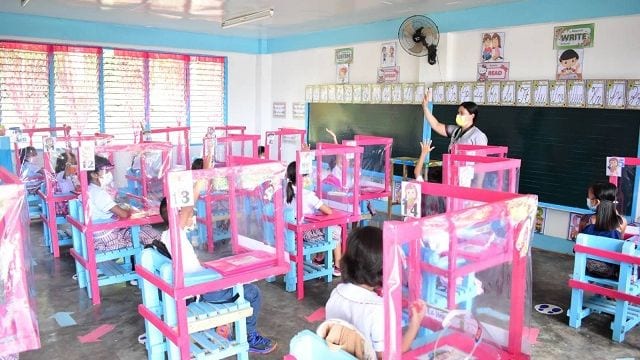
The Philippine education sector has taken steps to adapt to the effects of COVID-19. However, World Bank studies show the country's learning poverty worsened in 2021 when online classes and hybrid learning is still being implemented.
What is learning poverty?
According to World Bank, learning poverty levels are measured by the number of kids age 10 "who cannot read and understand a simple story by the end of primary school."
Just recently, the financial institution published twin reports, which tackled the implementation of new forms of learning while schools are shut down in various countries. The report titled, "Remote Learning During COVID-19: Lessons from Today, Principles for Tomorrow," showed that the Philippines' learning poverty went up to 90 percent this year, along with Ethiopia.
A report by Inquirer found that in 2019 or pre-pandemic, the learning poverty level in the country was at 69.5 percent. This means that there are now more Filipino children aged 10 who cannot read nor comprehend a simple story.
Factors affecting learning poverty during pandemic
The World Bank pointed out different factors as to why online classes do not prove to be effective in some countries like the Philippines. Among the factors is the participation of parents or guardians in the child's learning.
As of March 2021, lower engagement among kids was observed among households "where parents or caregivers lack any type of education."
"These children were three-to-four times less likely to engage in a learning activity compared to households where parents have tertiary education as seen in the Philippines and Peru," the World Bank report stated.
Another factor is access to devices and services vital for the implementation of remote learning. The report titled, "Remote Learning During The Global School Lockdown," shows that while mobile access in the Philippines is at 88.8 percent only 26.9 percent have Internet access.
How to improve remote learning?
In the Philippines, the government has started to reopen schools for limited face-to-face classes in areas with low risk for COVID-19 in November 2021. However, even the Department of Education has made it clear that hybrid learning will remain in the foreseeable future given that physical distancing has to be implemented.
This is also World Bank's prediction saying, "while remote learning has not been equally effective everywhere, hybrid learning is here to stay."
With this, the organization has offered five ways that aim to improve the implementation of remote learning while there is still the threat of COVID-19:
- Ensure remote learning is fit-for-purpose.
- Use technology to enhance the effectiveness of teachers.
- Establish meaningful two-way interactions.
- Engage and support parents as partners in the teaching and learning process.
- Rally all actors to cooperate around learning.
It must be noted that the World Bank acknowledges the role of parents to make remote learning work and benefit the children.
"It is imperative that parents (families) are engaged and supported to help students access remote learning and to ensure both continuity of learning and protect children’s socioemotional well-being," World Bank said.
Click here to read tips on how to survive remote learning from a mom-teacher.
What other parents are reading

Lorem ipsum dolor sit amet, consectetur adipisicing elit, sed do eiusmod
Lorem ipsum dolor sit amet, consectetur adipisicing elit, sed do eiusmod
