‘If Family Time Becomes Phone Time, Then It’s Not Really Family Time’
Singapore launches a nationwide movement to help families build healthy screen habits. Here’s what Filipinos can learn.

Published on Jun 4, 2026
On May 31, Singapore’s Prime Minister Lawrence Wong launched a nationwide movement called “Screen Smart from the Start,” aimed at helping families build healthier screen time habits. The program was launched just in time for the National Family Festival.
The program was created in response to a survey they conducted last year, which found that only 37% of Singaporean parents felt confident managing their children’s online lives. This meant that more than half of the population wanted and needed some form of external support.
The program, “Screen Smart from the Start,” is a direct action by the Singaporean government to consolidate and provide parents with the right resources they need to protect their children’s digital lives. “Many parents want to do more, but they don’t know where to start,” he said.
What is 'Screen Smart from the Start' by the SG government?
The first part of the campaign is the Be Screen Smart portal, a website where guides on how to build healthier digital habits are posted for every age group. It has everything from recommended screen times and guidelines on how to curate the online content your kids have access to, to house rules that can help create an environment that is not dependent on an online life.
He mentioned some helpful rules, such as zero screen time for infants, establishing a no-phone policy during mealtimes and an hour before bed, and keeping phones out of the rooms where children sleep.
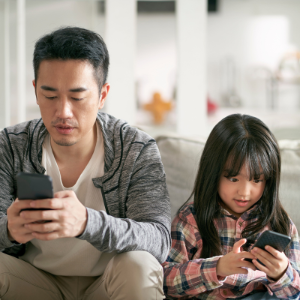
Parent's Guide To Digital Parenting
From understanding digital citizenship to setting up parental controls, parents' roles are vital in today's digital age.
READ HEREImplementing these habits early on, he says, will create an environment in your home where your children will grow up having a healthier relationship with their gadgets. He also mentioned, quite obviously, that parents should delay giving their children smartphones for as long as possible, and that young kids should start with “dumb” phones to instill in them the true use and value of a phone—to communicate.
The prime minister also acknowledged that this growing problem caused by digitalization is not a new one. He said that in the past, earlier generations of parents used to worry about comic books, then video games, and later too much television. This gadget addiction is not any different.
He has, however, noted that today’s parents have it a little harder, given the addictive features of social media apps and the very real problem of toxic online interactions, such as cyberbullying and online predators targeting innocent children.
But of course, limiting the use of gadgets in the home has to go hand in hand with creating offline activities. “You cannot just curb the use of devices and then leave a vacuum. As we limit screen time, we also need to have more time together as a family,” the prime minister mentioned.
What is SG doing to help families curb kids' screen time?
In this regard, the government promises to do its share—to create more family-friendly third spaces such as parks, museums, and libraries, and to support families with practical resources by providing books on digital wellness, creating more programs, and offering offline activities just in time for the June school holidays.
One of these activities, of course, is reading. Programs such as themed storytelling sessions organized by the National Library Board will be available, and the launch of the Book Bugs program is set for August this year. The program allows kids to borrow library materials, earn points, and collect cards the more they borrow and participate.
Aside from the portal launch and the provision of resources, the Singaporean government has also implemented several helpful policies. It has banned the use of smartphones during school hours, and new policies are being developed to tighten the safeguards of children’s access to social media platforms and other online spaces.
The portal will also provide a space for parents and families to build online communities, and it aims to create a network that involves community organizers, corporate partners, schools, and more in building a strong support system that involves everyone.
What Filipinos can learn from the Singaporean government
So what does this mean for us Filipino parents? Aside from being able to access the Be Screen Smart portal for free and make use of its resources, we can also take the prime minister’s advice.
Let us set newer, stricter house rules as the digital world becomes more and more predatory, explore more offline family activities, campaign for tighter security policies online, and build our own communities of support with fellow parents, community organizers, child experts, and schools.
In Wong's speech at the launch of 'Screen Smart From The Start', he encouraged Singaporean parents to keep family meal times sacred and phone free. "You have protected family time but during protected family time, please do not use phones... If family time becomes phone time, then it's not really family time."
"With these strong foundations, hopefully it becomes easier to manage screen time when children get older," Wong said in his speech. "Of course, eventually they will have their own phones. They will have their own smartphones. But we want to instill in them the confidence and the values to navigate the online world responsibly and safely."
Hannah is a contributing writer for Smart Parenting and an educator. When not writing, she loves reading, taking cat naps, and people-watching as she invents little stories about them in her head.