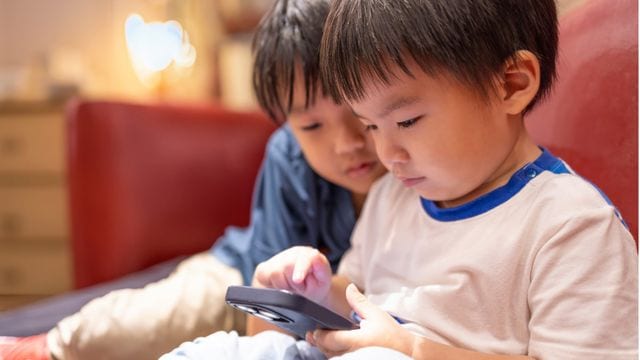
Hi, Parent,
I know this does not reach you well: you’re exhausted. But if you have the time, please read me out. I write to raise the alarm on the effects of screens and social media on our kids. I write to share our own struggles and maybe help a few of us along the way.
My son was born in 2011 and he was immediately socialized to an iPad. With hardly an intelligible word out of his mouth, he knew which buttons to push and how to make his toddler apps work. He loved the puzzles, the flash cards, and the songs on YouTube — and we loved seeing him learn.
At 16 months, we took him on a long-haul flight, and having the iPad onboard was crucial. His pediatrician, a tall, well-dressed, loquacious man, had surprisingly little to say about screens. He did caution us that the science on it was still coming together.
When my son turned five and his sister three, both were happily swiping at an iPad, slicing up fruit and launching excitable birds from a catapult. It was around this time that my wife, who does communications and media research, first learned about the ill effects of screens (and social media) on children and teens. It was worrying enough that we started limiting our children’s use of the iPad (which led to unhappy children). Soon, more research pointed to even worse effects, and we somehow slimmed down screen usage in our household.
Fast forward to 2019, and the pandemic happened. Students, including my kids, were locked down and forced to take online classes. For two whole years. The unintended consequence? A fully-digitized student life, and the hardening of an already problematic relationship with screens and social media. My kids were on screens for at least six hours a day.
And, at that time, many already knew that screens and social media were bad for our kids. In a 2020 survey of American parents, 66% say parenting is harder than two decades ago, with many citing technology and social media as the reasons why.
Now, 2024 and what was once mounting evidence has become a mountain. Excessive screen usage can: limit a child’s ability to develop optimally, lead to childhood obesity, poor language development, sleep disorders (especially among young adults), and mental health conditions including depression (again, especially among young adults).
We now also know how social media content amplifies inadequacy and extreme self-loathing, and erodes self-esteem, especially among teens.
Still, there are some things I found most other parents do not know. First, excessive screen use obstructs a child’s ability to properly interpret emotions. During the pandemic, when my daughter was going through grades 1 and 2 online, it was clear that she could not develop any relationships with any of her classmates or her teachers. They were just images on a screen, barren of any emotion.
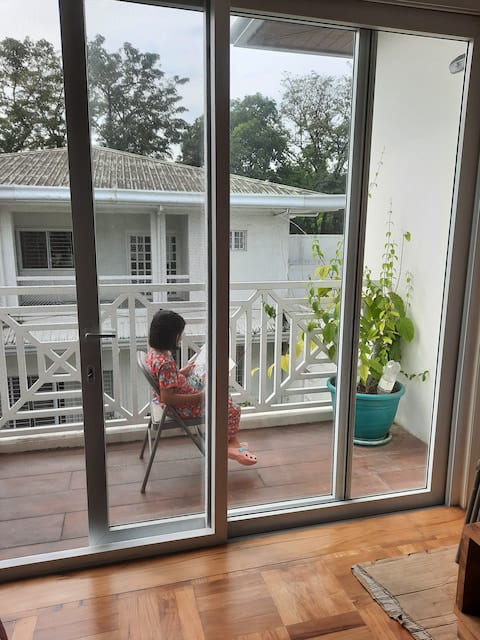
Not having any real connections with her classmates and teachers online, our seven year-old child started reading to a plant during the second year of lockdown.
And, I found my kids developed a peculiar anxiety we’d only recognize among adults who worry about a late night email from their boss; my kids found it hard to untangle their lives from devices. They started paying more attention to their screens than to us human beings. Remember when we got out of school at 5 PM and we wouldn’t hear from our teachers until the next morning? That freedom no longer exists for our kids. Schools — from teachers to group mates, from gossip to bullies — now have access to our kids 24/7. Just like our work often does. And, that’s pretty bad.
Then, of course, there’s all the garbage online. So many times I’ve spotted and reported racist, sexist, and patently offensive content I find on Facebook and Instagram — posts I know will harm any child — only to find Meta thinks that that content is, well, okay by their “community standards”. That’s not the community I want raising my children.
Now, I want to talk about academic outcomes. PISA scores from 2018 and 2022 have Filipino kids at or near the bottom in Math, Science and Reading among 81 countries. The DepEd calculates our students are as much as six years behind.
More significantly, the study found that globally, scores are all in decline. There are many reasons, but the PISA report sure thinks phones are the main culprit. I’ll quote from a recent article in The Atlantic:
PISA finds that students who spend less than one hour of “leisure” time on digital devices a day at school scored about 50 points higher in math than students whose eyes are glued to their screens more than five hours a day. This gap held even after adjusting for socioeconomic factors (emphasis mine).
In sum, students who spend more time staring at their phone do worse in school, distract other students around them, and feel worse about their life.
Recognizing the harmful effects of both screens and the social media they ferry, schools and governments have started to act. In the UK, the Online Safety Act requires social media platforms to shield children from harmful content or face steep fines.
In the U.S., the federal government has issued a public warning about social media, with the Surgeon-General adding “There are ample indicators that social media can also have a profound risk of harm to the mental health and well-being of children and adolescents.” You can read the full advisory here. The State of Utah has banned social media for kids in their state.
UNESCO has called for a global ban of smartphones in schools. In Vietnam, only students in middle and high schools are allowed to use smart phones, and only with the teacher’s permission. (Vietnam has consistently outperformed many developing countries and even wealthier countries in PISA assessments.)
Elsewhere, France and the Netherlands will have fully banned smartphones in schools by the end of 2024. Italy and China have also banned phones in classrooms. In Spain, there is good evidence that their school cellphone ban has reduced cyberbullying and improved grades in math and science. A study in Norway yields similar results, noting that a reduction in bullying targeting female students was “particularly pronounced”.
But everyone knows kids are too smart to be policed that way. They will find a way to get online. After all, these devices and their content are designed to be as addictive as possible. So, parent to parent, I’m sharing a few things that have worked for us, so far:
First, tell your kids everything I said above. Try “I just learned how bad screens are for you, and now I think you should learn it too.” Or, “We made a mistake in letting you use your devices too much. We’re sorry. Now, let me explain why.” Tell everyone at home too.
I always remind my kids to “pay attention to what they’re paying attention to”. I tell them that the people that “talk to them” on YouTube don’t see them. They don’t see that they’re talking to kids. And, frankly, if those TikTokers were in our house and I heard them talk that way, I would ask them to leave.
Second, be ruthless with how your kids spend their time on screens. You are central to their access. No screens at sundown, but give them something else to do. Bug their devices with monitoring apps (and use their hours to negotiate chores if you want). More importantly, know what they’re on, when they’re on it and who they’re on with. The comment sections are a no-go zone. Can’t chat with strangers, even about opening moves on chess.com. I know everything about chess from Netflix and that’s enough to crack on.
I know books can get expensive, but reading pays off immensely. Pay them with “screen credits” to read if you need to. One Christmas break, I gave my kids a reading list to finish for “iPad time”. Years later, they bring books everywhere they go, read while waiting (at the airport or for their ramen), and end the day with a book before bedtime. No bribes necessary.
Third, is the hardest: be the screen time for your kids. A half-hour at a time. If you’re having a conversation with them, that’s time they’re not on a screen. Start with “What was the highlight in your day so far?” Or, “What made you sad today?” Recruit the lolos and lolas to do the talking too. Tell them if they’re disappointed with how you turned out, well, this is their chance to shape the next generation.
During the pandemic, I introduced my kids to my hobby of playing board games. I felt it was perfect: board games were analog, cognitively challenging, and allowed us to socialize. That proved to be a success. My son, now 12, used to moan about not having a Nintendo Switch. Now, all he wants for his birthday is a board game.
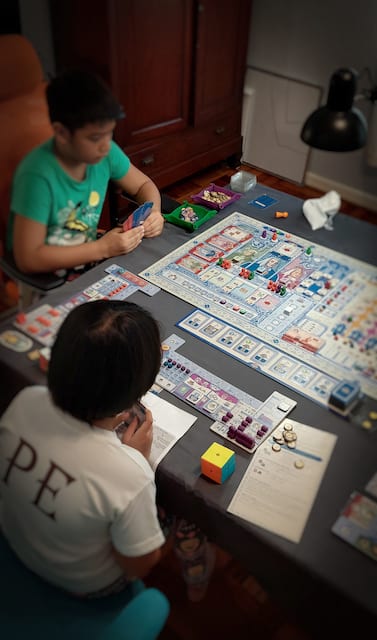
Contemplating a play. Board games promote literacy, teamwork, strategic thinking, and is great for boosting confidence, and learning how to fail. And, of course, family bonding.
Finally, maybe we can push our schools to be less reliant on digital devices and platforms. The pandemic is over, so we can let go of our pandemic solutions. Easing them off online platforms and messaging systems would relieve the digital burden on our children, and help wean them off devices. A new, groundbreaking study from Columbia University shows kids read better on paper than off a screen. So, maybe it will improve their grades; surely it will improve their mental health.
Does it work for us? I think it does, but it takes constant parenting — vigilance, creativity, and reinforcement — to make it stick. So far, both kids do well academically (>98 percentile in Math, Reading, Science), and will pick math as their favorite subject (none of their parents do!). They display good social skills (one is class president, both comfortable talking to adults and in front of an audience) and are creative in their play (they love their sticks and their rocks). More importantly, they know the effects of devices and when to put them down.
I want to end by saying I know not every parent has the time and resources we’ve had. I’ve spoken to parents who can’t offer any alternatives to their kids’ screens. They recognize the problem and feel powerless fixing it. Starting kids into arts or sports can be expensive, but maybe you can get them to help you in the kitchen? My kids have learned to love folding clothes and stuffing them into our closets. Have a rule where you can’t use devices in certain parts of your house, like on the dining table. Talk to other parents in your neighborhood and start a small library of books, games and jigsaw puzzles. Every hour they’re not on a screen counts.
So, tl;dr, excessive screen time is bad for our kids. Its effects are alarming, and we need an intervention: take back our kids’ math scores and their mental health.
Parenting is exhausting. Still, know that you’re not alone in the struggle, reach out, and remain focused on — and reward — the effort. The upshot will be there.
Yours truly,
A parent like you.
P.S. Ice cream helps.
P.P.S. A week after I wrote this, New York City “designated social media a public health hazard” citing its effects on mental health, comparing it to tobacco and guns.
*Originally published on Medium, republished with the author's permission.
What other parents are reading

Lorem ipsum dolor sit amet, consectetur adipisicing elit, sed do eiusmod
Lorem ipsum dolor sit amet, consectetur adipisicing elit, sed do eiusmod