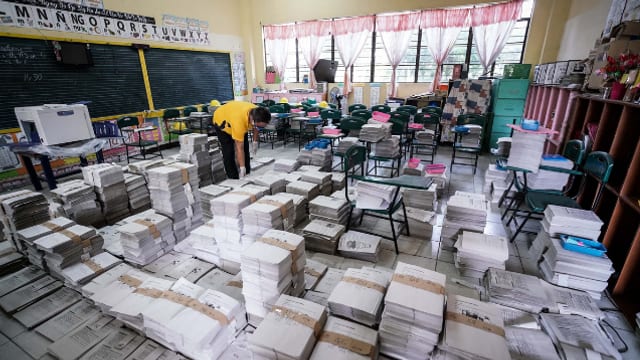
The Department of Education confirmed 155 of the 163 errors in learning materials reported to the agency between October 2020 to June 2021 during a hearing with the House Committee on Public Accounts at the House of Representatives.
A vulgar word for sex in Filipino in a Grade 10 learning module was among the errors that learners had to contend with this school year.
“Ang aswang ay pinaniniwalaan na ito’y tao na kumakain ng kapwa tao, kung minsan ang mga ito ay pinaniniwalaan ng may mga pakpak at sila daw ay gising kug gabi para maghanap ng mak****ot or maaswang,” the module read.

Other errors were not as obscene, though. One learning material labeled the image of an owl as an ostrich, while another said the liquid inside a thermometer was water instead of mercury.
DepEd Undersecretary Diosdado San Antonio said 104 of the confirmed errors came from learning materials produced locally, meaning in the regional divisions. These errors are then given to the unit that produced them for correction, he said.
San Antonio added the DepEd already issued an errata for the 155 errors. The material that included the vulgarity above was recalled as early as February. He assured lawmakers that the DepEd has a process to correct these errors and promptly do so.
Additionally, DepEd Undersecretary Tonisito Umali assured that most of the errors are a matter of editorial issue rather than a factual one.
“While there may be errors such as spelling, it is our humble view that many of the words and phrases considered by the audit team to be notably erroneous are matters of usage and editorial preference,” Umali said, reading from a letter previously submitted to the Commission of Appointments.
This congressional hearing wasn’t the first time that the DepEd was called out for errors in its learning materials.
In 2019, the COA already called the DepEd out for the errors in learning materials worth P254.253 million distributed to Grade 3 pupils.
“The existence of error-filled learning materials is an indication that the meticulous checking, review and evaluation processes of the manuscripts were not undertaken by the concerned bureaus before [their] mass production,” said a 2019 Inquirer.net report citing the COA letter.
If you've spotted textbooks with questionable content, report it to DepEd by emailing action@deped.gov.ph or lodge your complaint here.
What other parents are reading

Lorem ipsum dolor sit amet, consectetur adipisicing elit, sed do eiusmod
Lorem ipsum dolor sit amet, consectetur adipisicing elit, sed do eiusmod