
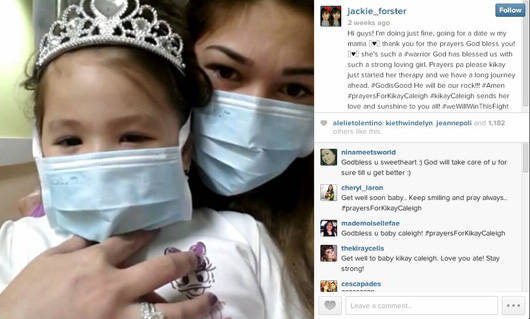
In late February this year, former actress Jackie Forster revealed in an Instagram post that her three-year-old daughter Caleigh has been diagnosed with leukemia. She called upon family and friends to storm heaven with prayers that her child would be strong and to recover.
Related story:
• Texan Community Reaches Out to 10-year-old Leukemia Patient
• Breastfeeding Healthy for Women who are Childhood Cancer Survivors
"Our dearest Caleigh has leukemia and she has started chemotherapy yesterday, this will be a long battle but it’s a battle We Will Win!” Jackie said. “She has been through a series of tests and transfusions the past 3 days so I would just like for us to pray together for her journey to be as easy as possible on her and that Victory will be ours!”
How exactly does one, especially a child, become afflicted with leukemia? What does it do to the body? How is one treated for it? We sought the advice of experts to shed light on this matter.
What is leukemia?
“To understand this entity, one must look at the normal function/physiology of the blood,” says Dr. Manolito H.Libongco, MD, FPCP,FPSHBT, a consultant in internal medicine, adult blood cancer and diseases.
“Blood is composed of three kinds of cells that have a life span with their particular functions, 1) red blood cells which deliver oxygen from the lungs to the different organs and tissues, 2) white blood cells which put up the defense of the body against infections, and 3) the platelets which plug up holes in the circulatory system to avoid loss of blood.”
Our bone marrow (our blood factory) normally produces trillions of blood cells each day to replace those which have died and have been used to maintain homeostatis, our body’s sense of equilibrium, explains Dr. Libongco. But when this system is disrupted, it will then cause leukemia.
“Leukemia develops when progenitor (ancestor or parent) cells mutate and lose its control mechanism to stop dividing,” he illustrates. “It divides into numerous useless immature cells (younger versions of the white blood cells) called ‘blast’. These cells are ravenous, having the capability to grab nutrients from the normal cells and grow and multiply until they overcome the bone marrow.”
“The myelocytic type is the most common in adults. Acute lyphoblastic leukemia (ALL) is the type that is common in children and carries a significant cure rate with treatment.”
How do you get leukemia?
You can get leukemia when you’re exposed to chemicals or radiation that may have caused your DNA to mutate. “Benzene-containing chemicals, industrial solvents, and alkylating (DNA-damaging) substances are some examples,” expounds Dr. Libongco. “Avoiding cancer-causing habits, like smoking, can also prevent the development of this dreaded disease.”
Are there risk factors we should take note of?
“There have been risk factors that were noted [in past studies],” says Dr. Sally Gatchalian, pediatrician and director of the Philippine Foundation for Vaccination, “like constant exposure to insecticides or, in some cases, a previous, severe infection. But generally, [it is] more genetic [in nature].”
[previous|page|next]
What are some of its symptoms in children?
“The symptoms are very non-specific. They can have bone pains, or they can have on and off fever, and you don’t know what’s causing it,” explains Dra. Gatchalian. “They can even have fever and pneumonia, so you’ll give her antibiotics. You’re giving the right medication and yet the child does not recover. They can have poor appetite, they can have weight loss. And sometimes, when you’re suspicious, you take a complete blood count, (CBC). That’s how you’ll see that there are ‘blasts’.”
What are the effects of leukemia on the body?
When less red blood cells are produced by the body, it causes anemia, which usually manifests in in a person being pale and weak. The white blood cell count also goes down, making one more prone to infection. The amount of platelets produced also goes down, causing abnormal bleeding in areas of the body such as in the skin, gums, and almost every other part of the body, in extreme cases.
“The problem with leukemia, and with any other cancer for that matter, is that you are very prone to infections,” points out Dra. Gatchalian. “This is because the immune system gets depressed.”
What is the prognosis for leukemia?
Left untreated, leukemia commonly leads to death in six months. For patients undergoing chemotherapy, they have a better chance of surviving, but with a small chance of cure.
“In children especially, the ALL subtype carries a significant cure rate with chemotherapy depending on the prognostigation (a doctor’s way of ‘predicting’ the outcome based on current signs or findings) data on diagnosis,” says Dr. Libongco.
Meantime, the best chance for recovery for those with Acute Myeloid Leukemia is to have a bone marrow transplant. This is recommended especially for those younger than 50 years old, or those who did not do so well during the first round of chemotherapy.
Those with chronic or recurring leukemia, on the other hand, are treated differently. “Usually the treatment is less aggressive, depending on the stage,” Dr. Libongco posits. “Oral preparations of treatments are available and can be done at home. Life expectancey is longer in untreated cases; two to four years and improves with treatment.”
Next story: 10 Doctor-Approved Home Remedies for Common Child Diseases
Photos from Jackie Forster’s Instagram account, @jackie_forster

Lorem ipsum dolor sit amet, consectetur adipisicing elit, sed do eiusmod
Lorem ipsum dolor sit amet, consectetur adipisicing elit, sed do eiusmod
