
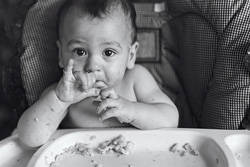
 The concept of baby sign language has been around since 17th century linguist William Dwight Whitney noticed the remarkable communication abilities of children with deaf parents. However, it was not until circa 1987 that the study of baby sign language began, when mom and professor Linda Acredolo started noticing her one-year-old daughter making up her own baby signs. Together with Professor Susan Goodwyn, Linda’s research partner at the University of California, they began studying the phenomenon; the result of which was over 20 years of research and the first edition of the book Baby Signs in 1996. Most of the tips I will be sharing with you come from the 2002 revised edition of this book, and also from our family’s own experience with using sign language to communicate with our 2 children.
1. Know when to start.
Acredolo and Goodwyn say that there is no specific age at which we can say all babies are ready to learn baby signs. Each child has his or her own timetable based on his or her experiences, interests, and rate of development. However, based on their research, it is safe to say that most babies start becoming interested in baby signs between nine and twelve months. What is most important though is that parents watch for when their babies develop an interest in communicating, as this is a good sign that they are both willing and able to begin benefiting from baby signs.
Some indicators that baby is interested in communicating are:
• Baby begins pointing to things.
• Baby brings toys and other objects to you, holding them out for you to see as if requesting you to label them.
• Baby begins to focus his or her attention on looking at pictures in books and other printed materials.
When our eldest was about a month old, I read a book on child care that had a short section about baby sign language. That’s when I first got interested in teaching my kids to sign. When he was about six months old, the age when he began eating solids, we started modelling simple signs like “eat” (place fingertips to lips), “more” (tap fingertips together) and “drink” (place thumb to lips) to him. To our delight, he began signing back at eight months old. We eventually started teaching him more simple signs and he quickly learned to model and use each one.
For our second child, she started modelling back signs at ten months old. This does not mean that her older brother is more “advanced” than her. It simply emphasizes the fact that each baby is special and develops at his or her own pace. Remember, the rate at which our children develop should not be compared to other children’s; child development is not a competition or a race. When it comes to baby sign language, this is also the case. Focus on your child’s readiness to communicate, have fun, and the rest will follow.
Click here to see more ways to teach your baby to sign.
[previous|page|next]
Read on to see more ways to teach your baby to sign.
2. Start small.
If you and your child are new baby signers, it is best to start small and begin with a few signs. This is more for your benefit than your baby’s – you need to get used to modelling the different signs to your child and form the habit of using a particular sign whenever the timing is right. Once you are used to modelling signs, it is up to you to decide how quickly you want to teach additional signs to your baby. If you feel that he or she can get used to learning more signs at a rapid pace, then feel free to use and teach as many as you want. Usually baby signers pick and choose signs that they feel will serve them best.
For our two children, the signs we started with were usually related to mealtimes - “eat,” “more,” “drink,” “milk” – and simple-to-remember-and-model ones such as “please,” “thank you,” “bye,”“hi,” “ball,” “baby” and “book.” We also modelled “mother/Mama”, “father/Papa”, “dog,” “cat” and “water” to them. (You can try these out with your kids too – see image below taken from www.babysignlanguage.com)

Say and sign words consistently.
Click here to see more ways to teach your baby to sign.
[previous|page|next]
Read on to see more ways to teach your baby to sign.
3. Always say and sign the word.
Baby sign language is our way of helping children learn to speak, as studies show that baby signers usually acquire the skills needed for speech more easily than children who don’t use baby signs. Because of this, it is crucial for parents to say the word as they make the sign. This way, the child is able to connect the word with the baby sign. As Acredolo and Goodwyn say, “using Baby Signs is a way to help your baby `talk’ by providing him with a choice. When he hears the word and sees the sign he has two options available instead of only one.” There are some words, like “ball” or “bye” that may be easier for Baby to say, and other words like “bird”, that may be more difficult. In the latter case, your baby may opt to use the sign for bird rather than say the word. Therefore, when you use baby signs and words together, you give Baby two options on how to express herself.
4. Repetition is key.
As most of us already know, repetition is crucial to learning. Therefore, the more your baby sees a sign (and hears the word for the sign), the easier and faster it is for him to learn it. Whenever you do a sign, repeat it several times for emphasis. In the same way that we usually repeat words when talking to babies, we should also repeat signs. For example, when you point to a dog walking on the sidewalk, we usually say “Look there’s a dog! See the cute dog? See the dog walking? What sound does the dog make?” Repeating the word helps Baby remember which word is the most important one, and which word should be remembered. When teaching baby signs, do the same thing. In a situation such as the one described above, use the sign for “dog” each time you use the word. Soon baby will discover the unique relationship between the sign, the word, and the object. Learning will then have taken place.
5. Point when you can.
When you are teaching a sign for a particular object like a dog or car, it is always helpful to point to the object as you are saying the word and making the sign. If you are going to repeat the sign or word a few times, repeat your pointing to the object too. This will make the connection between the sign to the object, the word to the object, and the sign to the word easier for your baby.
Teaching your baby by pointing to objects and saying the words for them is usually among the first form of “education” that parents give their children. Adding a sign to our “pointing and saying” helped my husband and I facilitate learning for both our children, and has helped communication within our family a whole lot easier.
Click here to see more ways to teach your baby to sign.
[previous|page|next]
Read on to see more ways to teach your baby to sign.
6. Guide your child’s hands, when necessary.
If you feel that it will be easier for your child to learn a particular sign by guiding him, Acredolo and Goodwyn suggest that you gently manipulate your baby’s hands to help him get the feel of the motion. Do not forget though that there are some babies who prefer to be independent at times, and they may prefer to do the sign on their own. Pay close attention to your baby’s response to ensure that she welcomes the help that you are giving her.
7. Incorporate baby signing into your daily routines.
Try to build baby signs into your baby’s daily routines: mealtimes, bath time, play time, diaper changing and washing time, and bed time. You can try hanging pictures around the house or labelling objects to help remind you to use the word and the sign for each object. Using picture books and other items that may be decorated with pictures of that certain object may also prove to be helpful.
Ensuring that your baby gets lots of exposure to the signs that you are trying to teach them will help make learning faster and easier. Involving other members of your household in teaching Baby how to sign, like his grandparents, nannies or siblings, will also help make things easier for everyone in the long run.
8. Look for signing opportunities.
To truly understand a word and the concept it stands for, a baby has to connect the word to the many different things it can stand for. For example, dog could stand for the toy puppy and the picture of the golden retriever, as well as the stray dog that likes to come around the house for scraps of food. In order for your baby to learn that the sign for dog stands for all dogs – whether real dogs, toy dogs, pictures of dogs – you must use the sign for “dog” whenever you have the opportunity to do so. Repeating a sign every time you encounter a different “version” of the same concept or object teaches Baby that baby signs can refer to any member of a category, just as words do.
In our family, we usually use the sign for “more” not just when it comes to food, but also when Baby wants to play with a certain toy again, or read a special book one more time. We even use it when we shower her with hugs and kisses, or tickle her. Always be on the lookout for opportunities to model the signs you want your baby to learn.
Click here to see more ways to teach your baby to sign.
[previous|page|next]
Read on to see more ways to teach your baby to sign.
9. Be flexible and patient.
With baby signs, unlike a formal sign language, like the Filipino or American Sign Language (FSL or ASL respectively), there are no rights and wrongs. You can use whatever makes sense and is helpful to both you and your baby. You can even make up your own signs! What is important is that Baby will be able to imitate your motions easily. Being flexible means knowing how to pay attention to physical behaviours Baby can already do, and taking advantage of these for creating new signs. If there is a certain sign in the ASL that is difficult for your baby to imitate, feel free to modify it to make it easier for him.
Patience is also a helpful characteristic not only in most aspects of parenting, but also when it comes to using baby signs. Remember that your baby may not be able to sign back as quickly as you’d like him to. According to Acredolo and Goodwyn, it can often take a month or longer before your baby will start signing. In this case, be patient, as once Baby begins to use signs, you will realize that it was worth the wait.
10. Make learning fun.
Children learn through play and interaction with their loved ones. That is why I usually say that homeschooling already happens right after Baby is born – when mother puts the child at her breast and guides him on how to latch on, learning is already taking place! When we respond to Baby’s cries and pick her up to soothe her, change her or feed her, we are teaching her the basics of love. Thus, learning is a natural part of everyday life. When it comes to teaching your child baby signs, make sure that you make it fun for him. Use lots of praise, encouragement and enthusiasm. Take note of and reward their early efforts, and do your best not to show signs of displeasure or disappointment when they fail to meet your expectations. The more enthusiastic you are about using baby signs, the more enthusiastic a learner your baby will be.
Remember, moms and dads, your baby will learn the most when he or she is surrounded by happy, loving and caring people who are willing to make time for him or her. So, make the most of your daily time with your kids and try to include baby signs in your family’s life. You won’t regret it! Happy signing everyone!
For more information on baby signs, or to get a list of baby sign language classes in the Philippines, you may contact the author at teachermamatina@gmail.com. Or get your own Baby Signs starter kit here.
Main photo from flickr.com

Lorem ipsum dolor sit amet, consectetur adipisicing elit, sed do eiusmod
Lorem ipsum dolor sit amet, consectetur adipisicing elit, sed do eiusmod
