
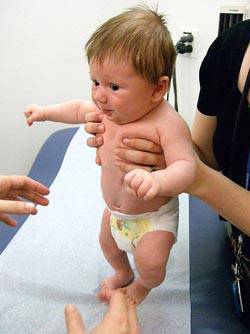
 Bowleggedness, known as being sakang in the vernacular, is a very common and normal condition in the first 2 years of life. During baby’s stay inside the womb, his body is folded in many different places so that he can fit inside the tiny swimming pool which is his home for 9 months, and the first few weeks after birth are the time for adjusting to new surroundings and developing his body.
Often, our elders would give advice to prevent baby from becoming sakang. Some of the more common suggestions are: not placing baby in a carrier, not having baby wear bulky diapers, and not carrying baby with legs wide open. To date, there are no studies that prove these to be true.
It was an old belief that a hilot or a traditional faith healer is able to do his magic on the sakang to straighten it out. The bowleggedness indeed straightens out, but whether it is the work of the faith healer or its ability to self-correct, we do not really know. There have been no studies that prove or disprove the magic of faith healers.
Genu varum is the medical term for bowleggedness, where the legs appear to have an exaggerated outward bending starting from the knees downward. Dr. Charles Villamin, Orthopaedic Surgeon at the University of Santo Tomas, Department of Orthopaedics tells us that “Genu varum is a common pediatric deformity. The legs of most newborns are typically bowed. When the infant begins to walk (between 1 -2 years old) the bowing may appear more prominent which prompts parents to seek consult. At this age though, it is unnecessary to be alarmed since there is usually a spontaneous resolution of the bowlegs at 24 months of age to normal alignment after 3 years of age. “
In more severe cases where the bowleggedness is more than 20 degrees bent and persists until after 3 years old, it is best to have your pediatrician examine it. Most often, a referral to a Pediatric Orthopedic Surgeon is needed. These conditions may require additional work-up like X-rays, aside from the routine history and physical examination. A proper diagnosis by your doctor must be made so that proper treatment can be done, and depending on the severity of the case, surgery may be recommended.
[previous|page|next]
“If bowlegs do not resolve at 3 years of age, x-rays maybe necessary to assess the knee. Local chiropractors or "hilot" are not necessary and will not help normal knee alignment. Orthoses (ie. braces) may be helpful at the age of 3 but must be done undetr the close supervision of your doctor. Surgery is reserved for progressive and/or severe deformity of the knee,” says Dr. Villamin.
Hilot as a massage, however, is beneficial to your baby in a different way. The technique of the massages strokes are not as important as the loving bond that is created between the parent and the child. It is a necessary part of developing attachment between the child and parents. It is the beginning of communication between you and your child. Because you make him feel secure, the child learns to trust you and develops an emotional tie to you. The child's response to those feelings of security deepens your feelings of love and protectiveness towards him.
Sources:
1. American Academy of Pediatrics. “Common Childhood Orthopedic Conditions. Kidshealth.org
2. “binti ni baby: sakang (bow legged) / piki (knock kneed) Smartparenting.com.ph
3. Tachdjian's Pediatric Orthopaedics, 4th Edition
4. Baby Massage: Parent-Child Bonding Through Touch, Amelia D. Auckett, Harper Collins, 1989.
5. http://www.infantmassagetraining.com/Baby_massage_positive_touch_G_chapman_and_C_Bond_.pdf
Photo by dolanh via flickr creative commons

Lorem ipsum dolor sit amet, consectetur adipisicing elit, sed do eiusmod
Lorem ipsum dolor sit amet, consectetur adipisicing elit, sed do eiusmod
