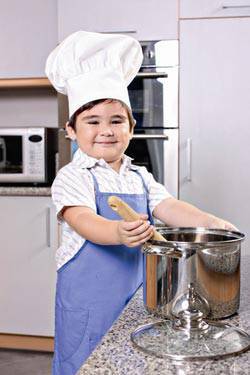
 Your little tyke won’t forever be scampering around the house carefree and unaccountable for anything. Growing up is inevitable, and responsibility comes with the package. Experts say the first step to raising an independent and diligent child is to encourage him to help with household chores.
According to Bernadette Benitez, M.D., section chief of the Developmental and Behavioral Pediatrics at the Asian Hospital and Medical Center in Muntinlupa City, it’s never too early to teach life skills to kids. Even if help is available around the house, we need to encourage our children to contribute to the tasks being done at home.
Involving them in household chores will boost their self-confidence, too, Dr. Benitez adds. Maricar Gustillo-De Ocampo, Ph.D., psychologist and education consultant for various schools, says there are a lot of alternative activities in the house that build character, cognitive, social, and life skills. If parents know what kids can do at every age and stage, then they’re well on their way to raising helpful and smart youngsters.
Ready to be responsible.
Asking a preschooler to help with simple household chores can be a venue for learning various concepts. However, we always have to consider the developmental level of preschoolers when giving them tasks, whether in school or at home, says Dr. Gustillo-De Ocampo.
A preschooler is typically more agile than a toddler. He has better dexterity in manipulating and handling things, she says.
Most of all, his cognitive and language skill levels are already more complex, giving him the ability to understand higher order concepts (such as associative thinking) and to explore novel activities by asking questions, Dr. Gustillo-De Ocampo explains.
Be ready with short but precise and clear explanations for some tasks (We pack away toys so we don’t trip over them when we walk or run in the room).
Keep in mind, too, that a preschooler’s judgment (for right and wrong) and concept of safety and danger are still not completely in place. Therefore, close supervision should be exercised when he is allowed to take part in household chores, adds Dr. Benitez.
Child-friendly cleaning aids and products should also be chosen well to keep your child away from injuries.
Click here to read more tips on how to raise a responsible and hardworking big kid.
[previous|page|next]
Read on for more tips on how to raise a responsible and hardworking big kid.
Cleanup smarts
The home is a child’s training ground for bigger challenges, and parents are his first teachers.
Dr. Gustillo-De Ocampo says chores also lay the foundation for mathematical skills. Simple household chores such as pouring soy sauce into a saucer enhance motor skills, while teaching them the concept of estimation.
Sorting out clothes for laundry teaches them about sets and color discrimination. Along with the analytical skills they learn, helping in household chores teaches them discipline and roletaking.
Having a task chart and a time table visible will allow the child to be aware of the distribution of roles in the family.
Household chores should never feel like a .chore. for your child. Start with simple tasks then move on to more difficult activities as he grows up. In the long run, he’s bound to have a more positive attitude towards work.
4 ways to make ‘em work
1. Model the right attitude
“Walk the talk!” says Dr. Gustillo-De Ocampo. If you highlight the chores as fun activities that brighten the home and make others feel good, then your child will learn to look at his task as a significant contribution to the home and not just a chore he is forced to complete.
2. Be consistent
Make sure everyone in the family follows a system. There should be consistency
and harmony in distributing the share of chores among family members.
3. Provide age-appropriate chores
Give small chores at first. Allowing your child to feel “accomplished” and good at a specific task (folding table napkins or lining up the shoes on the shoe rack neatly) boosts his confidence, inspiring him to do more. (Check out Chore Patrol: Age-Appropriate Household Chores for Preschoolers)
4. Praise a job well done
Children need feedback, especially on positive behavior. Saying “Great job!” or “I’m proud of you!” motivates him to do things by himself and get involved in household chores all the time.
Photography by Patrick Martires
SOURCES:
● Bernadette Benitez, M.D., section chief, Developmental and Behavioral Pediatrics, Asian Hospital and Medical Center, Muntinlupa; associate active staff, Department of Pediatrics, Makati Medical Center
● Maricar Gustillo-De Ocampo, Ph.D., education consultant and faculty member, Assumption College, Makati
● Funtastic Mathematics by Galileo
Enrichment Learning Program, 2008

Lorem ipsum dolor sit amet, consectetur adipisicing elit, sed do eiusmod
Lorem ipsum dolor sit amet, consectetur adipisicing elit, sed do eiusmod