
 Whenever his classmates queued up according to height, Miggy would always be at the start of the line. The scrawny, diminutive, but energetic first-grader became an easy target for the class bully Jeric. “He was always picking on Miggy who was very frail-looking,” relates mom Bettina de la Rama. “Jeric even slashed my son’s sleeve with a piece of broken glass. Once, he tried to pull out the chair my son was standing on while Miggy was erasing the blackboard.”
To fight back, Miggy put on a brave face at school and stood up to Jeric. “Miggy would make sumbong at home,” says Bettina. He was, after all, a talkative kid, so he told his mom everything.
Bettina intervened by trying to set up a meeting with Jeric’s parents. “I talked to the level coordinator, who called the boy’s parents to a meeting, but they avoided me,” she says. The meeting never took place. “I finally decided not to enroll my son in that school for the next school year,” Bettina concludes.
Violence in school
Like Miggy, four in 10 children in grades 1 to 3 say they have experienced violence in school, reveals a study entitled Towards a Child-friendly Education Environment: A Baseline Study on Violence against Children in Public Schools. The United Nations Children’s Fund, the Council for the Welfare of Children, and Plan International conducted this study among 6,931 students nationwide.
The study also reports that boys are more prone to physical violence than girls, although bullying is not limited to just physical acts. The study further reveals that verbal abuse is the most common form of violence in school. Moreover, acts of violence experienced by schoolchildren are committed more by their peers than by adults. That kid sitting right next to your child in class just might be a bully.
[previous|page|next]
Portrait of a bully
Contrary to popular belief, bullies come in all shapes and sizes. “Typical bullies aren’t necessarily bigger than the rest of the class,” says Mellissa Espiritu, principal of Veritas Parochial School in Parañaque. “At any size or height, they can exert much influence and display disruptive, aggressive behavior. Girls are also guilty of this in subtler ways.”
Espiritu adds, “Bullies incessantly and intentionally tease, provoke, and even push a classmate around.” Verbal abuse is a typical bullying tactic. “They resort to name-calling to insult or embarrass their victims. Sometimes, they display their aggressiveness by simply laughing out loud when a classmate answers the teacher’s questions.” Bullies can go as far as “provoking a classmate who is already vulnerable and shows signs of crying or fighting back. He’ll push him around or engage him in rough play,” reveals Espiritu.
A bully usually has low self-esteem. He wants “to show his classmates who’s boss, to establish a ‘kingdom’ he can rule or lord over,” states Espiritu. Bullies also seek attention. “They may not have their parents’ attention at home or they may enjoy too much of it that they expect the same kind of attention in school,” she explains.
The victim
“Typical victims of bullies would be the most timid in class,” Espiritu says. Bullies make fun of them because of their skin color, weight, size, disabilities, and other differences. Espiritu observes that other usual victims of bullying are “the silent achievers or ‘nerdy’ types, the vocal achievers, the sensitive ones, those with expensive things, and those who are eager to please.”
There are also so-called “serial victims.” Espiritu expounds, “Those who usually get bullied seem to be carry-overs from previous school years. For example, Boy 1 bullied Boy 2 in the first grade, second grade, and third grade out of habit. This becomes a cycle until both boys grow up.”
But just as there are no hard and fast rules for describing a bully, victims of bullying do not necessarily fit a mold, either. Espiritu says, “When we ask bullies the reasons why they target someone, they say, ‘Wala, trip lang.’ They pick on anyone.”
[previous|page|next]
The signs
How do you know if your child is being bullied? Rhamma T. Exconde, a former psychology professor at Assumption College and now a guidance counselor at British International School in Indonesia, tells parents to watch for these warning signs of bullying:
- Your child is reluctant to go to school. He comes up with excuses to stay at home. He might also have crying spells each morning.
- He loses money and cannot explain how it happened. A bully might be coercing your child to buy him food or other things.
- Some of his personal possessions (like a toy) are either lost or destroyed - and it's not his fault. Perhaps a bully has taken them from him.
- He comes home with unexplained bruises and scratches.
Note that victims of bullying are usually afraid to tattle for fear that they will get attacked if the bully finds out they squealed.
On the other hand, Exconde says a child might be a bully if...
- The money he has is more than the allowance he receives from his parents.
- He suddenly owns things his parents didn’t buy for him.
- He brags about a certain kid who does him favors like carrying his bag, doing his homework, and letting him copy his test answers.
- He has friends who seem unlikely to be friends with him.
Stop the bullying!
What to do if your child is being bullied? Exconde says, “If the bullying just started, ask your child to ignore it since it could be passing or temporary.” Tell him to leave the scene and report the incident to his teacher.
However, if the bullying persists, talk to your child. “If you have a strong suspicion [that your child is being bullied], it’s best to go to the school and ask his class adviser about your child’s interaction with his classmates or other students,” advises Exconde. Then approach the guidance counselor, especially if your child does not want to discuss it. If your child is willing to open up, get the details from him, and then report it to his class adviser and the guidance counselor.
[previous|page|next]
At this point, let the adviser and the counselor take over the situation. “The parents should not be the ones to approach the bully unless the bullying has become too harmful and detrimental to their child’s safety and self-esteem and the school personnel aren’t doing anything to address the issue,” stresses Exconde. Also try doing the following:
- Teach your child to be more assertive, and to put on his ‘brave’ face when dealing with a bully.
- Teach him to say no to the bully's demands using a firm voice. You can practice this at home through role-playing. Act out certain scenarios where he may experience aggression from others, and make sure there is a resolution to each situation.
- Show him early on how to discern between acceptable and unacceptable behavior by giving situational examples.
- Advise him on how to choose friends wisely and to stay away from troublemakers. Remind him to always stick to his own group of friends.
“Bullying should be addressed as soon as you notice changes in your child's behavior, especially if he refuses to go to school and comes up with all sorts of excuses to skip class,” says Exconde. Victims of bullying are also less likely to experience trauma if the communication lines between them and their parents remain open. “Assure your child that you are always willing to listen to him if he needs someone to talk to,” advises Exconde. “Make it a point to be available for him especially during parent-teacher conferences, school programs, and other activities, so that you are informed and updated on what's happening in your child's life.”
Bully, behave!
Rhamma T. Exconde, guidance counselor of British School–Indonesia, suggests what you should do if...
…you catch your kid being bullied. “If this happens in school, immediately report the incident to the class adviser and/or guidance counselor. Get in touch with the school personnel to make sure that the bullying is addressed properly and not overlooked.”
…you catch your child bullying another. “Talk to your child and explain why it’s not acceptable to bully another child. Talk about respecting individuals who are different from him. Make sure that he understands bullying and its implications, and elicit a promise from him that [the bullying] will not happen again.”
…the bully turns on you as you try to defend your child against him. “This is unlikely to happen because bullies prefer to victimize individuals they perceive to be helpless and who cannot defend themselves. Oftentimes, the bully will not exhibit aggressive behavior if the victim’s parents are around. But if this happens, you should try to talk to the bully as patiently as possible. Then, call the attention of the teacher or the counselor if it was committed on campus because they have the authority to discuss this issue.”
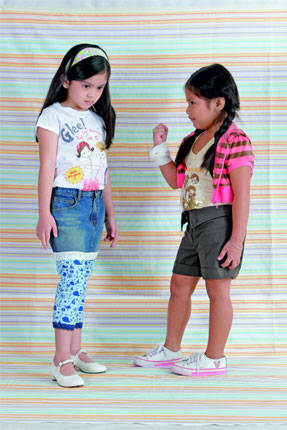
Photo by Ocs Alvarez

Lorem ipsum dolor sit amet, consectetur adipisicing elit, sed do eiusmod
Lorem ipsum dolor sit amet, consectetur adipisicing elit, sed do eiusmod
