
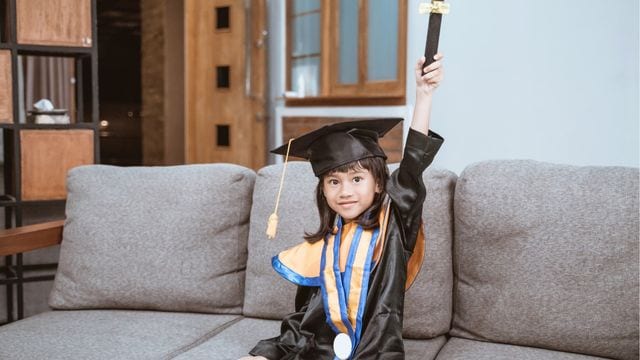
It’s been all over social media over the past weeks: proud parents posting their children’s school awards. Then you also come across confessions of those who can’t help feeling bad for their children who didn’t get anything. I’ve been on both sides, experiencing times my children received honors, and also years when they did not. I can attest to the feelings of joy and sadness. But even in those unawarded moments, as an educator, I was always comforted by the knowledge that awards aren’t the end-all and be-all for students.
A few weeks ago, I attended a meeting with my teachers as we reviewed the grades of our students to determine who would receive which honor award. Some of the students who were receiving high honors were surprised, but the consensus among the team was that they deserved it due to the hard work they had put in. Many people tend to think that academic excellence is a reflection of brainpower and ability, but for the most part, it is also a reflection of perseverance and determination in schoolwork. They are therefore not necessarily indicators of intelligence or skill.
So, for the parents whose children did not receive awards this year, here are some things you may find solace in:
What can parents do if children don't receive academic awards
1. Let it inspire them if they wish, and support them.
If your child did not receive an award this year, it may serve as inspiration to work for one next year. Allow children who truly want to get awards to work for them. Give them the support and encouragement they need, but don’t let it consume them. If students are working to earn awards solely for the benefit of their parents or teachers, this can cause them undue stress and may be detrimental to their self-worth and mental health. However, if students are motivated by their own desire to reach a goal they have set for themselves, they are likely to be more participatory in class, communicate better with their teachers, submit assignments on time, and possibly take on roles of responsibility in group projects.
'If your child has not earned any awards, but loves to learn, read, question, explore, then they are on the right track to success.'
2. Develop skills and talents in other areas.
If your child doesn't seem interested in awards, don’t despair. Instead, take the opportunity to help them develop skills and talents in other areas. I don’t give homework to my students because I would rather they use their after-school hours to relax or pursue their passions, whether taking up painting, learning to play an instrument, or training for a sport. Children will not only have skills, hobbies, or interests outside of school but also irreplaceable life experiences, such as participating in an art exhibit, piano recital, or sports tournament. Plus, they can acquire essential life skills through sports, music, and art, such as teamwork, respecting mentors, and creative thinking.
3. Don't forget socio-emotional development.
Another area parents can focus on is socio-emotional development. While there is a tendency to be consumed by Academics, it’s worth noting that children’s socio-emotional skills, from preschool to high school, are integral to the child’s overall development. Children who spend most of their after-school hours studying often miss out on the chance to interact with their peers, whether they play at the park, participate in playgroups, or join in social gatherings. Those with little to no opportunities to socialize are at risk for isolation, low self-esteem, and may have difficulty reading social cues. For young children, it is essential that they have regular opportunities to engage with family and friends, allowing them to build strong social connections and skills. Children also need to develop the emotional bandwidth to regulate their feelings and reactions, so they can survive and thrive in various situations, including those that are awkward and difficult.
4. Remember and remind them that the attitude towards learning is important.
More important than having high grades is the attitude your child has towards learning. Some students who overstudy are so exhausted that they have little energy or motivation for other things. Learning becomes simply the memorization of information given to them, so that they can spew it back and ace their tests. But, in such cases, it leaves little room for creative and critical thinking. Their natural curiosity and thirst for knowledge are drowned out by the number of drills they need to perfect.
School should not be seen as a place where they go to get grades and awards. It should be seen as a place where they can learn things that are meaningful to them. There should be a sense of excitement when they discover how to read books, write their own stories, hear about our history, speak our language, solve math puzzles, create masterpieces, make friends, and play games. So if your child has not earned any awards, but loves to learn, read, question, explore, then they are on the right track to success.
There are many teachers who make sure to give all their students awards at the end of the year, which highlight aspects such as kindness, resilience, empathy, honesty, leadership, generosity, and so forth. For your child to have received such an accolade, it demonstrates that this specific trait was consistently observed throughout the months. That is something worth being proud of.
Final thoughts
We might worry that if our children don’t receive honors, they will be less successful later on in life. That’s not necessarily true. You should remember that there are many small victories in your child’s life that will help them move towards success. These include the ability to set one’s goals and pursue them, the capacity to have a healthy sense of self, the opportunity to cultivate their passions, the ability to socially connect and emotionally regulate, and the natural desire to learn and think for themselves. But above all, as their parents and teachers, we should remember to value traits such as kindness, responsibility, and resilience—because these are what make not just successful students, but evolved humans—and they will be the ones on whom our future depends.
Thumby Server-Veloso is the Managing Director of Thinkers Unlimited and Toddlers Unlimited. She has over 30 years of experience as an educator, and is also a mother of two. She has been part of the Smart Parenting Board of Experts since 2022.
More from sp

Lorem ipsum dolor sit amet, consectetur adipisicing elit, sed do eiusmod
Lorem ipsum dolor sit amet, consectetur adipisicing elit, sed do eiusmod
