
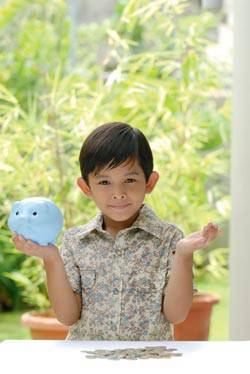
 Saving money is a lesson parents should teach their children. It imbues discipline, responsibility, patience, and other valuable qualities a child would need later in life. Children today have a precedent that those before the Internet age do not have.
The world is literally at their fingertips—from their cellular phones right to their personal computers, they have access to more information and market places than any single person can process.
Start them young; they’re more likely to keep good habits all through their lives when they learn early. no small change. Bring your child with you on grocery trips. They will most likely notice your transactions; and when they do, it’s the best time to teach and explain.
• Giving them ten pesos to buy snacks at the local grocery store is a good starter lesson on budgeting and purchasing. If a small pack of snacks is worth five pesos and your child handed over a ten-peso coin, explain to him that he should expect one five peso coin or five one-peso coins in change. Your little tyke will learn about denominations through this process; remember your child will have to handle real money in order for him to learn how to use it.
• Putting money inside a piggy bank can also be a fun activity for your child. Together, keep tabs of what he has put inside. You can do this via a small chart with stars or other paraphernalia representing his peso. If next time, he asks for snacks for your next trip to the grocery, have him draw the amount he needs from his collection and subtract the corresponding star or stars from the chart.
• An allowance should match the child’s age. Before they turn age 9 or 10, you will have given them a small allowance and paid them for chores they don’t usually do. By the time they are in grade 5, their allowance should come with a budget so they will learn to spend within their means. conserve and preserve. It also happens that conserving energy around your home can save you money in the long run.
In The Times article “Cut Carbon Emissions Now or Face Economic Calamity Later,” by Greg Hurst, the author warns that the cost of confronting climate change far outweigh the consequences if human beings do not. Applying green habits with your children will teach you and your kids of your part in taking care of our planet.
Click here to learn more ways on how to teach your big kid to save.
[previous|page|next]
Read on to learn more ways on how to teach your big kid to save.
• Toddlers and preschoolers are endlessly curious. Having them put away their toys will eventually lead to teaching them about the amazing on and off button on your TV, DVD players or light switch. Teach them to turn off the TV, computers, radios, and anything else that actually goes on standby after they use it.
• Wasting water actually wastes electricity. Cleaning up and supplying water is usually a city’s biggest electricity expense. Every fl ushed toilet uses 5 to 7 gallons of water. A leaking toilet can use 10,000 gallons of water a year. A leaking faucet can waste up to 2 gallons a year.
• Put “Don’t Forget!” signs near your faucets and light switches. They’re actually for you
• Never forget to recycle. Have color-coded and sealed trash bins for biodegradable and non-biodegradable items. With your supervision, have your child put banana peelings in one bin and plastics in another. Newspapers and white paper such as notebooks or stationeries should be put in a separate bin.
Saving need not be such a daunting task. It can be a fun, ever-evolving habit. How your children value money and conservation will depend on your attitudes, your own example, and the fact that you will be learning right alongside your kid.
Starting a Kiddie Bank Account
Primarily, opening an account for your child will benefit him in the long run. A toddler or a preschooler may not fully understand the purposes of banks early in life, but they may see the basic purpose of a piggy bank, for example, which is where he puts money in small amounts to save enough for later needs.
Certain banks have savings accounts tailored for children. As soon as your child learns how to write his name, you can open an account for him, with you as the primary co-signer. This means that you have control over what your child withdraws and what he deposits. It’s a very simple way of teaching them about which percentages go to the bank and why saving—in general—will allow them to acquire what they want later on.
Photography by David Hanson Ong
SOURCES:
● Sugar Macol, bank teller
● “Cut carbon emissions now or face economic calamity later” by Greg Hurst. The Times, October 30, 2006.

Lorem ipsum dolor sit amet, consectetur adipisicing elit, sed do eiusmod
Lorem ipsum dolor sit amet, consectetur adipisicing elit, sed do eiusmod
