
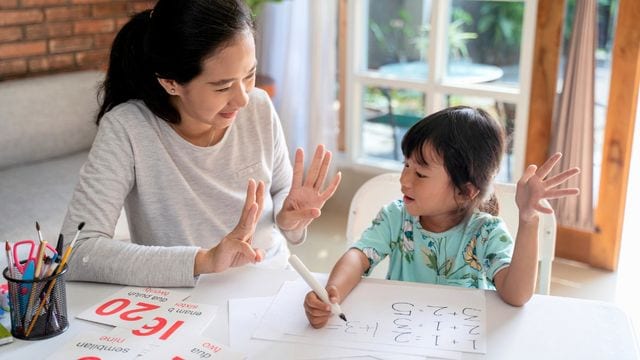
Originally developed by Singapore’s Ministry of Education in the 1980’s for Singapore public schools, Singapore Math is a mathematical teaching approach adopted around the globe in many forms over the past 25 years. This method, in general, moves from hands–to picture models or concepts–to abstract mathematical equations. It zooms in on mathematical principle and its application, hence it is believed to develop learners who are critical thinkers and problem solvers. This full math curriculum is typically aimed at students from Pre-Kinder to 8th grade.
To shed light on what Singapore Math is, how it is beneficial to Filipino children and how it is different from traditional Math–we asked Julie Chandiramani, Director for Program and Training at BrainLight Learning Center (BLC) - Singapore Maths Philippines, through an exclusive interview.
What is Singapore Math?
According to Chandiramani, “Singapore Math is a highly effective and internationally acclaimed teaching methodology from Singapore where every child, whether struggling, average or advanced, is taken into consideration and made sure to succeed. The teaching methods help a child increase his/her intellectual competency by focusing on problem-solving as the heart of its curriculum. It requires students to communicate what they are thinking.”
Chandiramani explains,“It started in the 80’s, when the educational performance of Singapore in international benchmarking tests was one of the lowest and it was affecting the economic growth of the country. After thorough research, the government decided to make a major overhaul in its national curriculum specifically in Math, as it can help produce better human resources with improved intellectual competency. This change will also have a direct correlation to its economic progress. The new Math curriculum teaching framework (now known as Singapore Math) was introduced in the 90’s. After several years of implementation and continuous revisions every 6 years, Singapore is now at the top of international assessments and has proven to have shown continuous economic progress.”
What are the key features of Singapore Math?
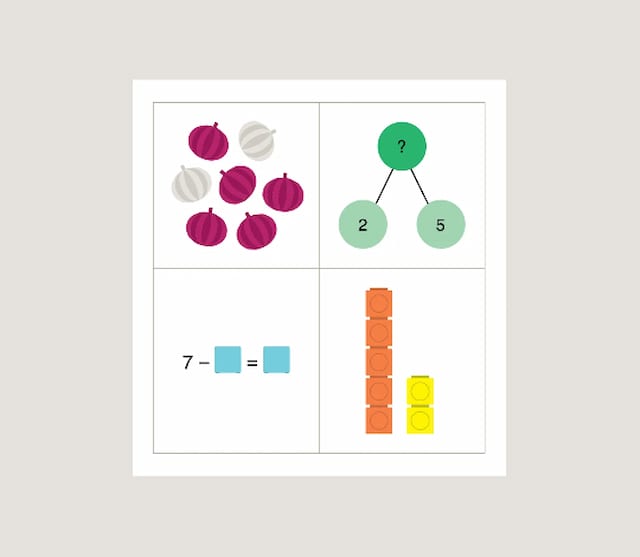
According to Singapore Math website, there are four main key features of Singapore Math, namely: CPA, number bonds, bar modeling, and mental math.
CPA (Concrete Pictorial Abstract) Approach
This approach introduces concepts tangibly or visually like blocks, graphs, and pictures, and then progresses to increasing levels of abstraction. For example, adding 5 + 2 (an abstract concept) can be best represented by counting five and two object representations separately and combining them to visually show how the answer becomes seven objects before introducing the numbers 5, 2, and 7.
Number Bonds
This shows the part-whole relationship between numbers. The visual representation of the problem is by showing the two parts (5 and 2) and the whole (7).
Bar Modeling
Bars help students solve word problems and visualize a range of math concepts, such as fractions, ratios, and percentages. This allows students to determine the knowns and unknowns in a given situation. Chandiramani adds, “By drawing bars or rectangles to represent information, a child can visualize and think algebraically at an age as young as Grade 2.”
Mental Math
Many mental math strategies involve factoring numbers into parts, then performing operations on them in a different order from the original expression. The thought processes involved in mental math are often illustrated by number bonds.
Related read: What’s The Big Deal about Singapore Math?
How is it different from traditional Math?
Chandiramani explains that while Singapore Math focuses on ‘conceptual understanding,’ traditional Math leans on rote memorization and learning. “It focuses more on operational computations, tedious manipulation of numbers, memorizing of procedures and formulas…more of a step-by-step format instead of making connections, thinking, and problem-solving. Such teaching approaches lead students to be just computation experts and not problem solvers,” says Chandiramani.
Is it beneficial to Filipino children?
According to Chandiramani, the teaching methodology of Singapore Math helps children not to become rote learners (or those who solve problems by merely repeating or replicating the worked example). Singapore Math will be beneficial to Filipino children in developing their thought processes and having the ability to communicate and reason.
“Filipino children always have this preconceived notion that ‘Math is hard’. They have developed a fear of the subject due to the stigma of being difficult, nonsensical, and something not useful in life. Math has always been associated as a subject understood only by ‘intelligent kids’, whereas these basic concepts are naturally comprehensible by almost all kids. If given well-thought opportunities and scaffold questions to understand and encourage thinking, any child CAN learn Math. Filipinos will thrive in their education and show progress in their application skills in real life, which may eventually help the country progress,” she adds.
Over the years, some schools in the Philippines have adopted the Singapore Math curriculum or incorporated its principles into their existing math programs.
Read also: This Mom Says Math Is Not Something You Study: How She Teaches the Subject to Her Kids
For children who do not have this in their curriculum, is there a way to incorporate Singapore Math in their studies?
Chandiramani believes that even if a child's primary education does not include Singapore Math, it can still be incorporated through supplementary programs.
“That's why we, at BLC, align the child’s non-Singapore math curriculum material and math topics sequence with our teaching strategies to have a good understanding and yet perform well in school. We provide specialized tuition programs designed to seamlessly integrate this proven methodology into your child's learning journey. Our experienced teachers use teaching techniques, customized teaching material, and enough focus to make them learn and be independent as well. Regardless of the child’s school's curriculum, one can benefit from the enriching experience of Singapore Math,” she further explains.
BLC is an enrichment company offering an after-school Maths Enrichment Programme based on the world-renowned Singapore Mathematics Curriculum set by the Ministry of Education of Singapore (MOE). It is located at Unit 315 - McKinley Park Residences, 3rd Ave corner 31st Street, BGC, Taguig. A second branch is opening on February 17, 2024 at 4th floor Madison Galeries Lifestyle Mall, Don Jesus Blvd, Cupang, Alabang Muntinlupa. For inquiries, you may call (+63) 917 162 9900. Visit BLC's website, Facebook Page, or Instagram to know more.
More from sp

Lorem ipsum dolor sit amet, consectetur adipisicing elit, sed do eiusmod
Lorem ipsum dolor sit amet, consectetur adipisicing elit, sed do eiusmod
