
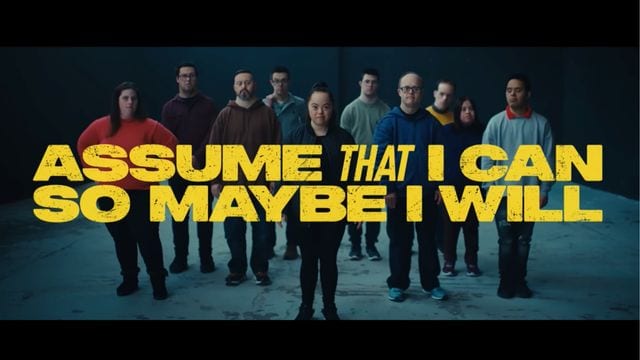
If you or someone you love has Down syndrome, chances are, you've seen all kinds of video campaigns that have empowering messages. Most of the time, it's about inclusivity and acceptance. But this year, the message coming from Down syndrome organizations, I assume, is one we've never heard of before.
World Down Syndrome Day 2024 campaign: what is it?
On March 14, the National Coordination of Associations of People with Down Syndrome or CoorDown, together with the National Down Syndrome Society (NDSS) and other international organizations, launched a global campaign that sends a powerful message that what people assume of persons with Down syndrome, which is mostly negative or degrading, becomes true.
The video entitled, "Assume That I Can," begins with Madison Tevlin, a Canadian model, advocate, and actor with Down syndrome, conversing with a bartender. "Hey, bartender. You assume that I cannot drink a margarita. So you don't serve me a margarita. So I don't drink a margarita." She added, "Your assumption becomes a reality."
She then continues talking to her parents who assume she cannot live on her own, to her training coach who assume she cannot hit harder, and to her teacher who assume she cannot learn Shakespeare. Madison then challenges, "If all your assumptions become reality, then assume that I can drink a margarita. So you serve me a margarita. So I drink a margarita," and so on.
The next lines give us the notion that persons with Down syndrome are capable to do the things that neurotypical people can do and enjoy: "Assume that I can do that job. That I can go to parties. That I can have sex. That I can be on stage."
The ad ends with a very powerful message, "Assume that I can so maybe I will."
Inspiration behind 'Assume That I Can' video
According to a statement by the National Down Syndrome , the video was inspired by Marta Sodano, a 29-year-old Italian woman with Down syndrome, whose speech during the World Down Syndrome Day Conference at the United Nations tackled the effects of "self-fulfilling prophecy."
"I discovered that in psychology there is a concept called “self-fulfilling prophecy”, whereby a teacher who thinks that a student cannot understand would just act accordingly and therefore they would not teach the student. And there you go: the prophecy self-fulfills. But in my opinion, there are no difficult or easy concepts, there is always a simple way to explain things. If I think of all the things that were not explained and taught to me, well I really get angry," she said in the NDSS statement.
First described in 1948 by Robert K. Merton, a US sociologist, the self-fulfilling prophecy is a sociological and psychological concept that illustrates how people’s assumptions and expectations affect events to such an extent that the initial prophecy comes true.
The video then challenges everyone to use this concept positively, changing the narrative to: if you believe in me, if you trust in me, you can have a positive impact, and then, maybe, I will achieve goals, even unexpected ones.
Reactions of persons with Down syndrome, netizens to the video
The video, which has gained over 29 million views on TikTok, and 92,000 views on YouTube as of writing, has mostly received positive comments and reactions from netizens.
Ellie Goldstein, a model with Down syndrome, shared her thoughts about the video in an article by Elle UK, "It’s important to treat us with respect, know our capabilities, and provide support when we need it," she said. "I remember at school and the doctors assumed I wouldn’t be able to walk, talk, and go to college," Ellie added.
Some of the positive comments by TikTok users read, "Why have I never seen ANY positive message about Down syndrome like this. Beautifully done."
Meanwhile, a parent said, "As [a] father of an 8-month-old girl who has Down syndrome, I love this ad."
Another user said, "Best ad I’ve ever seen, we had a co-worker with Down syndrome at Starbucks, and he was one of the best employees we had, literally one of the fastest learners I’ve ever met."
A parent's reaction to the video, Assume That I Can
Michelle Ressa Aventajado, whose daughter Geli has Down syndrome, shared with Smart Parenting her reaction to the video, “I effing love it! As we move towards a more inclusive culture, we know that we have to #EndTheStereotypes. Infantilizing adults with Down syndrome or any adult with intellectual and developmental disabilities (IDD) only further promotes stereotypes and leads to barriers to inclusion."
She added, "Adults with Down Syndrome can do many things. They are capable of all of the things that Madison shares in that powerful PSA. I applaud CoorDown for always coming up with thought provoking campaigns that amplify the abilities AND RIGHTS of individuals with Down syndrome."
Mish, who is the mom behind the blog, Momma 'N Manila, is the executive director of Best Buddies Philippines, a non-profit organization that promotes one-to-one friendship, employment, and inclusive living for people with intellectual and developmental disabilities (IDD).
Recently, they partnered with SM Cares, Miss Possibilities, and Special Achievers to celebrate #EndTheStereotypes, in celebration of World Down Syndrome Day. To know more about Best Buddies Philippines, follow its Facebook page here.
The video was launched in line with World Down Syndrome Day, where everyone is encouraged to spread awareness and knowledge about Down syndrome, to create a new culture of diversity, and to promote respect and inclusion for all people with Down syndrome.
The choice of the date 3/21 is not accidental: Down syndrome, also known as Trisomy 21, is characterized by the presence of an extra chromosome - three instead of two - in chromosome pair 21. The theme of this year's World Day is “End the stereotypes!” Stereotypes are harmful: for people with Down syndrome and intellectual disabilities.
Watch the full video here:
Read the inspiring story of a person with Down syndrome, who was successfully employed in a retail store here.
More from sp

Lorem ipsum dolor sit amet, consectetur adipisicing elit, sed do eiusmod
Lorem ipsum dolor sit amet, consectetur adipisicing elit, sed do eiusmod
