
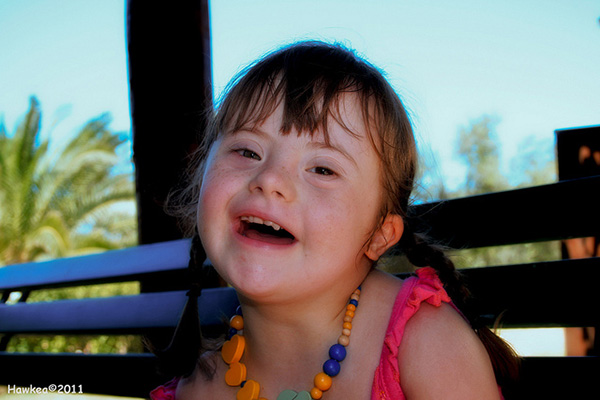
Photo from flickr.com
The Story of Hannah
The doctor came into my hospital room and announced that my baby was fine except that her ears were a little higher than usual and that more tests had to be done. Having given birth to three other kids, the last one, being 12 years back, I thought this was nothing serious. Then came the verdict, a final blood test one month after she was born. That test revealed that my newborn daughter was a Down syndrome baby. My husband and I were devastated.
Did I eat or drink anything prohibited or unhealthy during my pregnancy? Was I a negligent pregnant mother? I also questioned God. Why give me such a baby? I was looking for an answer but could not find any.
The answers came by way of Carmencita D. Padilla, M.D., a geneticist at St. Luke’s Medical Center, Philippine Children’s Medical Center and National Institute of Health. She examined our little Hannah, and confirmed that our baby was a Down syndrome child. Padilla explained that Down syndrome occurs as a result of an “accident of nature,” just like some people who were born with an extra finger, or with a mole or birthmark. And while she may have a weak heart or poor muscle control, she can certainly grow up to be a productive citizen living a normal, independent life.
We were encouraged. We had Hannah go through early intervention programs. We brought her to a physical therapist, an occupational therapist, and a speech therapist. We made sure she was growing up in a stimulating environment, which meant 24-hour symphonies and Christmas lights all year round.
The road to acceptance
Sometimes, I have difficulties accepting Hannah’s condition. I sometimes have attacks of shame and guilt. I would, at several occasions, shy away from bringing my baby out for others to see. My older daughter, on the other hand, proudly parades her baby sister to school excitedly announcing her sister is a Down syndrome baby, as if it was the most natural thing in the world. That’s when it hit me. A child, any child, is a gift from God. Why shouldn’t I be proud of my Hannah?
Sunshine from heaven
Hannah is now seven, and she grew up with very little health problems. Except for her poor eyesight, her heart is normal and her muscle tone within normal range. Hannah expresses herself quite well compared to the average Down syndrome child. And she now goes to a preschool for regular kids.
Hannah has a penchant for books. After Barney, she has moved on to Cinderella, The Little Mermaid and Beauty and the Beast.
Hannah doesn’t scream and kick and yell when things don’t go her way. What she’ll do is keep still, quietly pout, and cry. At times, she would just say, “I’m crying” or “I’m mad.”
At home, she is like sunshine from heaven. Her brothers and sister drown her with hugs and kisses. When somebody starts losing his temper, she would gently ask, “Are you mad?” Almost instantly, our foul mood melts away. Yes, Hannah is our family’s “checking angel,” a constant reminder that anger need not be harsh or violent.
Hannah is such a sweet, cheerful and gentle person. I once read an article that said people with Down syndrome are gentle creatures, and I believe it. Their pure innocence makes them very trusting, very forgiving. To them there is no such thing as prejudice, malice or suspicions. They harbor no bitterness. Vengeance is unknown to them.
Come to think of it, if everyone possessed such qualities, then there would be no place in this world for wars, crime, or violence —- and that would be like heaven!
Living with Hannah, with her simple joys and pure innocence, has certainly given our family a peek at heaven.
[previous|page|next]
The Story of Jeremy
"Would you have preferred it any other way,” people would ask me. Would I have wanted my son Jeremy to be born normal, without Down syndrome? It would have been great to have a normal boy. But this is Jeremy. He’s our son. And we love him and accept him as he is.
My husband Elmer knew right away that there was something different about Jeremy, even while he was still in the nursery. Jeremy’s eyes slanted upwards, his ears were a bit downset, his fingers were tapered like candlesticks. I didn’t see at once, but looking back, I remember Jeremy’s eyes did look different.
We were praying for a healthy normal boy. And when our geneticist confirmed that Jeremy had Down syndrome, we were devastated and disappointed. But we weren’t angry. Anger was never there although some guilt and disbelief were. For a day, Elmer went around wondering what he had done wrong. We thought that one day we’d wake up and Jeremy would be normal. But after some time, we realized that his condition was here to stay.
The first difficult steps
Our pediatrician gave us an envelope that contained information about Down syndrome. It was really hard to open that envelope because opening it would mean that we were accepting what happened. While Elmer and I were hesitating, I fell asleep.
When I woke up, Elmer was reading the contents of the envelope and crying. He said the reason he was crying was that he realized that there are many things individuals with Down syndrome can do. They can become functional members of society and even live on their own. Immediately, Elmer was very positive about it. When our daughters and relatives visited us at the hospital, we told them right away. We didn’t mince words. There was no reason for us to hide anything.
We knew people would take our lead and pick up from our feelings about Jeremy. If they saw that we were depressed, they’d feel sorry for us. But if they saw that we were positive and knew there was something that could be done, then they would probably decide to help us. And they did.
Raising Jeremy
The first thing our doctor did was to give us a medical checklist of things to do and a list of doctors to see. It was pretty over-whelming in the beginning. Aside from the pediatrician, we had to see the geneticist, cardiologist, ENT specialist, neurologist, orthopedist, pediatric ophthalmologist, physical and occupational therapists, and the speech pathologist.
We all work as a team with a common objective -— to let Jeremy live to be self-reliant, happy, confident in the knowledge that his condition is not his fault (or anyone’s) and that there are a lot of things he can do with his life.
Jeremy requires a lot of medical attention. During his first two years, he had respiratory problems that had us in and out of the clinic. Jeremy also had to go through a lot of different tests to let us know in advance if there’s something that had to be done.
We had to teach Jeremy how to crawl, how to sit up, how to kneel, how to walk -— all those things. I think it frustrates Jeremy when he cannot say what he wants to say because his speech is limited. That also frustrates me at times, but it’s something we have to deal with.
Underneath all the physical differences, though, Jeremy is still just a regular boy who messes up his sisters’ things and who, as his older sister Lian says, has taught us that things are not good or bad, beautiful or ugly, depending on how you look at them, but on how you think about them.
[previous|page|next]
Down Syndrome Facts
What is Down syndrome?
It is a genetic disorder where a cell turns out to have 47 chromosomes instead of the normal 46. The presence of this extra chromosome -— the 21st —- in a cell causes babies with Down syndrome to have slightly different physical characteristics. Also, the mental and physical development of children with Down syndrome happens much slower than the normal rate.
What are the usual signs that a baby has Down syndrome?
Babies with Down syndrome typically have flat facial features, lower-set ears, an enlarged tongue in proportion to the mouth, an extra fold on the eyelids, a single crease across the center of the palm, a large space between the first and second toes.
How does Down syndrome happen?
When a cell divides during egg (or sperm) formation, a woman’s (or man’s) pair of chromosomes splits so that only one chromosome is in each egg (or sperm)——adding up to 23 pairs. Down syndrome (also called Trisomy 21) happens when the division of the 21st pair of chromosomes does not take place accurately and a double dose goes to the egg (or sperm). This changes the genetic blueprint of the baby causing his development not to work efficiently.
No one can do anything or avoid doing anything to keep Down syndrome from happening. It is an accident that occurs when the baby is conceived.
Can children with Down syndrome be educated?
Of course. However, “each child with Down syndrome will need specific intervention because of the wide variation of their skills,” says Alexis Reyes, M.D., section head of Developmental Pediatrics at the Department of Pediatrics, UP-Philippine General Hospital. Some will need special education services with “intensive individualized therapy programs” while others can manage a basic academic curriculum. The important thing is to remember that, as Reyes explains, “managing the child with Down syndrome is always a collaborative effort with parents as partners and active participants.”
What can parents do to help in raising a child with Down syndrome?
The first step would have to be giving unconditional love to their child. And then, “they have to have the proper attitude regarding Down syndrome,” says Reyes. “All children with Down syndrome will usually ‘facilitate’ the accomplishment of goals if they’re given early opportunities as well as proper and timely intervention.” Home rearing, an early intervention program, the parents’ level of education, help in giving a child with Down syndrome a better cognitive outcome.
What are the chances of an older mother having a child with Down syndrome?
Women past 35 years old have an increased chance of giving birth to a baby with Down syndrome. However, this can also happen to a woman of any age. Studies have shown that 80 percent of children with Down syndrome are born to mothers below 35.
Who can give advice and help about Down syndrome?
The Down Syndrome Association of the Philippines, Inc. (DSAPI) has trained personnel who can recommend medical specialists and give advice on how to start out with your child -— what they call “early intervention.” DSAPI can also introduce you to other parents of children with Down syndrome, individually or at parent support group meetings. They have a library of literature about Down syndrome that members can avail of. Contact DSAPI at tel. no.: (02) 895-9642 or (02) 895-3606; e-mail: dsapi@hotmail.com; or visit their website www.downsyndrome.ph.freeservers.com. Their office is located at the 2nd Floor, 6372 Agrifina Building, Camia corner Meleguas Streets, Guadalupe Viejo, Makati City.
This article first appeared in the July-August 2003 issue of Smart Parenting magazine

Lorem ipsum dolor sit amet, consectetur adipisicing elit, sed do eiusmod
Lorem ipsum dolor sit amet, consectetur adipisicing elit, sed do eiusmod
