
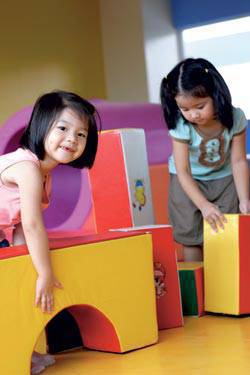
 Nothing beats the high of seeing your four- year- old dress up without help for the first time. After pulling off this feat, you’re at the edge of your seat waiting for another triumph to transpire. But as your child knocks off one milestone after another, it’s important that you’re right there beside him.
“Children learn best in the context of health, positive, and nurturing relationships with their parents and the other significant adults in their lives-including their teachers, peers, and family members”, explains Rosa Milagros Santos, Ph.D., associate professor of the Department of Special Education- University of Illinois, USA. Thus, being doting “stage parents” can be a big plus at this point.
As your child develops many of the skills he would need for everyday living (cognitive, physical, motor, social, emotional, language, and communication), keep in mind that what he learns and masters today will predict his success in the late years, Dr. Santos adds. That’s why it’s important for parents to understand how preschoolers acquire and develop life skills as well, says Rosita Guevarra, early childhood specialist and principal at the Little Presidents Learning Palace Preschool in San Miguel, Manila.
Dr. Santos stresses, however, that every child is different; each develops at a different pace. “Perhaps some sooner than others, simply because of their genetics and the environment with which they interact,” Dr. Santos says. Children have an inherent drive to explore and master their
environment because they are active participants in their own development.
How do you know your child is becoming a member of the big kid league? Look for the following:
From chatterbox to storyteller
Amazing skills – Your preschooler is learning an average of nine to 20 words a day, stringing together five to six words in a sentence just by listening to conversations and stories read aloud to him. He can now speak and express himself clearly to adults and caregivers. With a longer attention span, your child is more keen on recalling stories that he has read or heard, and would not tire of entertaining you with his fantastic attempts at inventing action and rhymes.
Must-do – “Surround your preschooler with printed materials so he can see and learn their many uses,”says Guevarra. Make reading, writing, and listening materials accessible. Seeing words around him can boost his early language development and, later on, his quest to read. But don’t force him into reading. Doing so will make it seem like a task, and not a fun thing to do.
Click here to read about more preschooler to big kid milestones.
[previous|page|next]
Read on for more preschooler to big kid milestones.
Busy with sorting, matching, and counting
Amazing skills - Counting becomes his favorite pursuit. He can count up to 10 and maybe a little more than that. Your preschooler now understands the concept of one-to-one correspondence, not just rote counting. He’s also getting better at sorting and matching; and becoming adept at naming and identifying objects according to size, shape, color, and texture.
Must-do - Stretch your child’s developing thinking skills (problem solving, memory, and reasoning) and boost his proficiency in math and language through fun, engaging games. Play thinking games that will let your preschooler identify and classify places, things, and ideas,
suggests Guevarra. Give him multicolored blocks and shape sorters, as well as all sizes of objects to count and textured toys to touch.
Dr. Santos adds, “Toys are tools for learning and most effective when a parent sits with the
child and engages him in meaningful conversations.” Take advantage of these teachable moments during play, “because this is when a child is highly interested and willing to learn skills,” she says.
Budding artist
Amazing skills - Your preschooler loves to draw and doodle. Only this time, his drawings are becoming more representational. This developing dexterity accounts for his ability to: Use kiddie scissors when cutting, draw circles and squares, and sketch a person with two to four body parts. He can also explain the meaning of his drawings with ease.
Must-do - A corner stocked with paper, crayons, pencils, and an assortment of other art materials
is any preschooler’s sanctuary. Encourage your child’s interest in art and zest in expressing his thoughts and ideas by letting him play with a variety of art materials. In Exploring: Child Development from Three to Six Years, a book on developmental theories and child care, authors Dianne Nixon and Maree Aldwinckle suggest not to teach drawing and painting. Instead, value each child’s creations and let him develop his own style.
Click here to read about more preschooler to big kid milestones.
[previous|page|next]
Read on for more preschooler to big kid milestones.
Moving to a new beat
Amazing skills - What used to be an awkward gait is now an effortless stride for your preschooler. He has achieved mastery in walking and running, Guevarra explains, so he’s bent on discovering and honing other movements like kicking, throwing, catching a ball, climbing, and skipping. Your child can now go up and down the stairs without your support, copy simple dance steps, and move forward and backward with agility. He also likes doing crazy stunts like standing
on one foot. His limbs are its most flexible, says Guevarra, as his bone density builds up.
Must-do - According to Nixon and Aldwinckle, .Self-concept develops as body awareness increases. Thus, a calcium- and mineral-rich diet is important at this stage. Also, exposing a preschooler to an array of activities that hone his gross motor skills will create a positive impact on his development. “Fun, no-fail activities should be developed to encourage them to practice skills they are not yet confident in,” they say.
“I can do anything!” attitude
Amazing skills - Your tot can now do several self-help tasks- like buttoning his own shirt.
He now has increasing control of his fingers (fine motor skills), has a more flexible wrist, and can move them with precision. This accounts for a number of useful self-help tasks that a preschooler is able to do, like putting on and taking off his clothes without help, fastening buttons and zippers, and using a fork, spoon, and sometimes, a plastic table knife. Taking care of his toilet needs, Proper wiping, hand washing, and such may take more practice, but will definitely be achieved in no time.
Must-do - Involve your growing preschooler in daily routines to establish continuity. Give him simple chores like setting the table, or pouring his own drink from a lightweight pitcher to a drinking cup. Let him dress and undress without you hovering about or interrupting. Play “throw and catch” to boost his developing motor skills.
Click here to read about more preschooler to big kid milestones.
[previous|page|next]
Read on for more preschooler to big kid milestones.
Master of his own development
Dr. Santos says, “Children are active participants in their own development. This, she says, reflects the child’s inherent drive to explore and master his environment. Consequently, “Children
can reach a full range of competencies through typical, everyday environment and activities that
are meaningful and interesting,” she adds. “The key is to know your child and find out what sparks his interests, then use these interests as starting points to learn skills,” Dr. Santos explains.
“Developmental competencies vary significantly across a wide range of individuals and cultures; one culture may value certain developmental milestones while others may not.”— Rosa Milagros Santos, Ph.D.
SOURCES
● Rosa Milagros Santos, Ph.D., associate professor, Department of Special Education, University of Illinois, Urbana-Champaign, Illinois
● Rosita Guevarra, early childhood specialist and principal, Little Presidents Learning Palace Preschool, J. Laurel St., San Miguel, Manila
● Exploring: Child Development from Three to Six Years by Dianne Nixon and Maree Aldwinckle
Special thanks to Little Presidents Learning Palace, J. Laurel St., San Miguel, Manila, tel. 733-4494
Photography by Jun Pinzon

Lorem ipsum dolor sit amet, consectetur adipisicing elit, sed do eiusmod
Lorem ipsum dolor sit amet, consectetur adipisicing elit, sed do eiusmod
