
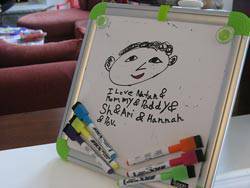
 TWO WORDS: writing legibly. If you’re a mom to a preschooler, these two words could make your palm sweat and leave you fidgeting relentlessly. The pressure of seeing your child inscribing his name neatly and easily on a piece of paper can be overwhelming. Imagine the weight it presses on your young scribe!
How do you achieve the best results minus the stress? There are fun ways to practice handwriting without forcing your child to write. Maro Pilapil, school director of Kinderhaus Learning Center in Quezon City, believes that your tyke’s little hands need to be prepared before actually introducing formal writing tools like pencils and crayons. The key, she says, is to develop your child’s fine motor skills first.
Here, some cool techniques and strategies to try with your child.
Clay play
“Rolling, tapping, and making shapes out of non-toxic clay fine-tunes your child’s fingers, preparing him for correct pen and paper work,” says Marierose Yuzon, academic assistant for Language Arts at the Miriam College Child Study Center in Quezon City. “It may sound trivial to some, but playing with clay actually does wonders to the flexibility and dexterity of the hand muscles,” Pilapil adds.
One, two, tie my shoe!
Simple everyday tasks like lacing his shoes and zipping up his trousers will help your child determine his dominant hand—the hand he will eventually use for writing. “Do not force your child to use one hand when he clearly prefers the other,” says Yuzon.
Show your child how it is done then give him a lot of time to practice. “These tasks aren’t easy for a five- or six-year-old, so be patient,” says Yuzon.
Guessing game
Put an item inside a box (a stuffed toy, for example) and ask your child to guess what’s inside by shaking, feeling, listening, or if it’s edible, tasting it. Sensory activities make use of the hands to feel the surface of the object, says Yuzon. This is a surefire way to develop hand-brain coordination.
Click here for more games and activities to help improve your preschooler's handwriting.
[previous|page|next]
Here are more games and activities to help improve your preschooler's handwriting.
Art smart
Work on your child’s fine motor skills while encouraging his artistic side. Colored paper, blunt scissors, yarn, ribbon, and paste spell hours of fun. Help him cut out shapes and paste them on paper to create a unique design. Punch holes on the sides of the shapes and ask your child to work the ribbon in and out of the holes.
“Take beans from the kitchen, like monggo, and have him paste these on his drawing, or get real beads with holes and string them together to make a bracelet.”
Say tweeze!
Tweezers are awesome tools for legible handwriting. “Give your child cosmetic tweezers, and have him pick monggo seeds or small beads with it,” suggests Yuzon. This activity helps develop the strength of his little fingers.
Clamp ’em up
Give your child a pair of kitchen tongs and ask him to open and snap them close to the rhythm of a song you both like to sing. Make sure to do this with each hand, one at a time. This is also another way to help your child determine his stronger hand, says Yuzon.
Building blocks
For future architects and engineers, wooden blocks or snap lock cubes promote coordination, manipulation, and creativity. Let them feel the 3D shapes, snap them together, pull them apart, build and rebuild over and over. Construction toys boost both critical thinking and motor skills development especially in the early years, Yuzon explains.
Color me happy!
Give your child a large piece of paper to paint on, and show him how to use vertical and horizontal motions. “This develops the wrist, the source of most hand movements,” says Yuzon. Get creative with painting tools and materials, she suggests. Use different sizes of paintbrushes and sponges as well as your bare hands and fingers for varying effects.
Scribbling
This may be the only practice activity that requires holding a pencil, but you’re not about to write letters or numbers just yet. “It’s more like letting your child doodle and write anything he wants to—sans the pressure,” says Yuzon. What you should take note of, however, is the way he holds the pencil. The goal is to learn the “tripod” way—thumb, pointer, and middle fingertips only. “Let your child use those large, triangular pencils first, to practice proper grasp,” Yuzon suggests.
Take note that your activities and the amount of time you spend doing them should be age-appropriate, or else your child would end up frustrated or bored. “Children younger than four should spend no more than 10 minutes for handwriting improvement activities. Four-year-olds can handle 30 minutes, while five-year-olds can take 45 minutes,” she says. If he goes away or does something else in the middle of your sessions, do not force him to stay. “Just make adjustments based on the clues,” she suggests.
Engage in these fun activities with your child as often as you can. Keep the materials available all the time so he can do them without you, at his own time, Pilapil says. Happy scribbling!
Scribble Away!
Rowena Juan-Matti, chief executive officer of Galileo Enrichment Learning Program, Inc., recommends the following tools to help improve your preschooler’s hand function, strength, and dexterity:
- Bat-and-ball toys Strengthen shoulders and wrists
- Bean bags or marbles Let him juggle, roll, and play with these to improve dexterity
- Work benches Simulation toys that involve hammering and turning screws are great workout toys for the hands
- Maze Improves hand-eye coordination, which is needed for writing
- Number and letter peg boards Exercise hands and fingers, and sharpen letter-
recognition skills - Wooden building blocks Help develop motor skills, hand-eye coordination, spatial skills, creative problem-solving skills, and language skills
- Squirt toys Squeezing keeps the wrist muscles fit and ready for scribbling
Sources
- Marierose Yuzon, academic assistant, Language Arts, Miriam College Child Study Center, tel. 435-9235
- Maro Pilapil, school director, Kinderhaus Learning Center, 14 Sgt. Esguerra Ave., South Triangle, Quezon City
Photo from flickr.com

Lorem ipsum dolor sit amet, consectetur adipisicing elit, sed do eiusmod
Lorem ipsum dolor sit amet, consectetur adipisicing elit, sed do eiusmod
