
“Same old; same old boring stuff.” How many parents hear this line from their kids, in spite of cheerfully asking how their day was? Something must have happened somewhere between kids skipping to school in kindergarten and the drudgery in their steps when they hit middle school.
This is the same thing thespian and mentor Audie Gemora noticed in many of the children he had mentored in Trumpets and mostly, in his son Richard. “For years, education followed a rigid, unchanging pattern. School has become something mundane and uninspiring. Children go to school simply because they have to and, while there, they are subjected to endless classroom drills. Math and science are reduced to steps and procedures, language to long lists of hard-to-pronounce spelling words, history to key dates, geography to national or provincial capitals. It was all so simple but very monotonous, academically rigid yet measures merely memory rather than understanding,” he says. “In my view a good academic institution is one that recognizes every child's uniqueness and is able to develop him according to his specific intelligences and talents.”
Audie shares how his son has attended two different schools that focus on academics. “Left brain development. I feel his many other talents and interests are not being developed nor tapped. I want to afford my own son an education that he will value, one that will maximize his full potential rather than get him to aim for high grades.”
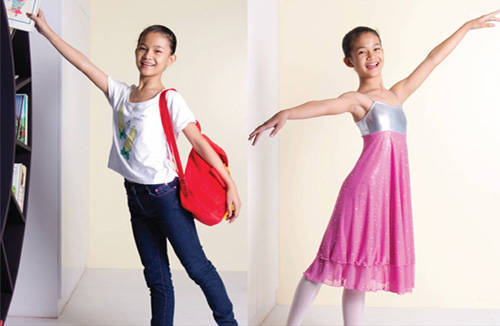
His sentiment was apparently not unique. Knowing him as an experienced developer and mentor of talented kids, his fellow-parents in Richard’s school approached him and asked about the possibility of forming a more balanced program for kids. “The vision was to put up a progressive school that would be considerate of every child's uniqueness. They asked if I could set up an arts program to augment the regular curriculum. I immediately recognized that this was the solution to the dichotomy of academics and arts! What we came up with is a school that will provide progressive academic education, paralleled by a progressive arts program and in between our flagship, arts integration. Arts integration uses the arts to aid in the teaching of regular subjects.”
[previous|page|next]

Completing the core group behind TSAA were businesswoman Vilma Moredo, child development expert and former UP educator Dr. Evalyn de Guzman-Hizon, entrepreneur and Industrial Designer Edwin Ayroso, and music maven and teacher Emmy Cayabyab. Named Talent School for Academic and Arts, or TSAA, the school that was born from the idea of parents grew further to include partners who provided the academic and administrative aspects, completing what many would see as the ideal.
“Sharing the vision behind Talent School of Academics and Arts or TSAA, because it is ground breaking, was like pushing a cart uphill. Thankfully we are at the top of the hill and the ride down is easy as more people catch the vision. Most people think the term ‘talent’ refers to an artistic gift when in fact Webster defines talent as the ability to do anything well. This includes talent in sciences, math, languages. If a child is a math whiz he is talented. The challenge now is to explain to the public that TSAA is not an arts school but a full academic school with a comprehensive arts program,” Audie adds.
Today, the school stands in an impressively-designed multi-level building along Don Chino Roces Avenue in Makati. Dep Ed authorities did an ocular of the school and likened the facilities to “a five star hotel,” Audie proudly beams.
But beyond the physical aspects, the foundation that was prioritized was the curriculum and teaching methodology. Cherry Fernandez-Napala, the school’s principal, adds, “TSAA’s curriculum integrates evaluation of the children’s work and of the program on an ongoing basis. This process incorporates extensive documentation of children’s work including individual student portfolios, exhibits, recitals, weekly review and planning meetings with teachers and artists, and an assessment of learning objectives conducted by the teacher three times annually.
“This balanced curriculum and teaching methodology supported by parent involvement and community outreach will develop in children a lifelong love for learning, a deep awareness of themselves and nurture strong relationships with family, the environment, the outside community and the world for a better tomorrow.”
[previous|page|next]

Audie says, “The trend in education in the US is towards creativity. In a world spurred on by innovation the education system is beginning to build more opportunities for students to be creative in the classroom.” At TSAA, the partners share, parents will see their child grow in all aspects: spiritually, academically, creatively, emotionally, physically. Their children are going to love going to school. “We like to refer to the parable of the talents at Talent School of Academics and Arts. God has given us children with not only one, but many talents and it is our duty to develop these fully.”
If he were to base all these values and principles which they have put into TSAA on his personal experiences alone, Audie attests, “Albert Einstein said: if you judge a fish for its ability to climb a tree it will spend its entire life believing it is stupid. I was a product of a traditional school where the educational approach was homogenous, generic. Up until high school I was an under achiever. Then I providentially stumbled into the arts. Once I discovered my talents, my academic performance improved greatly and I even made honor's list. Had I not accidentally found my portal of intelligence, I’d have spent the rest of my life believing I was stupid. Today I am a successful businessman as well as an accomplished artist.”
For its maiden academic year, TSAA is offering programs from Preschool to Grade 2 levels. More information and the enrollment details are available at www.tsaa.com.ph and at facebook.com/TSAAPH.

Lorem ipsum dolor sit amet, consectetur adipisicing elit, sed do eiusmod
Lorem ipsum dolor sit amet, consectetur adipisicing elit, sed do eiusmod
