
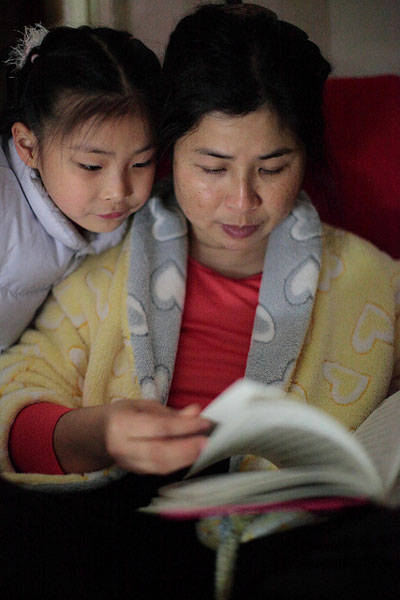
Homeschooling is becoming a more preferable option for many families nowadays. Dr. Francis Dimalanta, M.D., behavioral and developmental pediatrician, advises parents who are planning to homeschool to consider the following questions:
• Is homeschooling an answer to the family’s economic situation?• Is it addressing the family’s concern on peer pressure or bullying?
• Are the parents considering religion or certain values as a set part of their child’s education?
• Is the homeschool curriculum accredited by the Department of Education or even the U.S. Department of Education, in case the family is interested in further education abroad?
Vicky Alcordo, former high school English teacher and home teacher to her three kids, opted for the U.S.-based Calvert home school program for the following reasons:
• They personally reviewed the curriculum and found it complete and appropriate for their kids.
• The program gave them consistent support, always answering questions the following day.
• The program provides them with all learning materials and the option of a dedicated teacher to check the children’s work and grade them.
Bev Alarcon, entrepreneur, freelance web developer and home teacher to her three kids chose a local homeschool program that has a Christian U.S.-based curriculum, Living Heritage Academy because:
• The program has DepEd accreditation through its affiliate, School Of Tomorrow based in Paranaque City.
• They cover all basic subjects including Araling Panlipunan and Filipino.
• They provide parent training and ready-made work books that incorporate quizzes, tests, goal set forms, and grading forms.
[previous|page|next]
Do you have the right reasons for educating your child?
According to Genevieve V. Rivadelo, executive director of Alternative Learning Resources School (ALRES) and chair of the Special Education department at Miriam College, homeschooling “is a very good alternative for a child. One of the greatest benefits is the bond within the family. The child becomes more secure.” This is not to say that she endorses “helicopter parenting” - a term coined from the burgeoning literature on parenting. It refers to parents who “over-parent” or “hyper-parent” by hovering over their children in all their activities.
Rivadelo observes that sometimes, a parent may choose to homeschool simply to protect their child from harm and from peer ridicule. “The goal of education is not to protect a child from harm,” opines Rivadelo. “Its goal is to empower a child to protect himself and live in the real world where both negative and positive situations may be encountered.”
Dr. Dimalanta agrees,” Parents should find a balance. If homeschooling is used as a cocoon to keep kids safe and sheltered, how are kids being prepared for the real world?” Parents need to evaluate if they are choosing their child’s education for their child’s sake or for their own sake.
What does it financially cost to homeschool?
In the U.S., a homeschooling household spends only 40 percent of what the U.S. government spends for public school per year, per child.
• For Vicky, the savings generated by homeschooling is enough to send off the family on a yearly vacation outside of the country. “Aside from this, you can re-use some of the materials you’ve purchased for an older child and pass them on to her siblings. This adds to your savings as a family.”
• For Bev, the expense involved for homeschooling her brood of three is just P15,000 for a one-time registration for all her kids: P3,000 per child for tuition fee and P10,800 per child for colored activity books (activity book prices may vary according to the child’s level). She adds that multiple intelligences school tuition fees can be as high as P90,000 per child, per year.
[previous|page|next]
Is teaching experience required?
“Interestingly, having at least one parent who is a certified teacher appears to have no significant effect on the achievement levels of homeschooled students,” states the study, Home Schooling: From the Extreme to the Mainstream.
According to Bev, some homeschool programs require the home teacher to have a college degree. However, her homeschool program, Living Heritage Academy, does not require it and, in addition, provides training to parents. She encourages homeschooling to parents, whatever classification they fall under: dads, single parents, even working parents. “My three kids learned how to read from me. I feel so accomplished and proud. Di naman ako education major. That proves kaya ng isang simpleng parent magturo,” she adds.
“Any parent can homeschool,” Vicky agrees. “A background in education certainly helps, but it’s not necessary.” However, teaching requires a parent to be a student as well. To ensure that their kids have really learned a subject, parents need to be confident in their subject mastery.
Can you really find the time?
For parents who don’t think they have what it takes, Vicky shares the story of a couple who does tandem home schooling. The dad, who happens to be an executive at a local telecommunications company, teaches his kids math from 7 a.m. to 8 a.m. prior to his office hours. The mom then takes over for the rest of the day. So far, they’ve been successful at this arrangement.
“One to two hours a day is enough for young kids,” Bev says. “Depending on their age, a child just needs four to five hours of homeschooling. They need to play and enjoy their childhood.” Because the kids don’t need to spend time commuting, lining up for assemblies, and waiting for teachers to show up, they end up spending all their productive time learning. Mom also doesn’t have to wake up at 5 a.m. to prepare breakfast before the school bus arrives.
According to Carl Honore, in his book Under PRESSURE: Putting the Child Back in Childhood, “What children really need from us is time and encouragement. That does not mean running the home like an academic boot camp, with every moment scrutinized for its teaching potential. It does mean lots of conversation and curiosity about the world.”
[previous|page|next]
Commitment, the real personal cost to homeschool
Vicky’s top advice for parents who are considering homeschool: • Consider your relationship with your child. If you are secure and open to being a teacher to them and not just Mom or Dad, go ahead. Homeschooling is not the venue for sorting out strained relationships (whether between children and parents or between spouses).
• Be committed. It’s a full-time job for at least one of the parents. The parents have to evaluate lifestyle changes and routines. It’s not easy but the rewards are priceless.
• If you’re planning to enroll your child in the local high schools, don’t forget the subjects Filipino and Araling Panlipunan. You can get support from local homeschool programs or opt for tutorials.
• Observe a homeschooling parent go through her day. This will give you a better idea of what goes on during homeschooling and what techniques a home teacher has at her disposal. You’ll be surprised at how open and supportive homeschooling parents are to their fellow home teachers.
“All I would consider for homeschooling is the parents’ level of commitment,” Rivadelo says. “Skills can be learned but commitment is really the key. Homeschooling requires daily responsibility, creativity, and objectivity. A parent has to balance keen observation and letting his child master a subject without hovering.”
Dr. Dimalanta asks parents to consider that “this is an all- year round commitment. Are the parents ready for this? Are they equipped to teach their child - mindset, patience, academic knowledge, confidence, comfort level? Is the decision to homeschool a joint one - parents and child?”
Parents have the final word
According to Mel Levine, M.D., in his book A Mind At A Time, there are times when parents find it impossible to partner with schools to educate their children. This is especially true when the child has significant differences in learning. While Dr. Levine has reservations on some parents not being in the position to deliver rigorous education a child needs, he admits that “all kids should be homeschooled and most are - part time.”
Homeschooling, just like traditional social schooling or even progressive schooling, is a parent’s choice and prerogative. You can take your time weighing all the pros and cons, but you will need to decide at some point. The good news is that a lot of choices have opened up for parents in the last decade. You don’t need to be stuck with just one or two options. What you do need to remember is that education doesn’t stop in the classroom - whether that classroom is at home or in a school.
[previous|page|next]
Homeschooling Resources
1. Angelicum College
http://www.angelicum.edu.ph/hsp.html
Catholic Home Study Program from elementary to high school. Contact information: (02) 732-4243 loc. 118 or (02) 4158557
2. Colegio de San Juan de Letran
http://www.letran.edu/elementary/admission.php
Catholic Home Study Program from elementary to high school. Contact information: Elementary Principal’s Office—(02) 527-7693 to 97; local 45 or 46
3. The Master’s Academy (TMA)
http://homephilippines.multiply.com
A Christian school founded by the Christ’s Commission Fellowship (CCF) that has been offering a DepEd accredited international homeschool program since 1999. Regular group activities provide children with opportunities to interact as well as to display their talents.
Contact information: 3rd Floor St. Francis Building, Bank Drive, Cor. Julia Vargas, Ortigas Center, Mandaluyong City 1550
4. Catholic Filipino Academy (CFA)
http://www.catholicfilipinoacademy.com
The first Philippine Catholic homeschool program, co-founded by Bo Sanchez (www.bosanchez.ph), offers DepEd accredited education for preschool to grade school students. It provides training materials, lesson plans, and textbooks and support from other homeschooling parents. CFA is affiliated with Power Kids Academy, a private school located in Bulacan. Contact information: CFA, Lighthouse, 60 Chicago St., Cubao, Quezon City 1109, Philippines—(02)533-6097 and CFAinquiry@gmail.com
5. The School of Tomorrow (SOT)
http://www.sotphil.net/contact.htm
A Christian home school program for kindergarten to high school levels that has been provided by the U.S.-based organization Accelerated Christian Education since 1970. It makes use of the latest computer technology in providing an individualized education with a strong religious background.
Contact information: Mrs. Remia Camacho, rcamacho@sotphil.net
Trunk line: (02) 822-9663 Locals 125 to 130, School of Tomorrow®, Philippines, MJS Ave., Levitown Executive Village, Brgy. Don Bosco, Parañaque City
6. Get Facts On Home Schooling from U.S.-based NHERI (National Home Education Research Institute): http://www.nheri.org
7. Home Schooling in the Philippines web ring: htp://homeschoolingphilippines.wordpress.com/
8. Home Schooling According to Mommy Bloggers:
http://teachermamatina.blogspot.com/p/homeschooling-resources.html
http://teachermamatina.blogspot.com/p/filipino-homeschoolers-unite.html
9. A Home Schooling Mom’s Account: http://ivymarquez.multiply.com
[previous|page|next]
Sources:
• Genevieve V. Rivadelo, Ph.D. (Cand.), PTRP, executive director, Alternative Learning Resources School (Philippines) or ALRES; chair, Special Education Department, Miriam College
• Francis Xavier M. Dimalanta, M.D., Developmental and Behavioral Pediatrician, St. Luke's Medical Center, Quezon City
• Vicky W. Alcordo, former high school English Teacher, home teacher
• Beverly Alarcon, home teacher, entrepreneur, freelance web developer
References:
• Nurture Shock by Po Bronson and Ashley Merryman, Twelve, Hatchette Book Group, NY, 2009;
• Under PRESSURE: Putting the child back in childhood by Carl Honore, Orion Books Ltd., 2008;
• A Mind At A Time by Mel Levine, M.D., Simon & Schuster paperbacks, 2002;
• Now, Discover Your Strengths by Marcus Buckingham and Donald O. Clifton, PhD, The Free Press, NY, 2001.;
• Home Schooling: From the Extreme to the Mainstream, 2nd edition, by Patrick Basham, John Merrifield, and Claudia r. Hepburn, Studies in Education Policy, A Fraser Institute Occasional Paper, October 2007, Digital document available at: http://www.fraserinstitute.org/researchandpublications/publications/4932.aspx
• National Home Education Research Institute, http://www.nheri.org;
• “Homeschooling and open universities in the Philippines”, wikiPilipinas: The Hip ‘n Free Philippine Encyclopedia, http://en.wikipilipinas.org/index.php?title=Homeschooling and open universities in the Philippines;
• “Ten Powerful Principles on Homeschooling” by Bo Sanchez, digital document available at: http://catholicfilipinoacademy.com/cfa/10principles.php
Photo from flickr creative commons

Lorem ipsum dolor sit amet, consectetur adipisicing elit, sed do eiusmod
Lorem ipsum dolor sit amet, consectetur adipisicing elit, sed do eiusmod
