
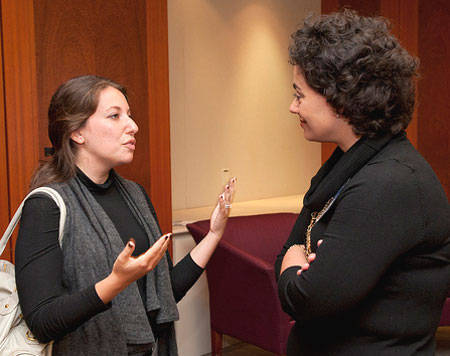
Starting the school year right doesn’t just involve preparing your home to be more conducive for learning – it also means knowing how to deal with those who will be responsible for your kid when they’re in school. This includes the teachers, as well as the school administration.
Cheryl Golangco, a preschool teacher at Makati Hope Christian School and the owner of LittleRunningTeacher.com, says that each school usually has its own ideas on how to make a school year “great,” though these are not necessarily the same as the parents’ own ideas.
Nonetheless, Cheryl says that parents should feel free to share their thoughts in a very calm and open environment. “There’s a tendency for parents to get mad (when things don’t go as they expect them) but please don’t!” she adds. “Communicate with the school as often as you need. You have the right to get updates at least once every two weeks or per month.”
Educator Myra Mabugat-Menguito, who draws from her many years of experience working with families and schools through the CFC Educational Foundation, Inc., says when parents and school administration commit to “start off at the right foot” at the beginning of the school year, the school is actually giving the parents the chance to be their children's primary educators, because that's what they really are in the first place.
“It's also about parents accepting that role/responsibility, because it is such a privilege to be our children's primary educators,” adds Myra, who is also mom to Paola Maria, 13; Joaquin, 8; and Tanya Maria, 4. “Thus, starting off at the right foot entails collaboration between the home and school. It is about always coordinating and cooperating with the school by attending functions, seminars, and all other activities initiated by them, as much as possible.”
[previous|page|next]
“On the part of schools/educators, ensuring a strong parent-school relationship entails listening to the parents and extending to them all the support and assistance they need in raising their children well, especially for them to be grounded on virtues and values,” she goes on to say. “Therefore, this means there should be open and constant communication and collaboration between the child’s school and home.”
Mommy Myra shares her own experiences when it comes to communicating with school officials: “Communication must be constant and consistent. As a parent, I communicate with the school/teachers every inch of the way: thanking them, airing out my concerns and sharing with them the challenges I face in bringing up my children. I am open and honest in a personal way.”
“As an educator, I see to it that the parents know everything that is happening to their children: their good deeds, misdeeds, accomplishments, and tips to help their children cope with academic/social/emotional/spiritual development,” she adds.
“I thank the parents for being there, honor them for taking part in school activities, and communicate with them in a personal way so they don't feel threatened or intimidated. It's all about expressing respect and trust that each party will fulfill the roles entrusted to them,” Myra emphasizes.
The mom who founded Bisaya Babe, an international community advocating to help the poor and underprivileged children of the Philippines receive access to free education, says an open forum to discuss the school policy on all matters related to student-teacher relationships is a good venue where parents can address teachers on issues about their kids’ safety on campus.
“With the recent spate of bad incidents like child snatching, child molestation, school bullying, plus other concerns like food safety at school canteens, tuition hikes and the like, parents should be able to discuss with the school how they are preparing measures to address such matters,” she says. “A bi-monthly meeting is ideal.”
[previous|page|next]
Mommy Donna Donor-Javier, a work-at-home-mom to Kib, 5, says that when it comes to bringing up concerns with your child’s school officials, it may be best for parents to address their child’s teacher first.
“If there’s a parent representative, you could try raising the concern with him or her first, especially if you feel that your concern will affect the whole class,” she adds. “If your concern involves only your child, you should set an appointment with his or her teacher.”
Donna advises her fellow parents to be cautious though. “If your concerns are not so urgent, it may be best to wait for the scheduled parent-teacher conferences, as raising minor concerns all the time may create an impression that you are demanding.”
“Nowadays, schools usually schedule meetings with parents anyway, especially before classes start. Usually these are when expectations are set, curriculum is discussed and school activities are laid out,” Donna shares.
Business owner Christine Arteta, mother of five-year-old Avienda, agrees that it is important for parents to keep constant communication with their children's teachers. “If we are to become responsible parents, we should keep ourselves updated with the people who influence our children,” she expounds. “We may not be able to control factors outside the home but we can address them before things get out of control.”
“Being informed with everything that is going on in school is part of responsible parenting, because we not only trust that the school will take care of our children, but we also make sure that what the school teaches our kids is not in conflict with our own values,” Christine adds.
[previous|page|next]
“As long as communication doesn't negatively affect the teachers and school administrators, and doesn't take too much of their and our time, we should do it as often as we can,” she continues. “I also believe that being friends with everyone in the community is important. Establishing a good parent-teacher relationship (and creating a friendship along the way), promotes harmony, and helps parents and teachers to understand and find better ways to educate and bring up the children.”
Christine believes that parents should also remember to try their best to avoid criticizing their child’s school and its ways of educating, and to avoid complaining.
“Some parents get in touch with the teachers and school administrators mostly to complain when something goes wrong,” she explains. “We should also practice expressing our gratitude and giving good feedback, especially whenever the school has produced significant good “traits” in our children (e.g. you noticed that your son is more confident, or your daughter is less shy). It is one way of helping the school continue doing what they do best.”
Mommy Christine ends by expressing her own opinion regarding constant communication. “It is really a key to success," she says. “This actually applies to everything, not just educating our children.”
“When it comes to communicating with our children’s school, there are many ways to do so. Formal parent-teacher meetings are not the only way to address our concerns and to express our appreciation,” Christine shares. “Getting in touch with our children's influencers is easier now due to modern technology (e.g. cellphone, social media and email).”
“We parents may not always be there for our kids, especially with our busy work schedules, but we must always be updated with what is happening to them when they are out of our sight,” she ends. “This information is very important in helping us keep our kids walk in the right direction.”
How do you strengthen your relationship with your children’s school administration and teachers? We’d love to get your inputs! Please feel free to leave a comment below.
Photo by University of Delaware Alumni Association from flickr creative commons

Lorem ipsum dolor sit amet, consectetur adipisicing elit, sed do eiusmod
Lorem ipsum dolor sit amet, consectetur adipisicing elit, sed do eiusmod
