
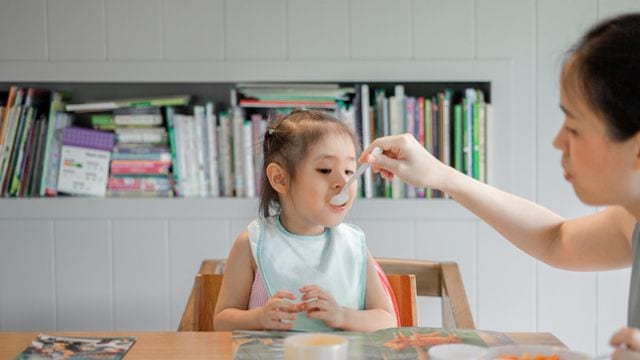
Children’s eating habits are tricky - parents need to know the right food, timing and amount, not too many sweets, maybe a lot of vegetables.
On top of this, a child’s mind is usually full of endless curiosity about the world, and sometimes sitting down for just one meal is impossible.
And if all parents are honest, meal times are sometimes a time of struggle. “Just one more bite,” we often hear ourselves say.
“Tapusin mo na ang pagkain mo, umupo ka dito.”
And if all our tricks don’t work, “Bibigyan kita ng ice cream pagkatapos mo kumain.”
RELATED: 'Anak, Isang Subo Na Lang': Why Experts Say This Phrase Sends The Wrong Message
‘Eating fast’ in the question pertains to a child focused on eating and finishing his meal, not necessarily about how many minutes a child eats.
Smart Parenting took the question to Smart Parenting Village and parents shared their tested and proven tips and what they did to make their child eat ‘faster’:
How to help kids eat 'faster'
1. No distractions
This was a unanimous suggestion from all parents: avoid distractions during meal times like gadgets, TV and toys.
Vanessa Yaco and Rachelle Anne Ocbena-Manuel said, “No distractions like TV, toys and gadgets.
Paula shared that before, this was also her problem, “Noon problem ko ito sa anak ko pero ngayon hindi na. 20 to 25 minutes tapos na siya kumain.”
She shared the first thing she did, “No gadgets. No watching television. No toys. Respeto sa hapag-kainan. And, in this way,makakapag-focus siya sa pagkain.”
'Sinasabayan naming kumain. They will follow what we do, not what we say
Paula also shared another secret in removing gadgets and TV during meal time, “Sinasabayan naming kumain. They will follow what we do, not what we say. Also, we consider this as isa sa mga quality time namin and may small talk kami kung kumusta ang school niya, ang araw niya at kung may mga gusto ba siyang i-kwento o i-share sa amin.”
Paula replaced gadgets with small talk, hitting two birds with one stone: no distractions over meal times and lots of quality time with kids.
RELATED: 6 Simple Ways to Change Your Child's Picky Eating Habits, According to a Pediatrician
2. Offer age-appropriate foods
Paula shared another tricks she did with her kids, “Try to cut the ulam lalo na yung mga mahihirap nguyain like beef, meat at chicken. Sa ganitong paraan, mas madali silang makakakain. Ganun din sa fruits.”
Aside from this, Paula also noted, “Be creative. If kaya ng time at budget, magshape ng rice at ulam gamit ang molder (may nabibili sa Shopee at Lazada).” Adding a little bit of visual presentation can help in getting the child’s attention back to the food.
RELATED: Healthy Eating Hack: A Mom 'Brands' Fruits and Veggies With Tot's Fave Character Stickers
3. Be consistent
Another important point was added by Paula, “Be consistent. Kung 6AM siya kumain ng breakfast, dapat ganun lagi. Same as snack, lunch at dinner. Hindi pwedeng kakain lang siya kung kailan niya gusto. Train him and be consistent. Be gentle.”
She shared that building a routine can help the child in the long run. It is also a training process that needs consistency.
4. Manage parents’ expectations
Vanessa Yaco, on the other hand, pointed out an external factor in our child’s eating habit–parent’s expectations.
While the tips mentioned above are proven effective, Vanessa put an emphasis on parents’ expectations, “How much are we feeding them? Is it an amount that our kids can ideally finish within a short amount of time?
Hindi naman 15 minutes, but let’s say 30 minutes kasi mga bata lalo na maliliit pa, usually have a minimum of 3 minutes to eat because they are easily distracted and they tend to explore the food with all their sensations (the visuals, the smell, the texture, etc).”
'Are we forcing our kids to finish up their plates even if their bodies tell them they’re already full?
She continued, “Are we forcing our kids to finish up their plates even if their bodies tell them they’re already full? Minsan din po kasi mataas expectations natin sa kanila na matapos o maubos nila yung pagkain and with them not wanting to offend or hurt us by notfinishing their food may end up trying too hard to finish the food that leads them to spend somuch time.
"Yun pala, busog na o wala nang gana (which, essentially, isn’t a bad thing). Our bodies have their cues kaya nagkakaiba approach natin sa pagkain.”
Paula also said, “Encourage your child to eat more. Walang magandang maidudulot kapag pagagalitan. Habaan ang pasensya.”
RELATED: Mom Shares Secrets How Her Kids Went From 'Maselan Sa Pagkain' To 'Magana Kumain'
Parents also need to learn how to manage expectations towards the child’s eating habits, whether they eat ‘fast’ or ‘slow’.
It is a long road ahead, but with a lot of patience, and a little dash of love, each meal time can be fast, or not as long, and most importantly a time to connect.
What other parents are reading

Lorem ipsum dolor sit amet, consectetur adipisicing elit, sed do eiusmod
Lorem ipsum dolor sit amet, consectetur adipisicing elit, sed do eiusmod
