Fact-Checked by Ronna Capili Bonifacio
This article was published on February 20, 2021, and has been updated on March 31, 2024.
A few weeks ago, I was moderating a Mystery Club meeting for our school. We talked about codes and how Leonardo da Vinci made his notes using mirror writing.
Some people believe he did that because he was left-handed and didn’t want to smear the ink. Some proposed he didn’t want other people stealing his ideas.
Is mirror writing or writing in reverse a sign of dyslexia?
While mirror writing is a cool way to send coded messages to friends, the unintentional reversals of letters, words, or phrases among young children have caused many parents’ concerns. Because some adults with brain injuries write in reverse, we worry that mirrored writing signifies something wrong in the child’s brain development.
Reversed letters sometimes bring up dyslexia worries as well. While some children with dyslexia do have trouble with reversals, the truth is most kids will stop by the age of 7.
Others mistakenly think mirror writing is a left-handed problem, but this is proven untrue. Right-handed children have been known to reverse letters.
What does it mean if a child writes a mirror image?
Teachers and other child specialists chalk up reversed letters to brain immaturity. Reversals can happen when a child has poor working memory.
For example, he can’t remember what a letter exactly looks like. It can also be caused by visual processing issues, like when young children can’t tell the difference between similar letters (like b and d, or p and q) or the direction they should face.
According to Reena Ermitano-Ray, a reading specialist, “Other causes could be weak visual-motor integration, which means they may remember the shape correctly but struggle with reproducing the figure.”
How does mirror writing happen?
A group of researchers has shown that children mirror letters in their writing direction. In English, figures that get reversed the most are the left-oriented letters (the one that you write going to the left) like J, 3, and Z. *
A 2011 study by Fischer suggested that when children were being taught to write, they unknowingly picked up that most characters face the right. Hence, they over-applied this rule to the other letters, thus reversing the direction of left-facing letters.
Ermitano-Ray also shares, “Letter reversals such as b/d, p/q are frequent and common at the early stages of writing development because these letters look alike and it takes a while for children to master correct letter strokes and left-right orientation.”
And while there is no exact age for when it starts and stops, researchers have found occasional mirror-writing between “no writing” and “correct writing” stages. (Della Sala & Cubelli, 2009; Fischer & Tazouti, 2011). **
How can you help your child with mirror writing?
The best way to help children overcome reversing letters is through practice. Allowing children to be exposed to print through books and texts (like signs, lists, notes) helps their brains form and hold better images of letters, numbers, words, and phrases.
Look for fun ways to get your child to notice letters and numbers
Try playing games that help them see these figures in different contexts, like memory games or I Spy, or by forming letters using blocks or clay.
Encourage your child to practice writing in the air
Writing in the air and various textures such as paper, whiteboard, and sand trays allows your child to work on visual-motor integration. Play directionality games—your child learns which is left from the right—like Simon Says or Following the Leader.
Let your child practice writing letters that use similar strokes
When you teach your child how to write lower-case letters, instead of teaching them alphabetically, think of training them in groups of letters that use similar strokes (for example, a, c, o, and g can be taught together).
If you notice your child is reversing letters that look similar, focus on practicing one letter at a time. Help them find words to associate with that letter.
Do the “make your bed” technique
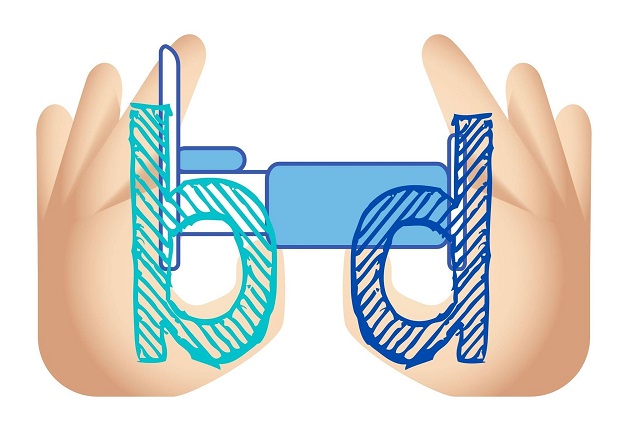
Then instruct the child to put his hands in front as you say, “The b (left hand) is the headboard, and the d (right hand) is the foot of the bed.”
Tell your child where to start on the paper
Sometimes it makes a difference. Put a dot on the upper left corner of the paper as a guide to where your child should start writing his first letter on the page.
If the child who often writes mirrored letters starts on the right side of the paper, chances are he will use the space from right to left instead of left to right. By placing a starting point for him, you re-orient his use of space.
When to worry about mirror writing
If, at the end of grade 2, your child is still reversing a lot of letters and numbers, then consult the teacher. Ask for her observations and see if she has any explanations or recommendations.
For Ermitano-Ray, most letter reversals are within normal limits until age 7.
“If letter reversals persist beyond age 7 or even after the child has undergone several years of formal schooling, a consultation with a developmental pediatrician or occupational therapist should be sought to determine the underlying cause for this to be properly assessed.”
Frequently asked questions about writing in reverse or mirror writing?
1. Can mirror writing be a symptom of other learning disabilities besides dyslexia?
Mirror writing can sometimes be associated with other learning disabilities such as dysgraphia, which affects a person's ability to write coherently and legibly. Research suggests that dysgraphia may involve difficulties with letter formation, spatial orientation, and motor coordination, all of which can contribute to mirror writing tendencies. Additionally, conditions like developmental coordination disorder (DCD) may also manifest with mirror writing as part of broader motor skill challenges.
2. Are there specific exercises or activities to prevent mirror writing in children?
Several exercises and activities can help children overcome mirror writing tendencies. For instance, activities that focus on letter formation, spatial awareness, and directional orientation can be beneficial. Handwriting exercises with an emphasis on correct letter strokes, visual-motor integration tasks such as tracing or copying patterns, and games that reinforce left-to-right directionality can all contribute to addressing mirror writing.
3. Is mirror writing more prevalent in certain languages or writing systems?
While mirror writing can occur across different languages and writing systems, its prevalence may vary. Some studies suggest that mirror writing tendencies might be more common in languages with complex scripts or characters that require greater spatial manipulation, such as Arabic or Chinese. However, further research is needed to explore potential cultural and linguistic influences on mirror writing.
4. Are there any technological aids or tools available to assist children with mirror writing?
Various technological aids and tools can support children with mirror writing difficulties. For example, specialized software programs and apps designed to improve handwriting skills often include features like visual prompts, guided tracing, and interactive exercises. Additionally, assistive devices such as digital tablets with stylus pens can provide tactile feedback and customizable settings to accommodate individual learning needs.
5. How does mirror writing impact a child's academic performance in the long term?
The long-term impact of mirror writing on academic performance can vary depending on the severity of the writing difficulty and its underlying causes. Persistent mirror writing tendencies may contribute to challenges in tasks requiring written communication, such as note-taking, essay writing, and completing written assignments. Addressing mirror writing early through targeted interventions and accommodations can help mitigate its potential impact on academic achievement.
6. Can mirror writing persist into adulthood, and if so, does it pose any challenges in professional settings?
While mirror writing typically decreases with age as writing skills mature, it may persist into adulthood for some individuals, especially those with underlying neurological conditions or persistent learning difficulties. In professional settings, persistent mirror writing could potentially pose challenges in tasks involving written communication, document preparation, and record-keeping, particularly in fields where precision and clarity are paramount.
Barbara Server-Veloso is known as Teacher Thumby in her preschool, Toddlers Unlimited, and Ms. Thumby in her grade school, Thinkers Unlimited, Alabang. She is also a partner in Spark Discovery Center in Jupiter Street, Makati, where she teaches the Baby and Me Class. Teacher Thumby has a Master’s degree from the University of the Philippines in Family Life and Child Development. She has been teaching since 1993. She is also the mother of Lucas and Verena.
What other parents are reading

Lorem ipsum dolor sit amet, consectetur adipisicing elit, sed do eiusmod
Lorem ipsum dolor sit amet, consectetur adipisicing elit, sed do eiusmod