
According to DepEd order No. 034 (unless otherwise amended), the Academic Year 2023-2024 will formally open again late next month. If you have a child who is going to attend his first school this year, you might have been deciding which school to enroll your child in. And since you are reading this article, you are most likely considering a Montessori School for your child's primary education.
So what exactly is the Montessori Method?
To put it briefly, Montessori is a method of education that is based on self-directed activity, hands-on learning, and collaborative play. It was named after its founder, (who is considered as one of the pioneers in the early childhood development) an Italian physicist and educator, Dr. Maria Montessori.
Who is Maria Montessori?
More than a century ago, Dr. Montessori, created a childcare center named Casa dei Bambini (Children's House) where she scientifically observed children and their learning abilities. Her work in a psychiatric clinic prior had a major contribution to her method as she wondered if with the right materials, all children’s minds could develop successfully. She also worked at the Ortophrenic School where she took notes based on what she saw observing the children.
At the Casa, she continued to observe children, making educated guesses about their underlying behavior. She focused on hands-on learning experience and adjusted the classroom environment according to children's needs. She replaced tall cabinets with low open shelves. She designed child-sized toilets and low sinks to name a few. When the children wanted to sit on the floor, she used rugs.
She "followed the children" and looked at them closely to have a clearer view of the inner mind of the child.
At that time, her approach to teaching and learning was significantly different than what people were accustomed to. Her method introduced the "child-centered" approach wherein the child is given the "freedom with discipline" to learn and discover on his own. Dr. Montessori learned that children are not empty vessels and that they can explore and learn at their own pace. Children are naturally curious and creative.
READ ALSO: Montessori School: Is It The Right Fit For My Child's First School?
The success of Casa dei Bambini stirred intrigue in other education pioneers. Soon Dr. Montessori would write the book, The Montessori Method in 1909, which would seriously impact education.
"The goal of Early Childhood Education should be to activate the child's own natural desire to learn." - Maria Montessori
Fast forward to today, most Montessori schools rely on this method promoting concepts of play, movement, collaboration, self-correction and self-motivation. The Early Childhood Curriculum offers five areas of study: Practical Life, Sensorial, Math, Language, and Cultural Studies.
In summary, below is what you need to know about the Montessori Method for Preschoolers:
Highlights of the Montessori method
1. Respect for the child
The Montessori method introduced the concept of "Follow the Child" which means that learning is not dictated or forced to the child; but rather, learning should be self-motivated. Every child has his own skill, gift, interest, and pace of learning. Thus, this child-centric approach allows children to make choices and channel their energy according to their focus with their teacher only as guide. This allows them to grow not only on an academic standpoint but considers "The whole child" and includes his social and emotional skills, recognizant of his cognitive abilities.
2. Mixed-Age groupings
Traditional preschool is typically attended by same-age children with a standardized curriculum where a child should meet the prescribed milestones for that age. With the Montessori method, preschoolers are a mix of 3-6 years old where the younger kids look up to the older ones as their leader and the older kids become their leader or example.
3. Use the environment to stimulate learning
Following the concept of "Respect for the Child," Montessori preschools are often equipped with low open shelves, small tables and chairs, child-sized sinks for handwashing, rugs and mats for floor activities--all intended to aid the child's independence and self-discipline. The room can also be filled with plants and furnishings made of wood for sensorial stimulation. There is minimal design to generally remove distraction and the structure is organized in such a manner that the child can move freely and learn instinctively.
4. Play is the work of the child
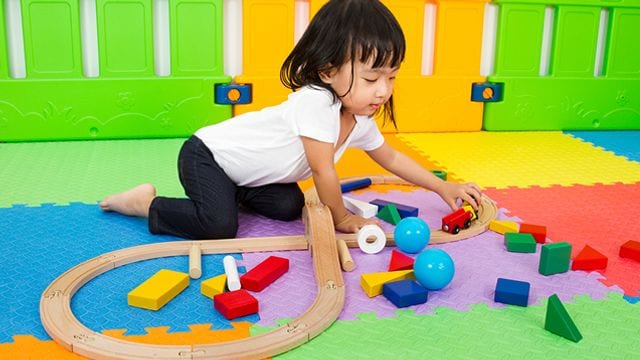
The Montessori Method believes in purposeful play so while traditional preschools are generally focused on worksheets and textbooks and play is a break from routine and recitation, the Montesorri method considers play as the work of the child. Montessori is invested in sensorial learning, discovery, and hands-on tasks. Among common Montessori Materials are movable alphabets, sandpaper letters, towers, binomial cube, beads, puzzle maps and cylinders. You might also find wooden blocks, bars and other materials for hands-on tasks such as scooping, washing, sweeping and pouring.
READ ALSO: The Best Montessori-Inspired Toys for Your Child (6 Months to 2 Years Old)
"Teach by teaching, not by correcting." - Maria Montessori
5. Making mistakes is okay
The Montesorri Method believes that making mistakes is part of the learning process. The goal is not perfection but to have the ability to recognize mistakes, learn from them and provide a resolution. Mistakes are not met with punishment, but rather with encouragement, to acknowledge one's errors.
Read this story if you want to apply the Montessori method at home.
What other parents are reading

Lorem ipsum dolor sit amet, consectetur adipisicing elit, sed do eiusmod
Lorem ipsum dolor sit amet, consectetur adipisicing elit, sed do eiusmod
