
 Orson Scott Card’s classic novel Ender’s Game centered around gifted children being trained for war through games.
Stakes were high, and most of the children were either sent home or sent to the hospital. While real-life play is not as dangerous, playgrounds function pretty much as the Battle School in the novel: they teach children to be aware of their bodies and to interact with their environment. Of course, this is not without inherent risks.
Gravity and the children’s still developing sense of balance often lead to scrapes, cuts, and the occasional broken bone.
Although locking your children up to keep them safe may seem like the logical thing to do, being at a playground can be a fun and educational experience even for children as young as age 2½ years.
Although there are no set standards for playground safety in the Philippines, the U.S.-based National Program for Playground Safety suggests that children between the age 2 and 5 years can already use and enjoy basic playground equipment as long as the equipment are age-appropriate and that proper safety measures are in place.
Swing-out Tots
Swings, probably the most common feature in playgrounds, should ideally not have more than two swings per set because crowded sets can lead to collisions and entanglement. “I also check if there is cushioning material beneath, in case my daughter falls off,” shares Carmela Lapena whose daughter Maya is a regular at Makati playgrounds.
Loosely-filled sand is best, but even bare soil would be marginally better than gravel or concrete since these offer no cushioning at all.
Slide and slither
Slides are another standard in playgrounds. While old-school slides were made of sheet metal that sometimes had exposed nails and rusty edges that tended to get too hot in the afternoon sun, heavy-duty plastic has become the material of choice for most children’s slides today. Hand and guard rails should also be present and be high enough to prevent a child from falling off the sides.
Marc Balanay, father of Xavi, always makes it a point to supervise his son on slides. “It’s very easy to slip or stumble because children are so excited to line up for their turn,” he says.
Click here to see more playground safety information.
[previous|page|next]
Read on to see more playground safety information.
See me go seesaw
Seesaws and other equipment with moving parts should be placed away from other equipment. Since children tend to run around, they might wander into the path of a seesaw or a swing, says the NPPS.
Adult companions should be watchful that children do not loiter near swings and seesaws when they are in use.
Although it goes against our collective playground wisdom, seesaws should only seat one child on each end. The NPPS says that the best solution to having a seesaw partner who is too heavy is not to add another child to the light end, but to find another partner for both kids. Having more than one child on one end could cause one of them to panic or lose their balance.
Swayin’ on the monkey bar
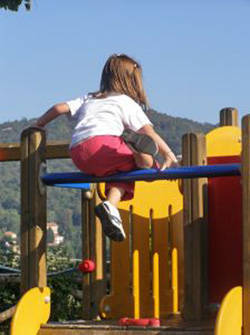
With monkey bars, jungle gyms, and any equipment that involves height, age-appropriateness is key.
Younger children should not be allowed on playground equipment designed for older, more developed kids. Hand-holds may be spaced farther apart, and a fall from a height that an older kid can just shrug off may cause serious injuries in younger children. Older kids should also not be allowed on equipment not designed for their age as they might get trapped in the narrower, more cramped spaces.
Sandbox
Parents should check the sandbox for debris like broken glass that could cause cuts. Also, sandboxes ought to be covered when not in use to keep stray animals from camping on it. Due to our tropical climate, metal equipment should be checked for rust and wooden structures for weathering. While playground equipment is generally sturdy, rusty edges and splintered wood could easily cause injuries. “I am very strict about this not only because I don’t like dirty equipment, but for safety as well,” shares Lapena.
Exercise caution
All playground equipment should be used as intended to minimize risks. Swings were designed for sitting; standing or kneeling on them—while more fun—may cause a child to lose his balance. Going down a slide headfirst is another no-no, as is using a seesaw as a diving board. “I used to do this a lot, but that was in the ’80s, and nobody really cared about injuries back then,” Balanay remarks as he shows his playground battle scars.
Aside from checking the equipment, a safe trip to the playground also requires that a child is accident-proof. Shoelaces should be securely tied to prevent tripping on them or snagging on equipment.
Drawstrings, pendants, and bags could also get caught on equipment which may cause strangulation. As with most physical activities, comfortable, loose clothing would be best.
While no amount of precaution can ensure that your child will never have a skinned knee or a bruised arm, taking the time to survey the playground equipment will reduce the risks of more serious injuries. That way, playground time can be stress-free and fun not just for your child, but for you as well.
Photo from sxc.hu

Lorem ipsum dolor sit amet, consectetur adipisicing elit, sed do eiusmod
Lorem ipsum dolor sit amet, consectetur adipisicing elit, sed do eiusmod
