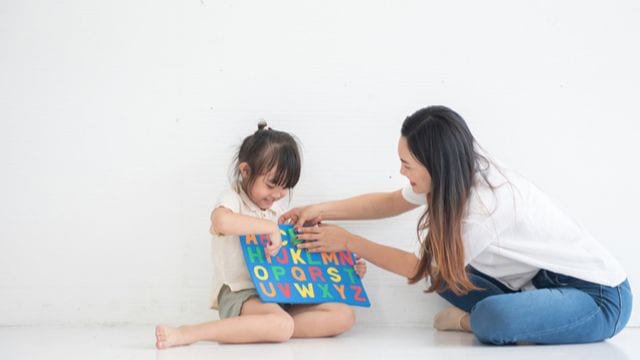
At age three, your child leaves the stage of infancy and enters the early childhood stage, which is also called the preschool age. This is the time when your child reaches the 3-year-old development milestones and learns basic academic skills, such as reading. That’s why, it would be best for you to have preschool reading activities with your son or daughter.
How preschoolers learn to read
The developmental milestones on the road to reading start at infancy to age 1, when babies learn, among other things, that gestures and sounds convey meaning, according to Kids Health. By the time they become toddlers, they can already identify the books by looking at the picture on the cover and have their own favorites.
Now in the preschool age, children usually start exploring books on their own and listen to longer books that are read aloud to them. They also learn how to retell a familiar story, sing the alphabet song with help, recognize the first letter in their names, and so on.
At age 4, also called late preschool, children typically start recognizing familiar signs and labels, especially those they often see in cartons and containers. They begin to name some of the letters of the alphabet, especially those in their names, and to write their names. They also develop awareness of syllables and understading that print is read from left to right, top to bottom, and so on.
Then, at age 5, children start producing words that ryhme and matching several spoken and written words, as well as writing some letters, numbers and, words. They begin predicting what will happen next in a story and identifying the start, middle, and end of sounds in short words, and so on.
Preschool reading activities
To help your child not only achieve the developmental milestones but also enjoy reading, experts suggest reading aloud to him or her. This can be fun for you, too, as pointed out by the Healthy Children information source of the American Academy of Pediatrics. When you show excitement reading, your child will enjoy reading, as well.
Experts also suggest running your finger under the words as you read to show your child that the print carries the story. Another technique is to read in an animated way, such as using different voices to emphasize the different characters and tones in the story. You can stop to look at the pictures or illustrations and ask your child to identify the things he or she sees. You can also tell him or her to ask questions.
Preschooler teacher Lyra Villaraza likewise recommends encouraging your child to read aloud, too. By doing this over and over again, your child will eventually connect the story to the pictures or even create his or her own story altogether. You can ask your child how he or she would want the story to end. This will help develop critical thinking.
You can also use these tips by Villaraza, who's called Teacher Lyra by her students. She designs her own yearlong program to teach kids from 2 to 5 years. This way, she can adjust the program, which is divided into three terms, depending on the levels and skills of her students.
Go for play-based activities
Instead of having a formal setup, Teacher Lyra suggests you play with your child. It can be as simple as singing the alphabet song or making sound games to create awareness and sensitivity to sound. For your 4 year old, for instance, you can ask for the sounds he or she hears in the word C-A-T.
You don't always need teacher materials
All you have to do, says Teacher Lyra, is to look around your house and you'll have a wealth of materials. You can tell your child to get anything that he or she can carry, and then ask for the object's name. Next, ask to identify the sound created by saying the object's name and what letter begins with that sound.
Know your child
This specifically applies to the type of learner your child is. Teacher Lyra points out that there are students who prefer learning with paper and pencil, while some opt to move around. With this info in mind, you can think up activities that will work for your child.
If he or she likes, for instance, working with his or her hands, you can tell him or her to leaf through your old magazines and find, maybe starting from, letter A. The next instructions can be to cut out the letter using safety scissors and then paste it on paper. That is also an activity to hone the fine motor skills of preschoolers, says Teacher Lyra.
Know your child's interests
For your son or daughter who's into dinosaurs, you can use his or her collection in your play-based preschool reading activities. Teacher Lyra suggests telling your child, "Okay, let’s sort the dinosaur with the beginning letter sound." You can also incorporate some math lessons by telling your child to sort the dinosaur according to size. The same goes for your child's other toy collections.
For more tips on reading for kids, read here.
What other parents are reading

Lorem ipsum dolor sit amet, consectetur adipisicing elit, sed do eiusmod
Lorem ipsum dolor sit amet, consectetur adipisicing elit, sed do eiusmod