
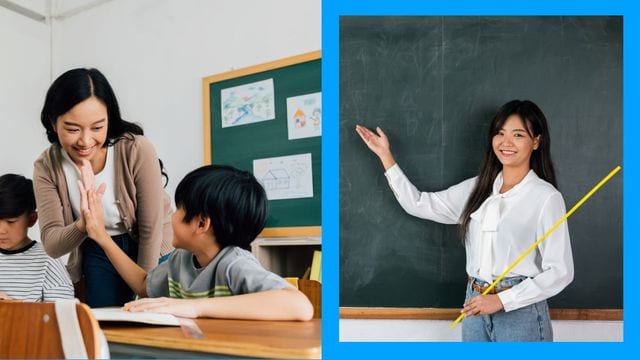
As cliché as it may sound, as parents, we only want what's best for our children. One of the most crucial decisions we will ever make is choosing which school to enroll our kids. After all, the school will be their second home; it will help them build character, form values, and develop academic skills.
For first time parents, the dilemma is usually this: should you enroll your children in a public or private school? Smart Parenting asked several teachers from both private and public schools to get their insights, to help you decide what do you think fits best for your child.
READ ALSO: Public Vs Private Schools In The Philippines: Parents Share Pros, Cons, And What To Focus On
Private school vs. public schools: What teachers say
Advantages of enrolling in a private school
1. Better teacher-student ratio.
Faith Gallano has been teaching in a private institution for 10 years. She said that private schools maintain small classes to provide a more individualized learning experience. They also have teacher assistants in preschool and childcare systems that equip the children to be well-guided.
2. More conducive learning environment
Gabby Tongco, a private school teacher who also holds a Master's degree shared, parents who enroll their kids in private schools find having an environment suitable for learning important. "In the private school where I teach, the maximum number of students in a class is 15," she said. "The students are given more attention by the teacher. We can also use manipulatives, and we do not use the traditional way of teaching. We utilize whatever resources we can find and do not depend on pen and paper."
In addition, Lloyd Fabrigar added that private schools have better provision of books, greater facilities, advanced lab equipment and apparatus. There are also more utility workers and security personnel, who can help in the upkeep of the school.
3. Getting your money's worth
Another teacher meanwhile said, enrolling your child in a private school gives you the assurance that you'll get what you paid for. "Sometimes, the thought of enrolling your child in a public school with no fees makes you wonder if the facilities are well maintained or if your child is getting treated well," the teacher said. "It's like, a parent can't demand anything since they didn't pay anyway."
Disadvantages of enrolling in a private school
1. Higher tuition and miscellaneous fees
Enrolling in a private school is definitely more costly than in a public school. According to Edukasyon.ph, annual tuition fees range from approximately P29,000 to P280,000 for preschool, P70,000 to P200,000 for elementary, P100,000 to P250,000 for high school, and P110,000 for college. It can pose a financial burden for families.
2. Private schools sometimes are run like a business
One teacher who is a practicing guidance counselor for 27 years already revealed, "One of the disadvantages of enrolling your child in a private school is when the school owner is not an educator but a businessman." The teacher explained that parents might question whether the objectives of the school activities are meant to develop the kids, or simply for-profit purposes.
3. Some private schools are a training ground for teachers
Teachers who are fresh graduates from college go to private schools to train. Hiring new teachers from time to time leads to less familiarity among the students.
Advantages of enrolling in a public school
1. Teachers are more trained.
Because more teachers are tenured in public schools, they are more familiar with the lessons and school system. Public schools are regulated and follow the national curriculum that the Department of Education (DepEd) sets. This results in a more standardized education across the country.
2. Children learn how to adapt and be resilient.
Since students will be surrounded by people from different backgrounds, it's one way of teaching them to be resilient amidst diversity. Exposure to diversity encourages adaptability as children learn to navigate various social situations.
Disadvantages of enrolling in a public school
1. Poor learning environment.
In the book Atomic Habits, James Clear shared how the environment fosters healthy habits. The environment promotes learning and growth. You get to be more motivated when your environment is conducive. Numerico Lloyd Fabrigar, who has a total of 13 years of teaching experience (six years in a private school and seven years in a public school), cited that most public schools have poor learning environments and obsolete learning materials. There is also a lack of laboratory equipment and apparatus, and computer facilities.
2. Too many class interruptions
Fabrigar also mentioned that students in public schools are more distracted because of several factors like teacher training, school events, and activities. Aside from that, public school teachers do a lot of administrative work, which delays classroom facilitation. They also perform other tasks such as being a class adviser, school paperworks, coordinatorship, etc.
Unlike in private schools, where there are specific systems and hired employees who do administrative tasks, public school teachers need to do more than teaching and instruction.
3. There is less focus on individual needs.
With larger class sizes and standardized teaching methods in public schools, there may be less emphasis on addressing the individual learning needs of each student.
As a former practice teacher in a public school for six months, I remember how teachers don't actually recognize or remember the names of the entire class sections they're handling. More than name recognition, some teachers cannot identify the individualized skills of students that will aid them in their progress.
A final word
All in all, these teachers enumerated the things that parents should consider in choosing between public or private schools, including financial capacity, the well-being of the students, the kind of training that the students will get, teacher qualifications, school facilities, and provisions.
When deciding whether to enroll your children in a public or private school, there are several factors to consider. It's important to note that the choice between public and private education is personal, and what works best for one family may not be the ideal choice for another. But the insights from the teachers may be the starting point on where to enroll your child.
The choice will be up to the parents. Consider the environmental, social, cultural, and academic aspects of the school where you will enroll in your child.
Good luck!
Looking for schools for your child? Check out these guides:
- Preschools in BGC
- Private Schools in Quezon City
- Private Schools in Manila
- Public Schools in Manila
- Public Schools in Cavite
Watch our SP Guide To Preschools on Smart Parenting's YouTube channel here.
More from sp

Lorem ipsum dolor sit amet, consectetur adipisicing elit, sed do eiusmod
Lorem ipsum dolor sit amet, consectetur adipisicing elit, sed do eiusmod
