
Watching a child at play is one of the most wonderful joys that a parent can experience. The happiness in their smiles and the curiosity in their eyes are a beautiful reminder of the gift of life. When children get into costumes and pick up props, they explore a whole world of possibilities. When their bare feet touch the grass and run free on the playground, they begin a journey of discovery. When they experiment with colors and shapes, they can bring life to their ideas on the canvas of their choice. 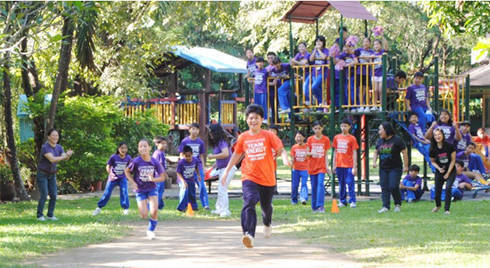
Situated inside Ayala, Alabang Village in Muntinlupa is The Learning Child School which is managed by founder and directress Mary Anne Alfonso. For the past 43 years, Alfonso has been working with her faculty and staff to provide children with learning experiences that infuse play at every opportunity.
“One of the ways children discover the world is through play,” says Alfonso, whose students fondly call her “Teacher Anne”. “When they play, they learn to create, imagine, and interact with different people. At this stage of their development, play is very important because it helps our children grow.”
Learning through play
For toddlers or preschoolers, play can be a good introduction to school and to learning. Because it is innate in children, play kindles a child’s imagination and provides him with an opportunity to experience different situations and adapt to new environments. Thus, The Learning Child’s preschool program was designed to provide the child with opportunities for both creative playtime and active playtime. During creative play, the focus is on nurturing the imagination with stories that allow them to imagine a different world that is full of life and every bit of the world they dream of.
Maan Yee, who teaches Nursery class at The Learning Child, incorporates play in her classroom activities. When the children choose to be veterinarians, a vet’s office or clinic is set up—complete with pet dishes, a doctor’s kit, stuffed animals, clip boards, dog treats, and pet cages - and with the children dressed in a white coat or scrub suit. Stepping into a specific role provides the children with an opportunity to tackle unique puzzles or challenges.
When teaching them about their community, the students re-create scenes at a restaurant, bakery, or an airport, giving them a fun way to learn about the topic for the day, while discovering how the ‘real world’ works.
[previous|page|next]
Meanwhile, in active play, the focus is on developing motor skills, muscle control, and coordination, and teaching kids about the environment. At The Learning Child, the children enjoy enough space to run and play tag, chase after balls, and fly on swings.
For Teacher Tess Ponce, The Learning Child’s Assistant Directress, learning through play helps the child get used to the idea of school, the environment, and being with new people. Play also helps children enjoy the experience of school and learning.
“For children, play is something that they do naturally. At their age, that is how they experience the world,” says Teacher Tess. “What we do is to build on it, and use play as a way to keep the kids engaged while teaching them basic skills. When the kids learn in an atmosphere of play and fun, they tend to love the subject and the teacher, and enjoy the experience of learning.”
Making play work
The Learning Child’s pre-school program encourages play and movement for children as early as two years old, and balances creative and active playtime.
There are periods dedicated to physical outdoor play. Here, students enjoy activities such as outdoor trekking, such as visiting the adjacent park to pick up leaves and twigs. Another play session has the students trying our Koosh ball painting in the school lawn. This school year, the school introduced yoga to the students to help them focus and relax.
[previous|page|next]
Play can also be an opportunity to introduce students to the nuances of culture. During one of the school’s Linggo ng Wika celebrations, students played Hit the Pot (hampas palayok) and raced using coconut shell stilts (karera ng baong sangko), introducing foreign students to these traditional Filipino games and to new words in the language.

For Teacher Anne, these physical school activities provide balance to the time children spend indoors or in front of television screens, computers, and video games, as it allows them to bring their adventures to life offline.
Looking ahead
Teacher Anne believes that play is crucial to instilling a positive attitude towards school and learning and towards life as a whole. She also believes that play teaches their students basic skills and values, and allows them to learn beyond textbooks or classroom work.
“I hope that our students can carry this love for play more permanently in their lives and lifestyle,” says Alfonso. “We hope that as they grow up and embark on their careers they will continue to love play as an activity to help maintain the equilibrium of a wholesome and healthy individual.”
Through their efforts to encourage the love of play in their programs and activities, Teacher Anne, Teacher Tess, and The Learning Child may have the key to fun, practical learning that works. By providing opportunities for students to discover new experiences naturally, and by continuing to spark their talents and interests, The Learning Child continues to inspire children to shape the world.
The Learning Child is located at 111 Cordillera Street, Ayala Alabang Village, Alabang, Muntinlupa City. To learn more, call (02) 850-3852 or (02) 850-4852, or visit www.thelearningchild.edu.ph.

Lorem ipsum dolor sit amet, consectetur adipisicing elit, sed do eiusmod
Lorem ipsum dolor sit amet, consectetur adipisicing elit, sed do eiusmod
