
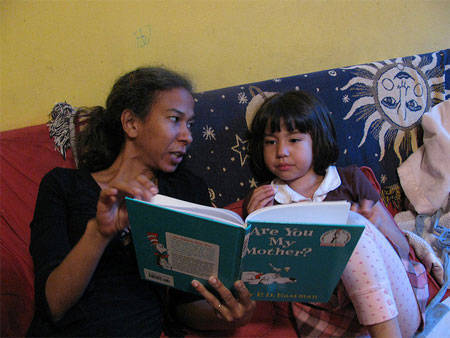
Many studies all over the world have found that homeschooled students outperform students in both public and independent (private) schools. This is regardless of geographic location and political jurisdiction. Check out these quick facts:
According to the study, Home Schooling: From the Extreme to the Mainstream:
• Almost one-quarter (24.5 percent) of homeschooled students perform one or more grades above their age-level peers in public and private schools.
• Grades 1 to 4 homeschool students perform one grade level higher than their public and private-school peers.
• By Grade 8, the average homeschooled student performs four grade levels above the national average.
• According to the U.S.-based National Home Education Research Institute (NHERI), homeschooling appears to have grown by seven percent per year since 2002 in the United States.
With these facts on hand, more and more parents are beginning to see that they have choices when it comes to educating their children.
Traditional versus progressive, social versus home school
Genevieve V. Rivadelo, executive director of Alternative Learning Resources School (ALRES) and chair of the Special Education department at Miriam College, clarifies the differences among schooling terms such as Traditional versus Progressive and Social versus Homeschooling.
• Traditional schooling - It is teacher- and curriculum- centered. There is a tendency to lean towards a more content-heavy curriculum, making classes more ‘advanced’ but perhaps not developmentally appropriate at times.
• Progressive schooling - It is a student-led, student-paced, and child-centered method. Classes go by themes chosen by the student rather than by the teacher.
These two types of schooling are more of philosophies than actual programs. They can both be applied to social and homeschooling.
Francis Dimalanta, M.D., behavioral and developmental pediatrician, agrees, “Homeschooling can combine both traditional and progressive philosophies. In some subjects, a more traditional approach may be appropriate. But the majority of homeschooling curricula develop with the student at the center.”
Rivadelo states, “You can call traditional social schooling in this country, ‘typical.’ It means that it’s suitable for children who are in the median of a bell curve. This doesn’t address those children who are outliers. If they don’t fit, learning might prove to be a difficult experience.”
[previous|page|next]
Another option: small alternative schools
The choices aren’t limited between traditional social schooling and homeschooling. “For parents who still choose to send their kids to school, but don’t want to send them to big schools with at least 40 children in one class, there are smaller schools now that can accommodate a more child-centered class size and pace. Also, for children with delays or developmental challenges, parents can cope better by sending them to schools like ours (ALRES) if they cannot put in the time demanded by homeschooling.”
Real Life Reasons to Homeschool
Vicky Alcordo, former high school English teacher and home teacher to her three kids, relates that homeschooling wasn’t on her mind at all. However, a series of disappointments with the school where she enrolled her children prompted her and her husband to study their options. It wasn’t an easy decision. “Sometimes, I still ask myself if I should go on. But at the end of each school year, I really see the benefits of homeschooling in my kids, and I’m inspired to pursue it.”
For Bo Sanchez, best selling author, entrepreneur, homeschool advocate and founder of The Catholic Filipino Academy, homeschooling has helped him introduce work and service in his children’s education. Work involves regular household chores and entrepreneurship, while service involves volunteer programs and visits to orphanages or homes for the aged.
Bev Alarcon, entrepreneur, freelance web developer and home teacher to her three kids, cites “being able to control the values my children will imbibe” as a key reason. As a result, her kids are obedient and well-behaved.
No socialization: a homeschooling myth
One key concern of parents when it comes to homeschooling is socialization. Social learning or learning from peers has its up-side such as learning to be friends and cooperating with others. However, it also has its down sides: picking up bad habits, bullying, and peer pressure. Kids will definitely get socialized in school; however, sometimes, it’s not the good kind of socialization. Bev’s eldest child was traumatized when he was in preschool. “He didn’t want to go to school because of this particular kid who was bullying him. In homeschool, he doesn’t have to encounter this at all. He’s not distracted.”
[previous|page|next]
What do the statistics show?
• According to the National Home Education Research Institute, “Dr. Shyers (1992) found the home educated had significantly lower problem behavior scores than do their conventional school-age mates. They also have positive self-concepts.”
• In the study, Home Schooling: From the Extreme to the Mainstream, “the average Canadian homeschooled student is regularly involved in eight social activities outside the home.”
Each child’s unique learning style
In the book, Nurture Shock, Po Bronson and Ashley Merryman discovered that “being disciplined is more important than being smart. Being both is not just a little better - it’s exponentially better.” It’s an advantage to kids if they are given the responsibility of setting their own learning goals and themes.
Vicky saw each of her children develop in unique ways with homeschooling.
• “Triccie was already an achiever, but with homeschooling, I saw her get deeper into what she already does well.” Her 14-year-old is now about to enter a local high school.
• Homeschooling brought out the best in her second daughter, Christine, 11. “Her involvement in extracurricular activities like music and sports made her more self confident. And this translated into her academics.”
• Her son, Renzo, 8, is in his third year of violin and enjoying it immensely. “This is the beginning of his foundation. It’s best to start as early as possible.”
Bev is amazed at the progress each of her children has made:
• Her nine-year-old son is now proficient with computers. “He knows how to Google, how to make Powerpoint presentations of his favorite cartoons, and he even wants to set up a gadget store called ‘Technology Works’ someday.”
• She’s proud to share that her daughter, Andrea, 8, won a silver medal in the Philippine Cadet Fencing Competition in 2008.
• Daughter Hannah, 7, has shown a love for music. She already composes her own songs.
[previous|page|next]
Nurturing your child’s strengths
According to Marcus Buckingham, in his book, Now Discover Your Strengths, everyone has strengths, and these are “a function of how your brain is wired. Strong synaptic branches of the brain tend to become stronger over time.” He cautions against being “well-rounded.” According to his research, the most successful individuals are not good at a lot of things; they’re good at just one thing. The same principle can be applied to education. Spot your child’s strengths early on and build on it, rather than have him spread out his energy on all his subjects.
Dr. Dimalanta says, “I believe each family should consider what will work best for their own family. I can see homeschooling working for children who are gifted outside of regular academics. For example, an Olympic swimming hopeful practices during the night because that is when the pool is more available. Therefore, keeping awake in regular school may be a problem. Homeschooling has the flexibility to work in the study hours that are later in the day, unlike traditional school.” He also sees homeschool as a viable option for children who have chronic illnesses.
Homeschooling Resources
1. Angelicum College
http://www.angelicum.edu.ph/hsp.html
Catholic Home Study Program from elementary to high school. Contact information: (02) 732-4243 loc. 118 or (02) 4158557
2. Colegio de San Juan de Letran
http://www.letran.edu/elementary/admission.php
Catholic Home Study Program from elementary to high school. Contact information: Elementary Principal’s Office—(02) 527-7693 to 97; local 45 or 46
3. The Master’s Academy (TMA)
http://homephilippines.multiply.com
A Christian school founded by the Christ’s Commission Fellowship (CCF) that has been offering a DepEd accredited international homeschool program since 1999. Regular group activities provide children with opportunities to interact as well as to display their talents. Contact information: 3rd Floor St. Francis Building, Bank Drive, Cor. Julia Vargas, Ortigas Center, Mandaluyong City 1550
4. Catholic Filipino Academy (CFA)
http://www.catholicfilipinoacademy.com
The first Philippine Catholic homeschool program, co-founded by Bo Sanchez (www.bosanchez.ph), offers DepEd accredited education for preschool to grade school students. It provides training materials, lesson plans, and textbooks and support from other homeschooling parents. CFA is affiliated with Power Kids Academy, a private school located in Bulacan. Contact information: CFA, Lighthouse, 60 Chicago St., Cubao, Quezon City 1109, Philippines—(02)533-6097 and CFAinquiry@gmail.com
5. The School of Tomorrow (SOT)
http://www.sotphil.net/contact.htm
A Christian home school program for kindergarten to high school levels that has been provided by the U.S.-based organization Accelerated Christian Education since 1970. It makes use of the latest computer technology in providing an individualized education with a strong religious background. Contact information: Mrs. Remia Camacho, rcamacho@sotphil.netTrunk line: (02) 822-9663 Locals 125 to 130, School of Tomorrow®, Philippines, MJS Ave., Levitown Executive Village, Brgy. Don Bosco, Parañaque City
6. Get Facts On Home Schooling from U.S.-based NHERI (National Home Education Research Institute):
7. Home Schooling in the Philippines web ring:
http://homeschoolingphilippines.wordpress.com/
8. Home Schooling According to a homeschooling mom/blogger:
http://teachermamatina.blogspot.com/p/homeschooling-resources.html
http://teachermamatina.blogspot.com/p/filipino-homeschoolers-unite.html
9. A Home Schooling Mom’s Account:
http://ivymarquez.multiply.com
[previous|page|next]
Sources:
• Genevieve V. Rivadelo, Ph.D. (Cand.), PTRP, executive director, Alternative Learning Resources School (Philippines) or ALRES; chair, Special Education Department, Miriam College
• Francis Xavier M. Dimalanta, M.D., Developmental and Behavioral Pediatrician, St. Luke's Medical Center, Quezon City
• Vicky W. Alcordo, former high school English Teacher, home teacher• Beverly Alarcon, home teacher, entrepreneur, freelance web developer
References:
• Nurture Shock by Po Bronson and Ashley Merryman, Twelve, Hatchette Book Group, NY, 2009;
• Under PRESSURE: Putting the child back in childhood by Carl Honore, Orion Books Ltd., 2008;
• A Mind At A Time by Mel Levine, M.D., Simon & Schuster paperbacks, 2002; Now, Discover Your Strengths by Marcus Buckingham and Donald O. Clifton, PhD, The Free Press, NY, 2001.;
• Home Schooling: From the Extreme to the Mainstream, 2nd edition, by Patrick Basham, John Merrifield, and Claudia r. Hepburn, Studies in Education Policy, A Fraser Institute Occasional Paper, October 2007, Digital document available at: http://www.fraserinstitute.org/researchandpublications/publications/4932.aspx
• National Home Education Research Institute, http://www.nheri.org;
• “Homeschooling and open universities in the Philippines”, wikiPilipinas: The Hip ‘n Free Philippine Encyclopedia, http://en.wikipilipinas.org/index.php?title=Homeschooling and open universities in the Philippines;
• “Ten Powerful Principles on Homeschooling” by Bo Sanchez, digital document available at: http://catholicfilipinoacademy.com/cfa/10principles.php
Photo from flickr creative commons

Lorem ipsum dolor sit amet, consectetur adipisicing elit, sed do eiusmod
Lorem ipsum dolor sit amet, consectetur adipisicing elit, sed do eiusmod
