
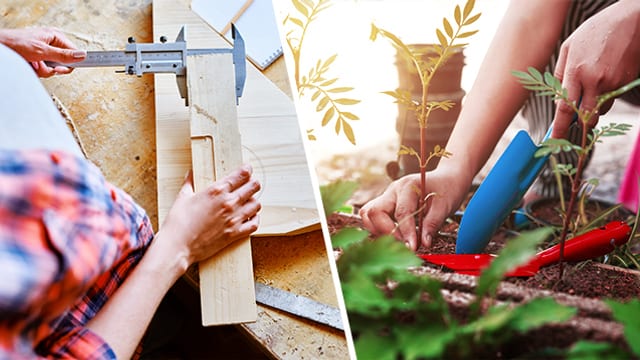
Alison Gopnik, a renowned developmental psychologist and researcher, says parents today can either take on the role of “carpenter” or “gardener” to their children in her book The Gardener and the Carpenter. But she gives compelling reasons how moms and dads can strive to be “gardeners” instead of “carpenters” when it comes to raising children.
Who is the Carpenter
When parents take on the role of a carpenter to their child, “the idea is if you just do the right things, get the right skills, read the right books, you're going to be able to shape your child into a particular kind of adult,” Gopnik told NPR.
This parenting style hinges on the belief that there is a formula to be followed in order to raise, say, a future doctor, lawyer, or an entrepreneur. But Gopnik does not believe in such a formula and even says that such a controlling method of parenting can backfire. “We're so concerned about how these children are going to turn out that we're unwilling to give them the autonomy that they need to be able to take risks and go out and explore the world,” she added.
What other parents are reading
Moreover, the parent-child bond can take a hit too. “What ends up happening is parents are so preoccupied with this hopeless task of shaping their children to come out a particular way that their relationships with children at the moment become clouded over with guilt and anxiety and worry and the need for expertise,” she told The Atlantic.
As a mom-of-three herself, Gopnik admits that not having a “formula” can give considerable stress to parent. “It isn’t that I don’t sit there thinking 'If I’d done something differently, maybe if I’d sent them to a different school…’ I’m not immune to that. It’s very natural as a parent, particularly if you’ve grown up in this culture,” she told The Telegraph.
So, how then can parents find reassurance that they’re on the right track to raising a well-adjusted adult? Gopnik suggests being a “gardener” parent.
What other parents are reading
Who is the Gardener
“Being a caregiver for human beings is...much more about providing a protected space in which unexpected things can happen than it is like shaping a child into a particular kind of desirable adult,” she said.
Think of how a gardener tends to seedlings. The gardener creates the most suitable environment — with enough sunlight, water, and good soil — for the little plant to grow and thrive on its own. The gardener does not force it but patiently waits for it to bloom while protecting it at the same time from harsh elements, like harsh winds and pests.
Because like plants, explained Gopnik, children are able to absorb and learn on their own as long are provided with an environment allows them this freedom. “We adults can help them best not by teaching, but by making sure that they have adequate social and physical environments and time and space in which to explore,” said research professor at Boston College Peter Gray in an article about Gopnik’s book in Psychology Today.
What other parents are reading
An excerpt from Gopnik’s book reads: “Our job is to provide a protected space of love, safety, and stability in which children of many unpredictable kinds can flourish…We can’t make children learn, but we can let them learn.”
Be attentive to your child’s needs both in the physical and emotional sense. Find out where her interests lie and where she’s most skilled.
“Love’s purpose is not to shape our beloved’s destiny, but to help them shape their own,” said Gopnik in her book. “It isn’t to show them the way, but to help them find a path for themselves, even if the path they take isn’t one we would choose for ourselves, or even one we would choose for them…Loving children doesn’t give them a destination; it gives them sustenance for the journey.”
What other parents are reading

Lorem ipsum dolor sit amet, consectetur adipisicing elit, sed do eiusmod
Lorem ipsum dolor sit amet, consectetur adipisicing elit, sed do eiusmod
