
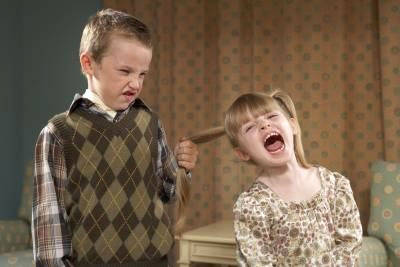
Can you recall a time when you saw your own child being hurt by another kid? I remember my son was only 2 years old when I first witnessed how another kid, who was a few years older than him, pushed him, causing him to fall down really hard. Fortunately, it was nothing serious, but as a mother, I couldn’t help but feel agitated. I wanted to personally discipline the kid who hurt my son, but of course I couldn’t do that. Naturally, my next reaction was to blame the parents and think, “what do they teach their child?” Seeing our children get hurt, pushed, hit, pinched, bitten, punched, grabbed by other kids is perhaps every parents’ worst nightmare. But what if it’s our own child who is displaying this kind of aggressive behavior?
“If I see my kid hurting others, I would feel like I failed as a mother, for I wasn’t able to teach him the right behavior,” Menchie Orona, a 38-year-old mother of three, says.
It is often difficult for us parents to accept and understand the idea that our sweet, adorable child is capable of hurting other kids. But whether we like it or not, this is a reality which we parents have to learn to deal with. Therefore, it is important for us to have a better understanding of the possible influences which could trigger our children to hurt others.
“It is quite typical for young children to use physical means to express themselves.” says Elizabeth King-Santos, a Professor on Early Childhood Education and Special Education in Kalayaan and Roosevelt Colleges. Often, it is never a child’s intention to hurt others.
King-Santos also cites factors which may affect children to resort to such hurtful behavior. These may be child-related, family and environment-related or society and culture-related factors.
“The main reason why young children use physical means to express themselves is because of their limited use of verbal skills, their lack of developed social skills and self-control”.
[previous|page|next]
Child-related factors
Their developmental stage and age can be linked to their manner of expression and level of aggression. For instance, “biting is commonly seen in infancy and toddlerhood, because infants and toddlers explore their environment mainly through the use of their mouths,” explains King-Santos. “Older preschoolers, on the other hand, are into pretend play that may involve themes like fighting superheroes, etc. that may cause them to get too carried away with their play and may unintentionally become too rough.”
A child’s coping mechanism is also a factor to consider. This is, however, genetic in nature. According to King-Santos, “Some children are just more flexible, some are fearful and sensitive while still some may be difficult or feisty.”
Family- and environment-related
This is where we, parents, play a crucial role. From my own personal experience as a mom, I have observed how my three-and-a-half-year-old son can easily mirror how my husband and I react to certain situations. If we raise our voice at him, naturally, that’s how he would also react to us.
King-Santos also states that “physical aggression is more of a learned trait. Children usually look at the adults around them for cues on how to handle anger and frustration.”
Our relationship with our child will definitely affect how he relates with other people. If we are harsh with our words and rough in our manner of disciplining, chances are our child would think that this is the right way of dealing with others as well.
Mhin Sagum-Fajut, 37, an architect and mother to 7-year-old Rico Angelo and 3-year old Johnne Elmynna, shares this incident with her son: “When my son Rico was around two or three years old, he would slap his yaya. As a mother, my initial reaction was to spank my son to discipline him.” However, she noticed that in spite of her spanking, Rico would still continue to hurt his nanny. Upon discussing the situation with her husband, they decided to resort to a different manner of correcting. This time, they tried a loving gesture instead of spanking their son right away. “It worked! From then on he learned not to hurt but instead to love more,” Mommy Mhin recounted.
Moreover, exposing our children to various negativities such as downbeat interactions between family members, will definitely affect a child’s physical outburst or aggression.
Society- and culture-related factors
“Cultural beliefs can and will influence our children's behaviors,” says Ms. King-Santos.
If child abuse or domestic violence is depicted by society as a normal situation nowadays, our children might grow up thinking that hurting others is an acceptable way of life.
It is possible to set limits and expectations that are appropriate for their age. Some children misbehave because they do not know what their limit is or what is expected from them in a certain situation. Young as they are, we can already begin to orient them on what is culturally-proper and acceptable based on the values we wish them to develop.
[previous|page|next]
A deeper understanding of how these various factors may affect our children will definitely help us parents realize the proper approach to dealing with our child’s aggressive behavior. In addition, here are some practical tips on how we can further prevent our kids from hurting others:
1. Communicate with love. Encourage your child to talk to you.
Frances Shalom Catabas, 26, a preschool teacher, firmly believes that “Communication is most important in their relationship with their children.”
Mommy Menchie, mother to 10-year-old Timothy, 9-year-old Julius and 4-year-old Faith, shares that, “when I see my kids hurting each other, I usually call their attention. I look them in the eyes as I speak to them, explaining in a loving and caring manner that it’s not good to hurt other people.”
2. Be your own child’s role model.
As parents, we should be conscious of our actions because we are our children’s first teacher. They learn by observing and imitating us.
“Model proper ways of dealing with anger and frustration... model how they should verbally express themselves”, advises King-Santos.
3. Help your child develop empathy.
Empathy, an emotion which enables people to identify or sympathize with others, is still developing in most young children. This makes it even more difficult for them to realize that they are actually hurting others.
“It is important to teach empathy to your children,” offers Teacher Frances. “One way could be by asking them, for instance, ‘what do you think the other kid felt when you pushed him?’”.
It is possible to reason with our child by using appropriate terms and words which he can easily comprehend. Children act out less when they understand the reasons behind a situation.
4. Speak positive words to your child.
Affirmation is one of the best ways to boost our child’s emotional confidence and making them feel proud of the good things they do. Every good deed our child does – no matter how simple – deserves to be praised.
5. Resort to a firm - but loving - manner of discipline.
Different parents have different ways of disciplining their children, but no matter what, we should always be conscious about making our children understand that they are being disciplined because we love them. If possible, avoid raising our voice, using harsh words, being rough and physical. Make sure to explain to them why they are being reprimanded for such and the possible consequences of their actions.
[previous|page|next]
6. Constantly show physical gestures of affection.
A constant loving gesture such as a hug, a tap on the shoulder, a pat on the back, stroking the hair or touching their cheek will never fail to offer a warm assurance of love from the parents. This will, in a way, make them aware of the difference between a gentle touch and being too physical and rough to the point of hurting others.
7. Teach them the value of sharing.
Start with the concept of sharing their toys. Most kids, especially toddlers, have the tendency to be possessive of their toys or anything they know they own. They are also in that stage where they would want to get other kids’ toys but are not willing to share their own. Affirm them whenever they do decide to share, and make them feel good about it.
8. Encourage your child to make friends.
Set up play dates for your child with kids their age. Get him used to relating and playing with them until he connects with them and learns to value their company. Support them in making friends and bonding with other kids.
“Provide them with experiences with other children so that they may practice their social skills and self-control.”, says King-Santos.
9. Be sensitive to your child’s emotional needs.
Understanding what they are feeling, what causes them stress, and what could trigger their aggressive behavior will give us parents an idea on how to handle our child’s hurtful behavior.
Teacher Frances advises that parents should try not to overreact when their child misbehaves or hurts others. Instead, take your child away from the situation, give him room to cool down and let him express his emotions to you, the parent. Preventing your child from venting out his feelings is not healthy. Make him feel that you’re there to understand him.
10. Teach your child to be humble.
“If they have hurt someone else, let them say sorry or give a hug to the one that they’ve hurt” says, Mommy Mhin.
Prepare your child for specific situations. If he will be engaging in activities with other kids, teach him how to behave, such as when joining games, borrowing toys, and others. Help him to learn the virtue of humility in situations when not everything would go his way. More importantly, teach him to say, “sorry”, when he unintentionally hurts others.
Finally, make your children feel LOVED. There’s nothing more powerful than the love of parents for their children. Be generous in devoting your time and presence to them no matter how stressed, tired and busy we may be. Those who lack it often resort to doing things which would get their parents’ attention, such as hurting others. Be a loving presence to them. Nourish and nurture them in a loving environment, for children who are loved will eventually have so much love to give others as well.
Photo from ehow.com

Lorem ipsum dolor sit amet, consectetur adipisicing elit, sed do eiusmod
Lorem ipsum dolor sit amet, consectetur adipisicing elit, sed do eiusmod
