
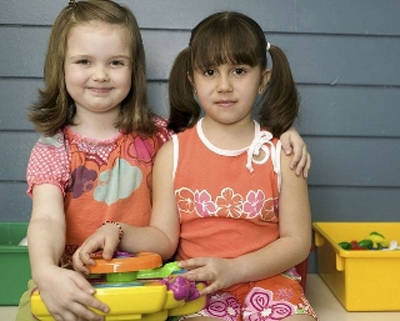
 Kids fighting over toys is a challenge all parents have to deal with. ”When I buy a toy for one of my kids, sometimes I have to buy the exact same toy for the other just to keep the peace,” says Marla Reyna, administrative assistant and mom to Marco, 7, and Mikey, 5.
Toy fights, especially among toddlers, is quite normal as they are only beginning to learn about their own identities. ”Most toddlers think that everything in their surroundings belongs to them,” explains share toys, administrator of Mindbuilders Preschool in Las Piñas and mom to Liane, 5, and Gavryl, 3. ”When a child finds a toy interesting, another will be curious and will also want to discover what’s interesting about it. And since children that age do not understand yet that they can’t have everything, they tend to grab the toy from someone.”
Toddlers fight over toys because they are just starting to understand the concept of possession and thus want to establish ownership over a particular toy. Sometimes, they also feel jealous when the focus is on someone else (i.e. sibling rivalry), so they pick a fight to get an adult’s attention. Although sharing is a learned skill, you can start building the foundation for learning this important value at home.
Sharing at home
One way to promote sharing at home is to have your children take turns playing with a certain toy. Make it fun by setting a timer and telling them that once the buzzer goes off, it is time to trade toys with one another. Don’t forget to praise them when they cooperate!
“Teaching your child the concept of taking turns will make it easier for him to learn to share in the future. It will also make him realize that .sharing his toy doesn’t mean giving it up forever,” says Marie Teves, mom to Riley, 5. Practice taking turns as often as you can - while eating a bag of cookies, turning the pages of a children’s book, or even shooting baskets. Vasquez-Estuesta adds, ”When a parent teaches her child to share toys with her siblings, she is also teaching her about equal rights. Therefore, a parent must be fair - avoid playing favorites or taking sides.”
[previous|page|next]
Sharing in playgroups
A public play area or playgroups are the perfect avenues for teaching kids about sharing. Toys in public areas are for everybody. ”Tell your kids that if they share their toys, other kids will also learn to share theirs,” says Le Trexie Burgos, human resource manager of Little Martians, a day-care and play center. Having a regular playgroup can also help enhance this value because it allows children to be familiar and comfortable with each other. “Fights usually ensue because children do not know and trust each other,” adds Vasquez-Estuesta. Before the playdate, it would also be good to ask your child to keep her favorite toys - those she does not want to lend. Then ask her to help you choose which ones everyone can play with. Bring out toys that are meant for sharing such as cooking sets, board games, and puzzles.
Marie likes to ask Riley’s playmates to bring a few toys over, too. ”When my son sees that there are ’new‘ toys to play with at home, he voluntarily lends some of his toys so he could borrow the ’new' ones,” she says.
Rules of play
Another way to avoid toy fights? Set rules. ”No one can play with the train unless you both learn to share.” ”If you bring that ball to Lola’s, you must be ready to share it with others. If not, just leave it at home.”
The most important thing to remember when setting rules is to be consistent. ”Rules should be clearly stated and implemented fairly. Once these rules are bent, children will no longer take them seriously,” says Vasquez-Estuesta.
Here are other strategies to keep fights and tantrums at bay:
1. Give your kids plenty of one-on-one time with you.
This prevents jealousy among kids, so they don’t feel the need to fight for your attention. ”I set ’dates‘ with each of my sons during the week. We play, eat, and read stories together for an hour or two in the afternoon. This way, they get equal bonding time with me. Our Sundays are sacred; it’s our time to bond as a family,” says Marla.
2. Avoid taking sides.
Instead, be a peacemaker; ask each child what caused the fight, and help them reach an agreement. “Whenever my boys fight, I ask each one what happened, and I try not to pin the blame on one child. We try to resolve the fight, but if they’re being stubborn, both get a time-out,” says Marla.
3. Let kids express how they feel – and make sure to listen.
“Allowing your children to express how they feel about the situation will make them realize that the fight may be more about their inability to express their needs,” says Vasquez-Estuesta.
4. Model good behavior.
Children learn proper behavior from parents, teachers, and guardians, so make sure to show them positive examples. “Do not punish an aggressive child by being aggressive in return; this simply reinforces the bad behavior,” says Vasquez-Estuesta.
5. Play games that promote sharing.
Engaging in group games, such as throwing and catching balls, allows kids to experience the fun in giving. “As he sees his playmate having fun catching the ball, the child feels good for making his playmate happy. And when the playmate throws the ball back, the child feels the fun of sharing and playing together,” explains Vasquez-Estuesta.
[previous|page|next]
Teaching children to play fair and to share is very important. Once children realize that it’s good to share and that no one is trying to take anything away from them, the fights will stop, and they will learn to play with one another peacefully. “The social skills a kid develops during his childhood will be manifested in how well he can relate to others, especially as he grows. Good social skills play an important role in one’s emotional development as well,” says Vasquez-Estuesta.
Some things to remember when it comes to playtime manners:
• When you’re at a playdate in someone else’s home, always ask your child to help pack away the toys and clean up before leaving.
• At toy stores, tell your child not to open packages and to handle each toy with care.
• When borrowing someone else’s toy, always ask permission first. Remind your child never to grab a toy from a playmate. And always remember to use the magic words: “please” and “thank you.”
• Teach your child to take care of toys, most especially if they are not his.
• Bringing toys to church is a no-no. Remind your child that the church is a place for praying, and not playing.
• Dining out? Keep kids busy by bringing along “quiet” toys for them to enjoy such as puzzles and coloring materials. This way, you don’t disturb the other diners.
Image from surfnetparents.com

Lorem ipsum dolor sit amet, consectetur adipisicing elit, sed do eiusmod
Lorem ipsum dolor sit amet, consectetur adipisicing elit, sed do eiusmod
