
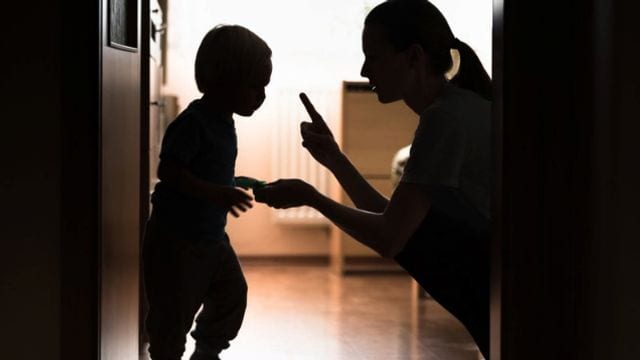
“Spare the rod and spoil the child.” This is a phrase some of us parents may have come across at one point during our lives. It refers to spanking one’s child as a form of discipline, which some people call “corporal punishment.” Whatever we call it though, spanking has definitely been a hot parenting topic and has caught the attention of many people — parents and non-parents alike.
A an article titled, Study shows spanking boosts odds of mental illness says, “Those who were spanked or hit as kids were between two and seven percent more likely to encounter mental issues later, said the research in the US journal Pediatrics, based on a retrospective survey of more than 600 US adults.”
However, we must take note what it says later on in the article, i.e. that “these studies have typically included more serious abuse. The current study excludes both sexual abuse and physical abuse that left bruises, marks or caused injury. Instead, it focuses on ‘harsh physical punishment,’ defined as pushing, grabbing, shoving, slapping or hitting as a form of punishment from elders.”
Definitely, “pushing, grabbing, shoving, slapping or hitting” is a form of abuse — but is spanking included, too? We asked several parents what they think.
To Spank
Diane Q. Manalo, homeschooling mom to Cailin, 6, Ava, 3, and Samuel, 4 months, says that the article quoting the study should be read more carefully. “They used the word spanking and hitting like it’s the same thing. But I think it is not.”
“When we relate this to parenting and discipline, it’s a whole different thing. People need to understand that when we spare the rod, we spoil the child and if I may quote Proverbs 13:24 ‘He who spares the rod hates his son, but he who loves him is careful to discipline him.’”
Referring back to the study, Diane says that those parents who hit their children may have been hitting them out of anger, wrath or rage. “I believe there is a proper way of disciplining children. That's why it says 'careful to discipline' in the verse,” she shares.“ And only the parents are supposed to do it (discipline their child) — not just any elder person in the home. Children need to know who their authorities are and they are their parents or main guardians.”
On a personal note, Diane says that their kids have become sweeter and are closer to her and her husband especially when they have disciplined them. “We need to explain to them why they need to be spanked and what rules they broke. We don't just get them and spank them. Communication and the rod (what we use for spanking) go together,” she explains.
Diane recommends that parents try reading “Shepherding a Child’s Heart” by Tedd Trip to get more great insights on disciplining one’s children. “I believe that children need to be disciplined. And one of the best ways to do it is by using a spanking rod or spoon (never your hand),” she says.
Karen Hornbostel Ilagan, a lifestyle photographer and homeschool mom of two, says, “There is a huge difference between punishment and discipline. Punishment is giving the offender what he deserves; in effect, you are making him pay for his sins. It's ‘payback time’ or revenge,” she explains. “Discipline, on the other hand, is positive instruction, it is a way to correct the offender and the goal should be to restore the offender's path to obedience.”
Both Karen and Diane insist that there's a big difference between child abuse (hurting out of anger, revenge) and discipline (spanking for correction, out of love).
Joy T. Mendoza, a former consultant for preschool at The Master’s Academy Homeschool and homeschool mom to Elijah (9), Edan (6), Titus (4) and Tiana (2), is another mom who disagrees with how spanking is presented in the article mentioned at the beginning of this article.
“Biblical spanking presupposes a good relationship between parent and child. I don't suggest spanking if parents don't have a good relationship with their child because it is hard for them to understand that discipline is out of love,” Joy explains. “Pushing, grabbing, shoving, slapping or hitting - these are things done in anger, which is not the context of biblical spanking and discipline, but which most people may mistakenly see as ‘disciplinary actions.” Joy emphasizes that anytime a parent hits a child in anger, it leads to a whole lot of hurt and trauma.
Joy, who was spanked as a child along with her siblings, also wishes to point out that spanking is not the only way to discipline a child. In a blog post she wrote about spanking, Joy clarified that she and her husband, Edric, spank their children for only a few important things, mostly connected to disobedience and disrespect. Joy wishes to share part of that post here:
“For example, with Elijah, our eldest who is turning 9, we can count the number of times he was spanked on two hands. By the age of 6, he didn’t really need spankings anymore. We use other forms of discipline, like withdrawal of privileges or natural logical consequences.
Our second son, Edan, who is almost 6, had his share of spankings but seldom receives them now. Our third son, Titus, was spanked the most number of times and still gets spanked from time to time, but because he has learned to obey, spankings are also rare for him.
The point is that Edric and I don’t carry a spanking rod around with us everywhere we go or have to use it all the time. But, we have very clear rules that we teach our children to obey and if they break them, they are disciplined for doing so.
Some people argue that spanking is abusive. It can be when it is for punishment purposes only, if it is done in anger, if rules are unclear, if a parent does not have a loving relationship with their child, if it is done in public to humiliate the child, or if it is done too often and randomly. We avoid all of the above.”
Donna Pangilinan-Simpao, a medical doctor and part-time consultant at The Parenting Company, also believes that biblical spanking has been beneficial for her own children, Vince, 13, Marco, 11, Raya, 9, and Gino, 7, because, first and foremost, they have good parent-child relationships.
“John McArthur (a popular pastor, author and conference speaker) said ‘discipline without a relationship leads to rebellion.’ Actually, the ‘biblical view on spanking’ is a broad term that encompasses the principles of relationships laid out in the Bible,” Donna shares. She also recommends the book “Dare to Discipline” by James Dobson.
Maria Ellen R. Tan-Valencia, a homeschool mom to Aya, 16, Misha, 15, and Ethan, 12, says, “The beauty of biblical discipline is you won’t even be able to recall when was the last time you did it to your child, because once he understands that you are doing it out of your love for him, the impact it will create on him is lasting.,” she expounds.“We have been homeschooling for nine years already and based on my experience with my three kids — two of whom are already in high school — I can't recall spanking them more than twice with the same offense.”
Blessie Adlaon, owner of Escrive Writing and Editing Services, and a homeschool mom of four, believes that spanking has a biblical basis, and that she does, in fact, spank her children. “When I do, I make sure they understand why they are being spanked: because all sins have punishment, and it is kinder for me to punish you now than to let the punishment grow before it catches up to you,” she explains.
For one-year-olds, though, Blessie says they skip the discussion and merely slaps their hands away with a sharp "no" when they are approaching something dangerous or when they disobey a direct order. “For my seven-year-old, I have spanked him only once this year, and that's because he repeated an action that I had warned him before puts his brother's physical well-being in dire danger,” she shares.
One may ask then: “What about natural consequences?”
“It depends,” Blessie says. “Sometimes, it is doable: if you don't do your schoolwork now, you will have to do it during playtime. Sometimes natural consequences are crueler than spanking. If you don't stop slamming the door, you can forever carry the guilt of your brother's hand being amputated because of you. Would our children be more mentally healthy with such a consequence? I doubt it,” she clarifies.
Donna Donor, a work-from-home-mom to six-year-old Kib, has her own inputs to share about the article:
“The study was done in the US, so I do believe that the results can't be applicable in all cultures. Most parents in the United States won't admit that they've punished their child for the fear of being jailed or their children being taken away from them by Social Services. My sister-in-law in the United States said that it's actually ‘okay’ to hit children as long as no one sees you doing it; and that's where the problem starts.”
Donna shares that based on the reports that she has heard about violence at home in the United States, most punishments done to the children were not because the child did something wrong, but due more to the parents not having a clear mind at the moment and taking out their emotions on their child.
She says that in the Philippines, on the other hand, parents will admit to disciplining their children by physical means. “It's a cycle actually; these parents experienced physical punishment from their parents, too. But what is changing is that modern parents — even if they are into physical disciplining — will explain the reason for such.”
To cite some examples, Donna says that in earlier times, we had luhod sa asin, dipa with heavy books, buntot-pagi, etc. Parents didn’t care which part of the body the child was hit. Nowadays, though, some parents usually kurot or palo on a particular part of the body only.
But what if you’re the kind of parent who cannot imagine spanking your own child?
Not to Spank
Suzette Cuerpo, the owner of a travel company, says that in all her daughter’s 13 years, she applied a totally different approach to discipline. “Experts call it ‘positive discipline,’” she says. “I do not know its long term effects but so far, I think it is working for both of us. I am glad we have a very good relationship.”
Suzette says that she has never resorted to physical punishment, which was very common during her time as a child. Instead, she and her daughter have always had serious talks.“ I explain why something she did was wrong, why it should not happen again, etc,” she shares. “Of course, if it does happen again (which, if I recall correctly, is a very rare incident for us), she has to face the consequences. Again, no physical punishments.”
Suzette says her daughter learns not to do a particular “wrong” thing again because of the consequences. “I also rarely raise my voice at her. A slight change in my pitch of voice warns her that ‘Mom is not pleased’ and she behaves accordingly or asks me what's wrong, if she has no clue. So far, she has not given me a major headache and I continue to pray that it remains that way,” she shares.
Kim Roxas-Espartero, a homebased online English teacher and homeschool mom to four-year-old Enzo, shares a similar philosophy with Suzette. “I was not spanked as a kid and I turned out fine, so I believe that spanking is not a way to discipline a child, especially a very young one,” she shares.
“I am not an expert on psychology, but how can you explain to your four-year-old that you are spanking him because he did something bad? Putting myself in his shoes, I will only think that I felt pain from the physical punishment — and isn't that bad, too? Why does Mommy or Daddy hurt me if they want me to have good behavior?” Kim explains.
Maricel Cua, co-owner of Medela Moms, and homeschool mom to Lia, 7, believes that when it comes to discipline, each family is different and one person's solution may not be another's. “In fact, my mom would always tell me that even amongst your own children, you sometimes need to adjust your disciplining methods,” she adds.
“All I know is that knowing your child really well will lead you to the right way to teach her and guide her in the Lord's way. My ‘head’ led me to try out different methods of disciplining (e.g. time-outs, even the ‘naughty chair’, forms of spanking, withdrawal of privileges, etc.) because they made sense. But, for some reason, they were not working with my daughter. Then, my heart led me to try out something new. Now, I wonder why it took me this long to figure out this way to reach my daughter's heart and thus, mind and will.”
Maricel says she now resorts to the “hug” method. If negativity starts brewing and she can see that "disobedience" looms on the horizon, she offers her daughter a hug. “Miracle of miracles, even if she stomps into the hug, in a few minutes, you can feel her relaxing (physically) and then after a while, she'll say ‘sorry.’ Then we can discuss calmly what she did wrong and move on with our day!” she shares.
Maricel is quick to add that she is not sure if this will work with other children. “I guess in the end, our role as parents is to take the time to figure out what will ‘move’ our children to obedience because they are ‘pure’ and untouched by ideas of manipulation and the like.”
Similarly Abby Sasscer, founder of Project Nazareth, author of the children’s book Sophie’s Stuff, and homeschool mom of three (Mia, 11, Ian, 7, and Elisa, 5), says she considers spanking a form of punishment so she “doesn't agree with it at all.”
“If a child is very young (like a toddler) and doesn't quite understand language yet, I would use redirection. For example, if a toddler keeps wanting to touch something he's not allowed to touch, I would calmly say ‘No-no’ and redirect his steps towards the playroom or towards a safer place. If he keeps coming back, I would redirect (without anger) for up to 30 times even,” Abby shares.
For older children, Abby advises the use of negative reinforcement (the removal of something good that a child enjoys). “For example, if my child is playing with a group of friends and is unwilling to share a toy, then I will have to take my child away from the group setting. If he or she wants to keep playing, then he or she will need to share. I'm also a big fan of positive reinforcement (giving something good for a desirable behavior),” she explains.
Abby also says that it's important to point out the natural consequences of one's behavior, for example: "When you disobey, you make Jesus sad, you make Mama upset and you are not giving a good example for your younger siblings."
Abby adds that spanking can also be a trigger for parents to get angrier than they already are. “It is confusing to a child in that, while we are trying to teach acceptable behavior, we are also teaching them that being angry and hitting someone else is acceptable behavior,” she expounds.
“I firmly believe that the basis of DISCIPLINE is DISCIPLESHIP. To discipline is to TEACH the difference between acceptable and unacceptable behavior,” Abby concludes.
Whatever the case may be — whether you are for spanking (with the proper guidelines) or not — parents everywhere should remember that children are a gift and that each child, no matter how young, is a person with rights that should be respected. Most of all, children learn best from our own examples. Therefore, we should give them the best examples of how disciplined, patient, God-fearing people should live. In the words of Wayne Dyer, American self-help author and motivational speaker: "Your children will see what you're all about by what you live rather than what you say."
How about you, dear readers? What are your thoughts on spanking? We’d love to know. Please feel free to leave your comments below!
What other parents are reading

Lorem ipsum dolor sit amet, consectetur adipisicing elit, sed do eiusmod
Lorem ipsum dolor sit amet, consectetur adipisicing elit, sed do eiusmod
