
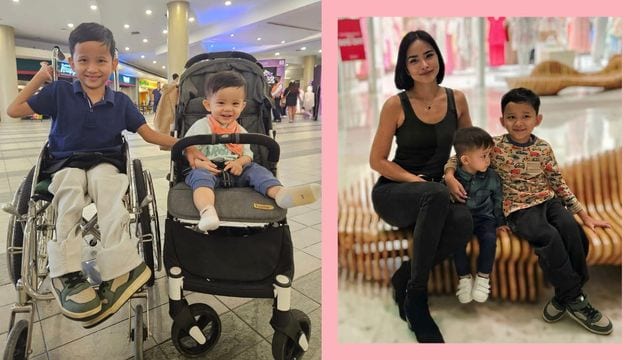
Strollers are considered a must for parents. They are a big help in bringing along babies or toddlers and their stuff anywhere. Anywhere, that is, except apparently for some malls in the metro.
Mother of two, former actress and beauty queen Wendy Valdez-Garcia took to Facebook to share her family’s experience at a mall. In the post, she emphasized the importance of ensuring that public spaces, including malls, should be inclusive for everyone, especially persons with disabilities (PWDs). “Yung malalaki ang katawan, at kumpleto ang mga paa, pero hindi makapag-pasakay ng PWD, o babies na naka-stroller sa elevator, kasi tamad na tamad silang gamitin ang mga paa at malalapad nilang binti kasi baka mabawasan daw sila ng fats,” she wrote.
What happened
In a chat with Smart Parenting, Wendy shared her family’s experience at the mall on that specific day. She said, “Nasa 6th floor ang parking namin. Tapos yung escalator going to 6th floor sira, so no choice kami.”
Wendy was with her two sons, 1-year-old Judah who was in his stroller, and 7-year-old Seth, who was in his wheelchair–the two can also be seen in a photo she posted on her original post. Having both a stroller and wheelchair, plus the two small kids meant that they needed to use the elevator to reach their parking level.
“Pag open ng elevator, ang lalaki ng katawan na mga nakatingin pa sa iyo na walang pakialam,” Wendy narrated. “Sabi ng sister ko, ‘Sorry please, kasi sira yung escalator, dadalhin namin yung wheelchair.’ Grabe, walang gumalaw,” she further shared.
The elevator had an operator, who then told them, “Babalikan nalang namin kayo,” but Wendy said this didn't happen as the elevator was always full of shoppers.
Wendy said that they had no choice but to carry the kids, the wheelchair, and the stroller up the stairs.
She also shared that this was not an isolated incident, and they had encountered a similar challenge on the same day when they arrived at the mall. “Una naman going down, pinasiksik ko talaga yung wheelchair and stroller kahit tamaan [the other people]. Kami ng mom and sister ko, nag-escalator. Sabi ko kay yaya, ‘Sige Ann, isiksik niyo yan, para sa wheelchairs and strollers yang elevator hindi para sa mga tamad.”
“Madalas [yan mangyari] kaya lagi kami [gumagamit nalang] ng escalator. Magaling na kami mag-escalator with wheelchair kahit na bawal kasi nga ganyan lagi. Kami nalang nag-aadjust,” Wendy further shared.
Using wheelchairs on escalators can be risky since any instability or loss of balance could result in a bad accident. The same risk applies for strollers.
Priority on elevators
The Batas Pambansa Bilang 344, an act to enhance the mobility of disabled persons by requiring certain buildings, institutions, establishments and public utilities to install facilities and other devices was signed in 1983. This means that all buildings intended for public use, including educational institutions, airports, work places, and shopping centers or establishments should have facilities that can enhance the mobility of disabled persons, including sidewalks, ramps, railings, and elevators.
This means that part of the reason why elevators are a common feature in establishments is to provide access to PWDs.
“Kung binigyan ka ng Panginoon ng kumpletong paa’t kamay, maayos na pag-iisip at pangangatawan, sana magamit mo ng tama. Sa tuwing ipapaubaya mo ang upuan mo o ang elevator sa mga tao [na] mas mahina sa iyo, napakalaking tulong na,”-Wendy Valdez
At the same time, elevator etiquette dictates that people should have enough courtesy to “yield to those with special circumstances,” which definitely includes parents with strollers, pregnant women, the elderly, and PWDs. And this applies in Wendy’s case.
“Kaya kayo may elevator staff, to inform na ang elevators ay para sa seniors, PWDs, babies, grocery carts, and pregnant [women]. Hindi para i-enable ang mga inconsiderate and selfish citizens,” Wendy wrote, reminding everyone, specifically the mall’s staff of who should be considered a priority in elevators.
Wendy’s plea
Wendy hopes that her family’s experiences can raise awareness about the importance of being more considerate of other people’s needs, most especially PWDs, when it comes to public spaces such as malls and other establishments.
“Kung binigyan ka ng Panginoon ng kumpletong paa’t kamay, maayos na pag-iisip at pangangatawan, sana magamit mo ng tama. Sa tuwing ipapaubaya mo ang upuan mo o ang elevator sa mga tao [na] mas mahina sa iyo, napakalaking tulong na,” she appealed.
“Malaking tulong sa mga matatanda na gusto ding makapag-libang pero mahina na ang katawan. Sa mga buntis na gusto ding makapag-ikot kahit mabigat na ang dala dalang tiyan. Para sa mga nanay ng may kapansanan na araw araw na binubuhat ang anak nila at inaalagaan. Sa mga may kapansanan na gusto ding makapasyal at makakita ng ibang lugar bukod sa bahay nila.
"Para sa kanila, sa mga tao [na] may karapatan din sa mundo at bansa natin, pero may kahinaan.
“Yung ibigay mo ang upuan mo, o paunahin mo sila sa elevator kasi dun lang sila makakapanik panaog ng floors, sobrang laking bagay na magagawa mo. Sobrang laking bagay na magagawa mo, na masabi mo na hindi mo nasayang ang kalakasan na binigay ng Diyos sa iyo, kasi naisip mong unahin ang iba, yun ang totoong pagmamahal.
“Naabala ka ng konti pero nakatulong ka. At sana, yan din ang ituro natin sa mga anak natin.”
Wendy’s eldest son, Seth, was born with spina bifida, a serious neural tube defect wherein a baby’s spinal column did not close all the way while developing inside the womb. Spina bifida is considered an unpredictable condition as it may affect many other organs that may prevent the child from being able to walk, or cause him to be sickly and easily tired.
Wendy regularly shares stories and videos of Seth and Judah on her Facebook account, which includes Seth “wheeling around” in his wheelchair as the family enjoys travels to places such as Dinoland, DisneySea, and Universal Studios.
Hopefully, Wendy’s post reminds us to be more conscious and responsive to the needs of others especially in public spaces.
Have you encountered difficulties in managing your stroller in public spaces? Share your thoughts.
Read here to learn more about spina bifida.
What other parents are reading

Lorem ipsum dolor sit amet, consectetur adipisicing elit, sed do eiusmod
Lorem ipsum dolor sit amet, consectetur adipisicing elit, sed do eiusmod
