
Water is the source of life. Without it, humans and other living things would not survive. Hydrotherapy loosely means rehabilitation with the use of water. In some countries, hydrotherapy is seen as a vital part of conventional medicine and patients are reimbursed by health-insurance companies in some of parts of Germany. Within the Philippine SPED context, hydrotherapy (sometimes referred to as aqua play) is usually tapped in the Early Intervention (EI) of children and Rehabilitation services.
The Benefits of Hydrotherapy
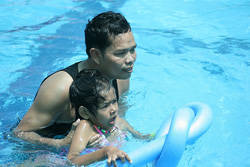 Hydrotherapy can be categorized as a social rehabilitation service as it can be used to change negative attitudes on disability that the child, family and community may have. According to Venus Ilagan, in her paper, Breaking the Barriers: Enabling Children with Disabilities in the Philippines, one of its benefits is increased mobility, thus, maximizing education opportunities and overall well-being.
A local experimental study (conducted by Marian Patriarca in 2010) utilized aqua play on children with Attention Deficit Hyperactivity Disorder (ADHD) and found that hydrotherapy enabled the respondents to improve their behavior in 18 aspects:
- Give close attention to detail and avoid careless mistakes;
- Sustain attention on tasks or play activities;
- Listen when spoken to directly;
- Follow through on instructions and finish school work or chores;
- Organize tasks and activities;
- Engage in tasks that require sustained mental effort;
- Keep track of things necessary for activities;
- Ignore extraneous stimuli;
- Remember daily activities;
- Control movement of hands or feet or control squirming;
- Stay seated;
- Minimize inappropriate running or climbing;
- Play quietly;
- Control constant activity;
- Control excess talking;
- Control blurting out answers;
- Stand in line and take turns; and
- Participate into conversations and games without interrupting or intruding.
Children with ADHD are characterized by inattention, hyperactivity and impulsivity which hydrotherapy can address. For more information about children with ADHD, please refer to our related article.
Click here to read more about the benefits of hydrotherapy and its presence in the Philippines.
[previous|page|next]
Who Benefits from Hydrotherapy?
Everyone can gain from aqua play, however, in SPED, several groups can use it to assist them in their further development and progress, in the interest of ‘normalization’*. Children who can benefit from aqua therapy are those with muscular dystrophy, congential abnormalities, spina bifida, osteogenesis imperfect, cerebral palsy, epilepsy, head injuries, visual impairments, hearing impairments, learning difficulties, balance disorder, hyperkinetic syndrome, perceptual disabilities, neurological impairments and autism (as cited in a study in Patriarca’s paper).
Presence in the Philippines
Two NGOs (non-governmental organizations) in collaboration with PTU (the Danish Society of Polio and Accident Victims), have taken the initiative to make this service available even to those who may be considered financially disadvantaged. In 1995, KAMPI and the National Federation of Disabled Persons in the Philippines developed an innovative model of EI through the establishment of Stimulation and Therapeutic Activity Center (STAC). And as of the writing of the report, according to Ilagan, 118 municipalities of 14 different provinces have benefited from these STACs.
Speciabilities Development Center is a well-known therapy center that offers aqua play therapy and facilities.
* Note: Normalization is a term used in SPED to indicate that although some of our students have debilitating conditions, therapists work on giving them a sense of normalcy where they can perform tasks that most normally developing persons take for granted.
About The Author:
Frances Mijares-Magtoto has a Master’s Degree in Education from Ateneo de Manila University and is a candidate for a Ph.D. at U.P. Diliman. On days when she is not with her husband and toddler, she can be found at the Graduate School of St. Joseph’s College teaching Special Education majors, or at UP finishing her dissertation.
Sources:
- Ilagan, Venus M. (July 2005). Breaking the Barriers: Enabling Children with Disabilities in the Philippines. Retrieved from World Bank Institute on 22 April 2010, http://www.devoutreach.com/july05/SpecialReportBreakingtheBarriers/tabid/908/Default.aspx.
- Muscular Dystrophy Campaign. (January 2009). Retrieved 12 March 2010, http://www.muscular-dystrophy.org/assets/0000/6646/Hydrotherapy_report.pdf.
- Patriarca, Marian Christine V. (2010). Utilizing Aqua Play for Children with Attention Deficit Hyperactivity Disorder. Research Journal in Special Education & Independent Living, 2(1), pp. 34-45.
- Stimulation Therapeutic Activity Center – Quezon City (STAC). Retrieved 23 April 2010, http://www.mccidonline.net/stac/.
Photo from flickr.com

Lorem ipsum dolor sit amet, consectetur adipisicing elit, sed do eiusmod
Lorem ipsum dolor sit amet, consectetur adipisicing elit, sed do eiusmod
