
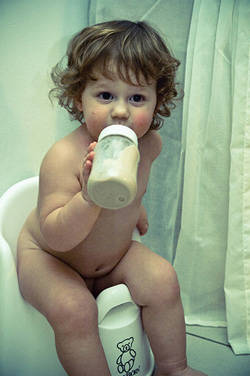
 Hardly heralded as a crowning achievement for a proud parent is when your toddler makes his or her first “legal” splash or drop at the toilet. Moments like these are not often on the family camera, and are hardly ever posted on Facebook. Being what it is though, it deserves more accolades than it receives, as proper toilet training is quite the milestone - not so much in Filipino culture, as we tend to favor constant care over early independence - but the new generation of parents are more keen on self-reliant attitudes developing in early childhood.
Just as most key signs of progress manifest, there are some indicators for potty readiness in children as young as 18 months, although this can extend up to a child’s third birthday. If you notice his or her diapers are less full, it’s high time to observe. Can your child stay dry for two hours? If such is the case, observe your child’s behavioral patterns. Pivotal ones include:
1. Curiosity about underwear. Questions while strolling through a department store are typical. “Kuya has Spiderman briefs, can I try Sponge Bob briefs?”
2. Predictable bowel movements. Not on the dot, but you may notice good patterns and regularities.
3. Curiosity about the toilet. Watching you use it and asking questions or pointing at things.
But take note that these signs are not exact science. A child, ever inquisitive, may just be on the verge of exploring a new thing, and then move on to another chapter of miscellany. It also may be a phase. Ask yourself the following:
1. Can my child communicate his needs effectively? This is especially useful when teaching a child when to say he or she wants to use the toilet.
2. Can your child understand, follow and commit to instruction?
3. Can your child pull his or her pants/diapers down and pull them up again?
4. Are you urging your child to begin toilet training without the signs listed above? Unless your young child is four and still unwilling, it’s time to set some serious measures, or consult help. There could be an underlying issue.
[previous|page|next]
If you feel your child is ready - hopefully he’s not just willing, but also exuberant – it’s time to go buy that potty chair and place it in the bathroom. Be a model for your child. Enlist the help of a close friend or relatives if you feel the need, because although it’s not impossible to learn from the opposite-sex parent if you’re a solo mom/dad, it’s a simpler concept for a young mind to grasp. One thing though, if more than one person is teaching your child, make sure the same methods are employed to avoid confusion.
1. Familiarize your child with the potty chair. Have them sit comfortably on it, with diapers on while you talk casually about its use and purpose. You can dump a used diaper there to illustrate.
2. Keep vigilant. Watch out for signs that your child may want to “go”. If your child is not very verbal, squirming, making faces and the like are enough to tell you to bring your child safely to his or her potty. While doing this, instruct them to say “pee pee” or “poo poo” or whatever terms you may want to use, when they have these feelings and urges. Soon your child will understand. Use incentives (stickers, stamps) and plenty of praise.
3. After about six weeks of successful potty work, try to ditch the diapers. But don’t go all heavy on mistakes.
4. Remember that it takes about six months to master this art, but night time episodes are still inevitable. Be prepared!
With regard to boys and the standing up or sitting down conundrum, it may be easier starting them off sitting down to initially get the concept of the potty. However, many parents go ahead and let them practice standing up. If you have a shower area, its best to practice “aiming” there a couple of times before creating a mess with the potty and discouraging your child. Later on, tiny bits of toilet paper can be tossed in an actual toilet so boys can learn how to project their urine. With girls, make sure they wipe properly, front to back. With both, letting them flush the toilet allows them a sense of achievement. Make sure proper hand washing and drying completes the agenda.
Should your child be unsuccessful, maybe he or she just isn’t ready yet. This shouldn’t be a great concern unless other signs of delayed development are noticed by you and your pediatrician.
You may also want to read the following:
• Potty Training Your Toddler: Transition from Diaper to Potty
• How do I start teaching my 2-year-old son how to use the potty?
Photo by Inferis via flickr creative commons

Lorem ipsum dolor sit amet, consectetur adipisicing elit, sed do eiusmod
Lorem ipsum dolor sit amet, consectetur adipisicing elit, sed do eiusmod
