
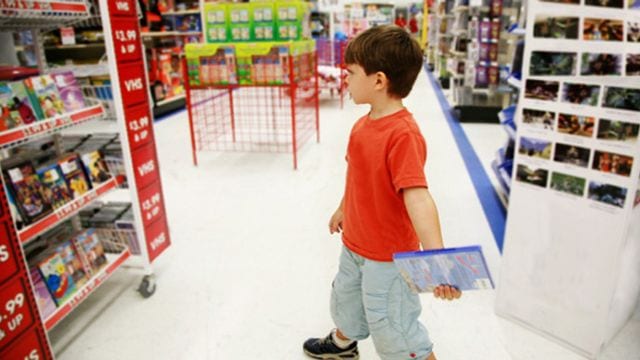
When my daughter Andrea was about three years old, she would always cry and throw a fit whenever she wanted a toy from the mall,” reveals Rose, mom to six-year-old Andrea. “The only thing that stopped this behavior was when we told her she could buy a toy on her birthday,” continues Rose. “Andrea didn’t know when her birthday was, but she just took it that way. She was slightly disappointed, but knew she was eventually going to get a toy.” And so, each time their family would go to the mall, Andrea would ask if it was her birthday, and when her parents would say no, she wouldn’t make a fuss anymore.
Rose tried to stay firm, even when Andrea asked for the Barbie doll she wanted badly. “I’d always tell her we would get it next time,” she says. “(I think) I said that too many times during our mall visits, that once, she just stood in front of the Barbie shelf and didn’t move at all.” Andrea didn’t budge even when Rose kept calling her. And just like any parent, Rose’s heart melted when she saw tears in her daughter’s eyes, so she gave in.
Nipping it in the bud
If you’ve experienced having your child beg, cry, or throw a tantrum after refusing to purchase something for him, you might wonder where this kids’ urge to buy whatever they see at the mall comes from. According to Ria Tirazona, associate psychologist of PsychConsult, Inc., “To some degree, this behavior can be expected of children. As a whole, it’s almost human nature to want all the new and attractive toys, gadgets, and the like.”
Tirazona points out that this is not a sign of greed at all. “To some degree, we are conditioned by society to want things, and for children, this desire is greatly tapped into because they are highly impressionable. Walk them past a toy store, and they will definitely want something,” she adds.
Nathalie Galera, preschool director of Amerikids Preschool, says this behavior of wanting to acquire what they see is a phase that usually starts in early childhood, when children begin establishing their own independence. “They have discovered how it is to make their own decisions and choices, and they test how far they can push this independence by asking their parents to get what they want.”
Tirazona explains the cause of the tantrums and the tears upon refusal, “Young kids want instant gratification. They are not yet able to manage their emotions and thought processes to understand the concept of ‘next time.’ This is why if they see something they want, they will ask their parents to, ‘Buy me this’ at the moment they see it.”
This is mine!
It’s a common sight in malls: parents desperately begging their child to let go of a truck or prying their little one’s tiny fingers off a stuffed animal. Parental excuses range from the usual, “Next time, next time,” to the more straight-forward “Wala akong pera ngayon,” to the amusingly creative “Sira ‘yung laruan,” or “Hindi ‘yan binebenta.” Of course, the question is whether these excuses are effective in controlling your child’s buying impulse. More often than not, the parents become frustrated, voices are raised, and more crying ensues.
To understand this behavior, Galera says, “You must realize that this happens because they are at the age of ‘I, me and myself.’ “(Young children) think they are the center of the world and that everything belongs to them.” She adds, “The best way to deal with this is to explain to them that it is not theirs.”
Tirazona explains further, “This is normal in young children. They do not fully understand yet the concept of mine and yours. Usually, toddlers and kids around three to four years old will behave this way. They don’t see it as stealing or anything malicious, they are just consumed by the desire to have this toy or thing. Around this age too, they begin to discover the concept of ownership, mainly by example.”
Click here to read more.
[previous|page|next]
Overcoming the ‘bilmoko’ urge
One need not worry, however, that the child will grow up to be materialistic or greedy. Both Tirazona and Galera assert that this behavior can be curbed when responded to and addressed correctly. “The urge to make pabili dissipates over time, especially if parents do not give in to their child’s every whim,” stresses Tirazona. Galera warns, “Giving in never helps. It just sets a precedent for other situations. Once you give in, then your child knows he can manipulate you. When you give in, your child learns that the next time he wants something and can’t get it, he just has to throw a tantrum.”
Introducing the concepts of ownership and possession to your child in simple examples helps teach him that he cannot always get what he wants:
- Talk to your child. “Calmly explain to your little one in simple words that money is valuable. That you have to earn it to be able to buy something; that parents work hard to earn money. In the same way, [your child] also has to work hard to get what he wants. This will help him learn to value money as well as be more industrious,” advises Galera.
- Bring your child to work. “Let your child see what you do. You can tell him, ‘I do this so you can have food, so you can go to school, so I can give you gifts when you’re well behaved...’” suggests Galera.
- Expose him to other children. Galera explains that children who are exposed to playgroups or go to school learn about ownership and possession because there are other kids they need to share the toys and books with. “This teaches them the value of sharing and taking turns,” she says.
- Be a good example. Tirazona advises, “[Parents] can help explain this concept to their kids by acting it out or role-playing. For example, Mommy can ask Daddy if she could borrow his cell phone for a minute and then return it afterwards. Act this out in front of your child so he can observe you.”
- Teach the magic words of sharing and borrowing. Tirazona suggests, “Instead of just saying ‘May I borrow...’, get your child involved by saying, ‘May we borrow your _____, please?’” She adds, however, that “parents should also follow up this lesson with the idea of things we cannot share and why we cannot share these. This will strengthen and reinforce the concept of possession.” Examples of things we cannot share are personal objects such as a toothbrush, underwear, towels, etc. “Because it is not hygienic to do so,” adds Tirazona.
- Give your child a piggy bank or savings account. Aside from teaching him about the value of money, this is also a way for your child to discover what possession and ownership are all about. Remind him that the money he saves is his and that he should use his money for things he believes have value.
- Read books on sharing and ownership. “Storybooks about sharing help teach the concept of ownership quite well. It helps your child understand that some things are ‘mine’ and some are ‘yours,’” says Tirazona.
- Come up with a wishlist. This isn’t an ordinary list of things your child might want, but rather “a wishlist with a counterpart expectation to be able to receive the item as a reward,” according to Tirazona. “[It is a good way to let your child] understand that things aren’t always given freely, but that you have to work hard to [get what you want]. This can translate to a good work ethic in the future where your child will be aware that you have to put in effort to gain something in return.”
Mina Garcia, graduate student, teacher, and mom to Catia, 6, sums it up, “Your children should be made aware of the value of money and be able to distinguish wants from needs.” She proudly reveals, “Sometimes, when I go into a department store with Catia, she asks me if she could buy a toy. I often say, ‘Maybe next time’ and ‘only if it is not too expensive.’ Now she’s the one who says, ‘Mama, next time if you have extra money, could we buy this toy?’ She knows that toys are gifts/wants and not needs. I think it’s important that children keep that sense of joy in receiving toys and gifts so it does not become an expected thing.”
Click here to read more.
[previous|page|next]
Mina tells of one instance when she and Catia were shopping for a school bag. Catia saw a toy she really wanted, but knew they were searching for a stroller bag. “Catia negotiated that if I get her the toy, she would gladly use one of her many other backpacks or her previous stroller bag. We made a deal and she was happy with both her toy and bag. It’s nice to see a young child be thankful for what she has,” she beams.
Ending the buying habit
Eventually, Rose’s daughter Andrea outgrew this ‘bilmoko’ behavior. “One thing that also helped us with Andrea was telling her prior to going to the mall that we were just there to get specific things and that we weren’t going to buy toys, but we could look at them. Knowing ahead of time that she could just look but not buy made things easier. And it really goes with age because (now that she’s older), she can understand better,” tells Rose.
Heading to the mall? Here are some guidelines on how to manage that buying urge.
- Explain to your child the purpose of the trip. “I make it a point to tell my child that going to the mall doesn’t mean we have to buy something all the time. I tell her we can only buy if there’s an occasion or if she deserves a toy for being good at something,” says Mita Molina-Roman, mom to Chloe, 5.
- Set firm rules. Tirazona mentions, “One way to avoid unintentionally encouraging the child’s ‘bilmoko’ habit is by setting firm and consistent rules. When you go to the mall, for example, [you and your child] can agree on a set amount that is allocated for his purchases. This way he won’t be pointing to every single thing that looks attractive.” Adds Jen CC Tan, mompreneur and mom to Paul, 8, and Kevin, 5, “I usually give them a budget for toys and a budget for books.”
- Set a budget. “My kids know they can only buy toys and clothes on special occasions (i.e., birthdays and Christmas), and within a specific budget. When they have a special award from school, they get the opportunity to ask for what they want in kind or in cash—but always with limitations. We make it very clear to them that buying should always be within a certain budget,” says Aurea Fernandez-Cruz, mom to Moira, 10, and Deio, 6. She adds that the children “save up for the toys, shoes, or clothes they like that are beyond our set budget.”
- Include your child in shopping activities. “I always try to include Catia whenever I do certain tasks, like grocery shopping. I ask her to write down the grocery list for us, and I make her in charge of crossing out the items on the list. While making the list, we ask her what she thinks she’ll need for the week, so she feels part of the decision-making. My mom taught her how to look and compare prices in the grocery, so there are times wherein she’d stop us from getting one item because the other one is ‘cheaper’ she says,” reveals Mina.
- Remind your child of the consequences of his actions. “Whenever we enter a toy store, we always tell our children that we are only there to look and play with some of the toys and that if they want something, maybe they can save up for it for their birthday or Christmas. As for the tantrums, any time my kids show signs of throwing a fit, either we leave and go home, or they stay in the car until their behavior becomes appropriate,”says Ronald Reyna, dad to Igo, 6, and Pabu, 4.
Sources
* Nathalie Galera, preschool director, Amerikids Preschool, Manila.
* Ria Tirazona, associate psychologist, PsychConsult Inc., Unit 227 Regalia Park Towers, 150 P. Tuazon Avenue, Cubao, Quezon City. Tel. no. 421-2469.

Lorem ipsum dolor sit amet, consectetur adipisicing elit, sed do eiusmod
Lorem ipsum dolor sit amet, consectetur adipisicing elit, sed do eiusmod
