
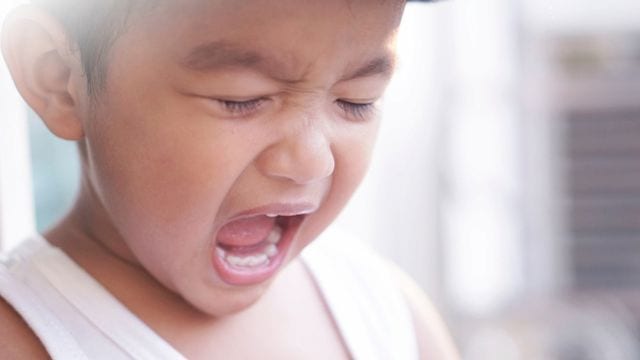
They say children are like sponges, but parents sometimes underestimate how smart they can get in just a short period of time.
One minute, you are teaching them to say, 'Mama.' The next, you are finding out how they can unlearn saying curse words like 'Sh*t.'
An anonymous parent shared on Smart Parenting Village that what’s causing their stress lately was their son who is already saying bad words at age 3.
“I am living with my parents, and nakuha niya sa mom ko yung word. Hindi ko maalis sa kanya yung sinasabi niya. Paano niyo dina-divert yung word para makalimutan niya?”
Parents in the comment section shared what worked for them.
Mommy Dianne Jimenez Briones said, "First, try to be calm when you hear your child says the swear word (They just love it when they get a strong reaction from us).
“Then, maybe suggest an alternative to the swear word? Something which could be funnier-sounding. Then have your toddler repeat this instead of the swear word.
Mommy Dianne, who is also certified positive discipline parent educator, shared, "I have a friend whose granddaughter heard the word 'Sh*t' from her. Then my friend corrected her and said, “Oh, I said, SHeep. (as in baa, baa, black sheeep).”
One mom shared, her child knows bad words but never tried to say it, “Kasi papakainin ko talaga siya ng sili.”
Others said that the adults are to blame. One mom said, “Maaalis lang po [yun] if wala na siya naririnig na nagmumura.”
Why do kids say bad words?
Smart Parenting sought the help of Gail Frances Galang, Ph.D., chair of the Family Studies program of Miriam College, on how to handle this issue. While this is alarming for parents, she said that at age three, young children are in the phase of exploring language, and they “realize that certain words carry more power than others.”
“They realize that some words lead to an immediate response to their need. They utter "mamam," and milk is offered by Mommy. They also realize that some words invite attention. "What did the dog say, "aw! aw!" and everyone cheers in delight,” she explains.
“Sometimes they test words to understand what it means. When they see a response or a reaction, whether positive or negative, they know a connection was somehow achieved. While experimenting with words, sometimes swearing happens by accident.”
Dr. Galang said, it is possible that children hear swear words from other people and simply imitate these without malice.
“Eventually, they realize that some words and phrases get a bigger reaction from a person they want something from. This provides an alternative to hitting or pushing that person out of frustration.”
Where do they pick up bad words?
Dr. Galang explains, it is normal for children to try random words they pick up from others. This goes the same for curse words, which they might pick up from what they watch on videos.
“They take note of it, especially if the word comes with a gesture that made them laugh,” she said.
“As they interact with other children, they can also learn new words from playmates. Sometimes, they try these words to see if it will elicit the same response.
They may use swear words to imitate family and extended family. In time, they may even know which words match a situation they're in. So, they say angry words when upset and curse words when furious, just the same way Dad does when driving, or what Mom says when scolding Ate, or what Kuya says when losing a game online,” she adds.
Veronica Ester Mendoza, Ed.D., a psychologist, also advises, “Don’t put so much energy into getting angry. Calm down, and ask your child where he heard such words.”
How do kids acquire language in the first place?
Dr. Galang explained that children learn language by interacting with the people around them.
“For those of you who have babies, you will observe that babies seem to know the difference between spoken language from other sounds in the environment. At six months they coo and babble sounds as a way of responding to people around them.
As they grow some more, they realize that some sounds go together and forget about sounds that are not useful to them.
Toddlers and preschoolers build a vocabulary of words as they explore their immediate environment. When they learn something new, brain connections are formed. The more it is practiced, the stronger the brain connections are made. New learning that is not practiced will eventually be forgotten.
Having said that, curse words that are ignored will eventually be forgotten, especially if it is not reinforced or if it is not heard again.”
What to do when children say bad words?
Dr. Galang, who is also the associate director of the Center for Peace Education of Miriam College, shared tips for parents who experience the same dilemma as the anonymous poster.
1. Ignore the curse word completely.
She advises parents to do this so that the brain does not form a strong connection between the word and your intense reaction. “Personally, I avoid any reaction like laughing or getting upset. It would be good to avoid eye contact as well.”
2. Catch kids when they say polite words.
She emphasizes, “Again, repeating polite words make brain connections for these words stronger, increasing the likelihood of being used again and again.”
3. Correct mispronounciation calmly.
When your child obviously mispronounces a neutral word like "truck" or "sit", calmly correct your child by saying the right pronunciation. Don't fuss about it or draw attention to it because in the first place, it was simply a mispronunciation.
4. Teach your child other words to express their anger or frustration.
Accept that your child may be upset too. Take the time to talk to your child about things that are upsetting him or her. Don't scold them on public for uttering a bad word.
5. Role-play polite language and good manners using stuffed animals.
This is something you can immediately do with your child. "Imaginative play will help them learn empathy. This makes them more aware that some words offend and hurt others."
6. Have a rule about expressions.
Choose what expressions are acceptable to you. Is it okay to say "OMG!" Would it be okay to say "What the fudge? Sometimes, they hear expressions through what they watch so be sure you are within hearing distance when they watch videos, movies, and play on line.
7. Teach older preschoolers mindfulness techniques when upset.
For parents with older kids, you can teach them to breathe deeply and exhale gently. She also recommends to get them to use the S.T.O.P technique: Stop everything. Take a breath. Observe the situation. Proceed with calm.
8. If they don't stop using swear words, talk to your child.
You can tell your child calmly, "We don't use that word in our family. That word hurts the feelings of others. It makes them sad and angry too." Ask them how they would feel if those words were said to them or to someone they love.
9. If you hear other people curse, use it as a teachable moment.
Discuss to your child how swear words cause others to be more angry. Take this time to teach them better ways of expressing anger. "I know you are angry, but we don't use those words. Next time, say 'Don't take my toy' instead of calling them bad names because they will never know what got you mad."
10. Be a good role model and talk to other people in the house to be one as well.
This is what a mom of a 2-year-old did when her son started saying bad words, like “P*cha.”
“After that incident, my husband and I have become very conscious with our words when Nara is around,” Mian Arcega said in a previous Smart Parenting article.
Dr. Galang reminds parents to be aware of what they say when they are mad or upset.
“Many times, children just imitate what they hear from us parents. So, if you want your kids to stop swearing, avoid it also.”
For more parenting tips, read Dr. Gail Frances Galang’s stories here. You can also follow her on Instagram @gailfrancesgalang
What other parents are reading

Lorem ipsum dolor sit amet, consectetur adipisicing elit, sed do eiusmod
Lorem ipsum dolor sit amet, consectetur adipisicing elit, sed do eiusmod
