
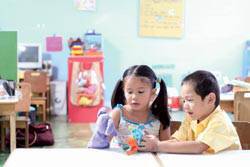
 For children, play is naturally enjoyable. And since it is their active engagement in things that interest them, play should be child-led, or at least child-inspired, for it to remain relevant and meaningful to them. Children at play are happily lost in themselves; they are in their own realm of wonder, exploration, and adventure, pulling parents in at times with a frequent “Let’s play, mom!” as an open invitation into that world.
As early as infancy, children immerse themselves in play activities with the purpose of making sense of the world around them. Doug Cole, chairman of the International Play Association in Wales, U.K., said, “Play gives children the opportunity to learn and experience things themselves, which is vital for their development.” Although peek-a-boo games seem pointless to adults, tots are awed by the surprise that awaits them as they see the suddenly emerging faces of people they love.
Stages of Play
During toddlerhood, children experience a motor-growth spurt that equips them to solitarily fiddle with anything they can get their hands on—be it a construction toy or the box from where it came. Toddlers also love breaking into song, wiggling and jiggling to tunes, and imitating finger plays they are commonly exposed to.
Preschoolers begin extending their play to involve others, whether they bring others in at any stage of the game or they plan their game and its players way ahead. Their physical and motor skills allow them to widen their play arena, from dramatic play to table games to outdoor pursuits.
School-age children start appreciating organized play—such as innovated songs and rhymes, games with rules, relays and other physical activities, sports, and projects that they can accomplish over a certain time frame.
Click here to learn more about the benefits of playitme for your child.
[previous|page|next]
Read on to learn more about the benefits of playitme for your child.
Play Perks
Why the big fuss about playing? Play benefits the child in ways that might be a tad difficult for adults to imagine.
• Play brings pure and utter joy. A toddler who jumps into an empty box and runs around the house “driving a car” shows the sheer happiness that play brings her. When children are asked what they did in school and they answer “play,” it is a clear sign that these kids remember a feeling of genuine joy that is captured in this 4-letter word.
• Play fosters socio-emotional learning. What does a 10-month-old baby who shrieks at the sight of her stuffed toy have in common with a 10-year-old girl who plays basketball with her friends? They both deal with their confidence as they choose to embark on their play activities. At the same time, they are displaying their independence in the decisions that they make. These 2 children are also internalizing social rules in their respective play situations: the baby waits patiently for her stuffed toy to appear, while the school-age child has to contend with an impending loss in a ball game.
• Play hones physical and motor development. Play often involves the use of the senses, the body, and the extremities. When children play, they exercise their bodies for physical strength, fluidity of movement, balance, and coordination.
Perceptual-motor ability, or the capacity to coordinate what you perceive with how you move, is an essential skill that preschoolers need to develop. A 3-year-old who is engrossed in digging, scooping, and pouring sand into a container must match her perception of the space in front of her with her actual hand movements so that she can successfully fulfill the motor activity.
• Play facilitates cognitive learning. Play is vital to the intellectual development of a child. We live in a symbolic world in which people need to decode words, actions, and numbers.
For young children, symbols do not naturally mean anything because they are just arbitrary representations of actual objects. The role of play is for the child to understand better cognitive concepts in ways that are enjoyable, real, concrete, and meaningful to them.
For instance, through play, a child is able to comprehend that the equation 3 + 2 = 5 means “putting together” his toy cars by lining them up in his makeshift parking lot. When he combines 2 triangles to make a square during block play, or writes down his score in a bowling game, the child is displaying what he knows about shapes and numbers.
Through play, the child is constructing his worldview by constantly working and reworking his understanding of concepts.
Click here to learn more about the benefits of playtime for your child's development.
[previous|page|next]
Read on to learn more about the benefits of playtime for your child's development.
• Play enhances language development. Toddlers who are still grappling with words need to be immersed in oral language so they can imitate what they hear. They benefit from songs and rhymes that provide the basis for understanding how language works.
When these tots are playing with toys, adults model to them how language is used to label objects or describe an event.
At play, preschoolers use language to interact, communicate ideas, and likewise learn from dialogues with more mature members of society.
• Play encourages creativity. Barney the dinosaur was right about using imagination to make things happen. A lump of play dough suddenly turns into spaghetti with meat sauce and cheese; a small towel transforms into a cape that completes a superhero’s wardrobe; and a tin can serves as a drum that accompanies an aspiring rock artist. Play opens an entire avenue for children to express themselves, show what they know and how they feel, and to create their own masterpieces.
• Play provides bonding opportunities between parent and child. When my son, River, comes to me and says, “Let’s play, mom,” he means he wants to spend time with me. The only rule asked of me is that I give him my undivided attention (mobile phone and television turned off).
Rules of Play
Renowned Swiss psychologist and child specialist Jean Piaget puts it best: “Play is an important factor in development. It provides for interaction, experimentation, and moral development.”
Here are ways by which parents can encourage and support their children’s playtime.
• Let your child be the player-leader. Let children initiate their activity, set their own theme, choose the parameters where play will take place, and well, play. Play becomes a venue for children to express their feelings and be in control.
• Help them help themselves. When your 5-year-old asks for help, say, figuring out how to piece together a puzzle, stop yourself from coming to her rescue and first ask your child questions that allow her to help herself. Say, “Where do you think this piece should go? There’s something about its color…” Afterward, commend her success.
Click here to learn more about rules parents can set for playtime.
[previous|page|next]
Read on to learn more about the rules parents can set for playtime.
• Play attention! Once you make a commitment to play with your child, watch for the following signals:
o Does she want you to actively play a part in the activity?
o Does she need encouragement?
o Is she tired or hungry? Does she need to take a break?
• Have a play plan. If you seem to have little time for playing with your child, consider using self-care chores to have fun with her. Let her get into water play during bath time. Also, get support from other people in your home like household help, older siblings, or the child’s grandparents, so that they understand why play is important and how they should continue to encourage play.
Photography by Jun Pinzon

Lorem ipsum dolor sit amet, consectetur adipisicing elit, sed do eiusmod
Lorem ipsum dolor sit amet, consectetur adipisicing elit, sed do eiusmod
